MAKE YOUR FREE Tenancy Agreement
What we'll cover
What is a Tenancy Agreement?
A Tenancy Agreement is a contract between a landlord and a private tenant to rent out property to the tenant. Residential Tenancy Agreements are used to rent out residential property. Commercial Tenancy Agreements are used to rent out commercial property.
Tenants are also known as ‘contract holders’ in Wales. For the avoidance of doubt, references to ‘tenants’ also apply to ‘contract holders’ unless otherwise specified.
These Tenancy Agreements for England comply with the Renters’ Rights Act 2025.
When should I use a Tenancy Agreement?
Use this Tenancy Agreement to:
-
rent out a residential property in England, Wales, or Scotland (ie a house, flat, or room in a shared property)
-
rent out a spare room in your home (ie take on a lodger)
-
let a commercial property in England or Wales
Sample Tenancy Agreement
The terms in your document will update based on the information you provide
 These documents have been customised over 1.8M times
 Legally binding and enforceable
 Complies with relevant laws
 Ask a lawyer questions about your document
 Sign this document online for free with RocketSign®
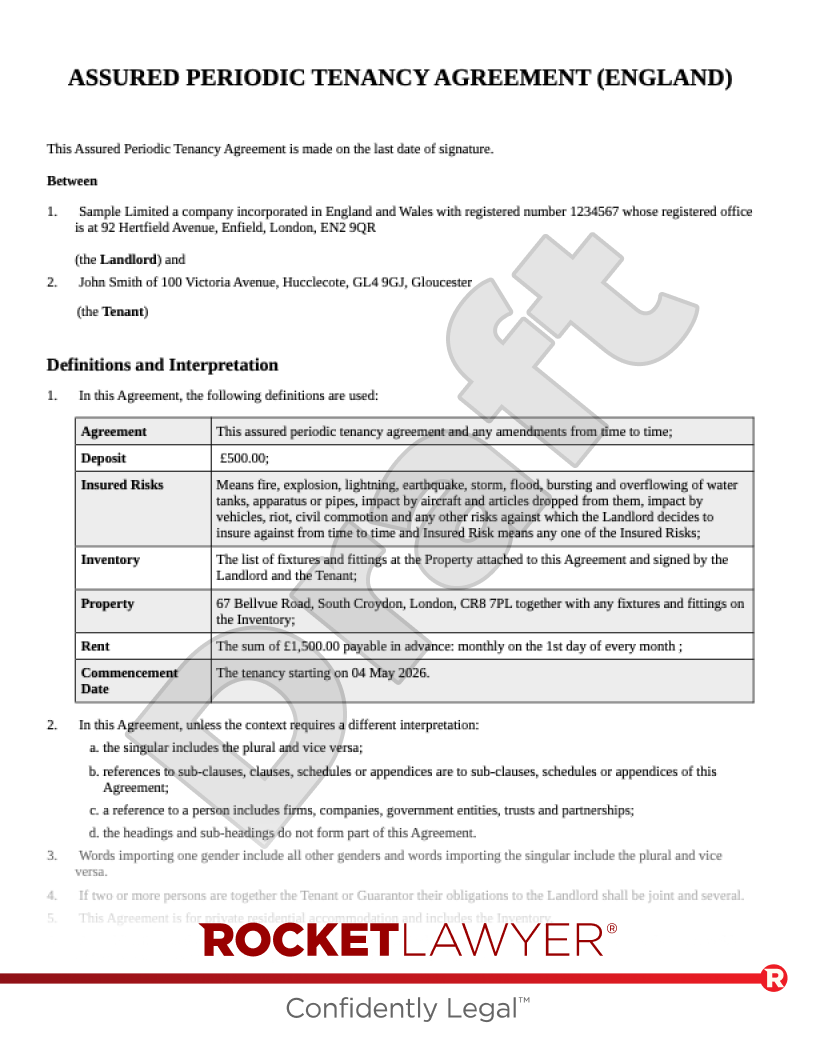
ASSURED PERIODIC TENANCY AGREEMENT (ENGLAND)
This Assured Periodic Tenancy Agreement is made on the last date of signature.
Between
- of ,
(the Tenant)
Definitions and Interpretation
- In this Agreement, the following definitions are used:
Agreement This assured periodic tenancy agreement and any amendments from time to time; Deposit £; Insured Risks Means fire, explosion, lightning, earthquake, storm, flood, bursting and overflowing of water tanks, apparatus or pipes, impact by aircraft and articles dropped from them, impact by vehicles, riot, civil commotion and any other risks against which the Landlord decides to insure against from time to time and Insured Risk means any one of the Insured Risks; Property , together with any fixtures and fittings; Rent The sum of £ payable in advance: weekly on of every week; Commencement Date The tenancy starting on . - In this Agreement, unless the context requires a different interpretation:
- the singular includes the plural and vice versa;
- references to sub-clauses, clauses, schedules or appendices are to sub-clauses, schedules or appendices of this Agreement;
- a reference to a person includes firms, companies, government entities, trusts and partnerships;
- the headings and sub-headings do not form part of this Agreement.
- Words importing one gender include all other genders and words importing the singular include the plural and vice versa.
- If two or more persons are together the Tenant or Guarantor their obligations to the Landlord shall be joint and several.
- This Agreement is for private residential accommodation.
- Any obligation on the Tenant to do or not to do something includes an obligation on the Tenant to use their reasonable endeavours to ensure that no other person does or fails to do that same thing.
Grant of Tenancy
- Landlord grants and the Tenant accepts a tenancy of the Property from the Commencement Date at the Rent and subject to the terms of this Agreement.
- This Agreement is intended to be an Assured Periodic Tenancy under the Housing Act 1988 (as amended by the Renters' Rights Act 2025), and any successor legislation in force from time to time).
- The Tenant accepts:
- the tenancy is a periodic tenancy and shall continue unless and until terminated in accordance with applicable law;
- the Landlord shall be entitled to recover possession of the Property only in accordance with the statutory grounds and procedures prescribed by the Housing Act 1988 (as amended), including, without limitation, those set out under Section 8, together with the service of any notice required by law; and
- the Tenant may terminate the tenancy only in accordance with applicable law or any express provision for termination contained in this Agreement. In accordance with the Renters' Rights Act 2025, the Tenant may terminate the tenancy by giving not less than two months’ written notice, unless a shorter notice period has been mutually agreed in writing. Termination shall take effect on expiry of such notice, but this shall not affect any rights or obligations accrued prior to termination.
- If the Tenant has use of the Landlord's furniture. The Tenant will:
- not damage or remove any of the items from the Property;
- keep the items clean and in a good condition; and
- make good all damages and breakages of items which may occur during the Term.
Use of Property
- The Tenant shall:
- use the Property as a single private home and not carry on any trade, profession or business on or from the Property.
- immediately notify the Landlord if the immigration status of the Tenant changes.
- not permit anyone to occupy the Property without the prior written consent of the Landlord (such consent not to be unreasonably withheld).
- send the Landlord a copy of any notice or other communication affecting the Property within seven days of receipt and shall not take any action regarding such notices or communications without the prior consent of the Landlord.
- The Tenant shall not:
- keep any pets or any other animals on or in the Property without the prior written consent of the Landlord (such consent not to be unreasonably refused or delayed).
- The Landlord should accept such requests where they are satisfied that the Tenant is a responsible pet owner and that the pet is of a kind that is suitable to be kept at the Property, in relation to the nature of the Property.
- The Landlord will not consent to any pets which may cause damage to the Property and its contents, or can be a health hazard or cause a nuisance to neighbours.
- The Landlord is deemed to have granted consent to the pet unless the Landlord provides a written refusal, with reasonable grounds, within 28 days of receiving the Tenant's request.
- The Landlord is prohibited from charging a fee to the Tenant who wishes to keep a pet at the Property. Consent will be given on the condition that the Tenant pays an additional reasonable amount towards the Deposit, provided the total Deposit taken from the Tenant does not breach the deposit cap requirements under the Tenant Fees Act 2019.
- leave the Property unattended for a period of more than 21 consecutive days or change the locks on any door or window without the prior written consent of the Landlord.
- park a caravan, boat or trailer at the Property.
- keep any pets or any other animals on or in the Property without the prior written consent of the Landlord (such consent not to be unreasonably refused or delayed).
- The Tenant shall not do anything to or on the Property that:
- causes a nuisance, annoyance or damage to occupiers of the neighbouring, adjoining or adjacent property, or the owners or the occupiers of them;
- involves using the Property for immoral or illegal purposes; or
- has the effect of invalidating the insurance that the Landlord has taken out in accordance with this Agreement.
Keys
- The Landlord shall provide the Tenant with at least one set of keys and any security device (for example a key fob) that the Tenant will require in order to obtain access to the Property (the "Access Devices"). The Tenant is responsible for looking after and keeping safe the Access Devices for the duration of the tenancy. If the Tenant loses an Access Device, the Tenant shall pay the actual cost of replacing any lost Access Devices and other expenses reasonably incurred by the Landlord as a result of loss of the Access Device (for example replacing the Property's locks).
Rent
- The Tenant shall pay the Rent and all other sums due under the Agreement (whether formally demanded or not), clear of all deductions at the agreed times.
- The Tenant shall be in breach of this Agreement if the Tenant fails to pay the Rent in accordance with this clause and the Landlord shall be entitled to use the statutory provisions contained in the Housing Act 1988 or any other statutory remedies available to recover possession of the Property.
- If the Property is damaged or destroyed by an Insured Risk so as to be unfit for occupation and use then, unless the damage or destruction was caused by the wilful actions, negligence or default of the Tenant, payment of the Rent shall be suspended until the Property is fit for occupation and use.
Rent Increase
- The Landlord may increase the Rent no more than once in any 12-month period by serving the Tenant with not less than two months’ written notice, in accordance with the statutory procedure prescribed under Section 13 of the Housing Act 1988 (as amended).
Utilities and Outgoings
- The Tenant shall pay directly to suppliers all charges for gas, electricity, oil, water, sewerage, telephone (including line rental), council tax (or any similar property tax that might be charged in addition to it), any television licence or other services used at the Property.
- The Tenant shall comply with all laws and recommendations of the relevant suppliers relating to the use of those services and utilities.
Repairs and Alterations
- The Tenant shall keep the Property clean and in a good condition and make good any damages or breakages to the Property (excepting fair wear and tear), provided that this clause shall not impose any obligation on the Tenant that is the obligation of the Landlord under Section 11 of the Landlord and Tenant Act 1985.
- The Tenant shall keep the inside of the Property (including glass in the windows) in a good state of repair and condition.
- The Tenant shall not cause any blockage to the drains, gutters and pipes of the Property. This obligation does not require the Tenant to carry out any works or repairs for which the Landlord is liable.
- The Tenant shall keep any communal halls, lifts, passageways, driveways and other common areas clean and fit for use.
- The Tenant shall not make any alteration, addition, or redecoration to the Property without the prior consent of the Landlord (such consent not to be unreasonably withheld).
Assignment or Subletting
- The Tenant shall not take in any lodgers or assign, sublet, charge or part with or share occupation of the Property or any part of it.
End of the Tenancy
- Upon lawful termination of the tenancy, the Tenant shall:
- yield up the Property with full vacant possession;
- return all of the items to the Landlord in the same state (excepting fair wear and tear);
- give the Landlord a forwarding address;
- remove all rubbish and personal items (including the Tenant's own furniture and equipment) from the Property; and
- return all the keys to the Property to the Landlord.
- If any of the Tenant's personal items have not been removed from the Property when the tenancy ends:
- the Landlord shall be entitled to remove and store such personal items from the Property;
- the Landlord may recover any reasonable costs of removal and storage from the Tenant;
- upon removal of the Tenant's personal items, the landlord shall then use its reasonable efforts to notify the Tenant of where the personal items are being held, the date of any proposed sale or disposal, and the Landlord's contact details in case the Tenant wishes to take back personal items;
- the Landlord shall be entitled to sell, dispose of, or otherwise deal with any personal items 21 days after the Landlord uses its reasonable efforts to notify the Tenant in accordance with the clause above.
Landlord's Right to Enter the Property
- The Landlord reserves the right for the Landlord (and all those authorised by the Landlord) to enter the Property at reasonable times, on giving the Tenant at least 24 hours' prior notice in writing (with the Tenant’s consent, not to be unreasonably withheld) for the purposes of:
- check the state of repair, decoration and condition of the Property;
- carry out repairs, decoration or alteration to the Property or adjoining property; and
- clean or renew any pipes, sewers, drains or gutters at the Property.
- The Landlord may enter the Property without prior notice in the event of an emergency.
Repairing Obligations
- The Tenant shall notify the Landlord of any disrepair or defect or act of vandalism carried out to the Property, Common Areas or the items.
- The Tenant shall immediately comply with any notice given to it by the Landlord under this section that requires it to make good any damage to the Property or items to be made good.
- If within one month of receiving a notice the Tenant has failed to comply with such notice, the Landlord may, upon giving the Tenant at least 24 hours’ prior written notice (except in an emergency), enter the Property at reasonable times (with the Tenant’s consent, not to be unreasonably withheld) and execute the repairs. The Tenant shall, on demand, pay the costs reasonably incurred by the Landlord pursuant to this clause upon the Landlord providing evidence of such costs (for example in the form of receipts).
Landlord's Obligations
- Subject to the Tenant paying the Rent and carrying out its obligations under this Agreement, the Landlord agrees that the Tenant may quietly possess and enjoy the Property.
- The Landlord shall maintain and keep in good repair the exterior of the Property and keep all installations for the supply of water, gas, electricity, sanitation and heating at the Property in good repair and proper working condition.
- The Landlord shall keep in good repair and proper working order the installations in the Property for space heating and heating water.
- The Deposit must be held in one of the Government tenancy deposit protection schemes ("Deposit Scheme").
- Within 30 days of receiving the Deposit, the Landlord must give the Tenant the necessary prescribed information about the Deposit Scheme.
- Subject to any rules or provisions of the Deposit Scheme, the Landlord or their agent will be entitled to claim from the Deposit:
- any Rent or other sums payable by the Tenant under this Agreement which are in arrears; and
- any reasonable sum the Landlord incurs in remedying any failure by the Tenant to comply with any of the terms of this Agreement, including those relating to the cleanliness, state and condition of the Property (provided always that the sum claimed by the Landlord is reasonably incurred and reasonable in amount); and
- any unpaid account for services or council tax incurred at the Property; and
- any reasonable costs incurred in respect of any repair or damage to the Property (excepting fair wear and tear and repair that is the responsibility of the Landlord).
- Unless required under the Deposit Scheme, no interest will be paid to the Tenant by the Landlord in respect of the Deposit.
- The Landlord must insure the Property and the contents which belong to the Landlord with an insurance company of repute against the Insured Risks the Landlord from time to time in their absolute discretion decides to insure against. The Landlord shall be under no obligation to insure the Tenant's personal items at the Property.
- The Landlord will ensure that all furnishings at the Property comply with legal regulations on safety and that all appliances are maintained and the appropriate safety checks carried out.
Default by the Tenant
- The Landlord may seek to recover possession of the Property only on one or more of the statutory grounds for possession set out in Schedule 2 to the Housing Act 1988 (as amended from time to time) and strictly in accordance with the procedures prescribed by law. Nothing in this Agreement shall operate to create any right for the Landlord to determine the tenancy otherwise than in accordance with such statutory provisions, and the tenancy shall continue unless and until terminated by order of the court or otherwise in accordance with law.
- If the Tenant is in arrears of Rent or otherwise in breach of this Agreement, the Landlord may rely on any applicable statutory ground for possession.
- If any Rent or other sums due are not paid 14 days after becoming payable (whether formally demanded or not), the Tenant will pay interest on any sums due at the rate of 3% per annum (above the Bank of England's base rate), calculated from the date payment is due up to the date payment is received by the Landlord and such sums will be recoverable as rent in arrears.
- If the Property is damaged to such an extent that the Tenant cannot live in it, the Rent does not need to be paid until the Property is rebuilt or repaired so that the Tenant can live in it again unless:
a. the cause of the damage is something which the Tenant did or failed to do as a result of which the Landlord's insurance policy has become void; and
b. the Landlord had given the Tenant notice of what the policy required.
- If the Tenant breaches this agreement or fails to fulfil any of its obligations under this agreement, the Tenant shall pay any reasonable costs properly incurred by the Landlord in remedying such breaches or in connection with the enforcement of those obligations.
General
- Any notice or other document required or permitted to be served on the Tenant during the tenancy shall be served either by leaving it at the Property or by sending it to the Tenant at the Property by first-class post. A notice shall be deemed to have been served if left at the Property on the next working day after delivery, or if sent by first-class post, on the second working day after posting.
- The Landlord's address for service is , .
- For the purpose of Section 48 of the Landlord & Tenant Act 1987, any notices, including notices in proceedings, must be served on the Landlord at the address stated in this Agreement.
- The Landlord confirms that all prescribed information required by law, including the Government’s written statement of tenancy terms, will be provided to the Tenant prior to the commencement of this tenancy, in compliance with the Housing Act 1988 and the Renters’ Rights Act 2025 (as amended from time to time).
- This Agreement will be governed by and interpreted according to the law of England. All disputes arising under the Agreement will be subject to the exclusive jurisdiction of the English courts.
| _________________________________ | _________________________________ |
| _________________________________ | _________________________________ |
About Tenancy Agreements
Learn more about making your Tenancy Agreement
-
How to make a Tenancy Agreement
Making a Tenancy Agreement online is simple. Just answer a few questions and Rocket Lawyer will build your document for you. When you have all of the details prepared in advance, making your document is a quick and easy process.
What information you need to make your Tenancy Agreement will depend on the document in question. However, the types of questions you may be asked include:
Party details
-
What are the landlord’s details (ie their legal structure, name, and address)?
-
Who will sign on the landlord’s behalf (eg an estate agent)?
-
What are the tenant's details (ie their name and current address)?
Property details
-
What is the address of the property being rented out?
Tenancy details
-
On what date will the tenancy start?
-
What is the rent, and how often will it be paid?
-
Is a deposit payable? If so, how much is it?
-
What rights will the tenant have under the Tenancy Agreement? For example, can residential tenants keep pets, or can commercial tenants use private access for deliveries?
Ending the Tenancy Agreement
-
Can the Tenancy Agreement be ended early? If so, how much notice needs to be given?
-
-
Common terms in a Tenancy Agreement
Tenancy Agreements govern the relationship between a landlord and a tenant (or lodger). While the terms of a Tenancy Agreement differ, depending on the document in question, examples of common provisions in Tenancy Agreements include:
Between
The start of your Tenancy Agreement will set out the details of the parties who are entering into the Agreement.
Definitions and interpretation
This section of the Tenancy Agreement includes a table of definitions. This explains the specific meanings of certain terms used throughout the Tenancy Agreement.
Tenant's obligations
This section sets out the obligations of the tenant while occupying and using the property rented out under the Tenancy Agreement.
Landlord's obligations
This section sets out the obligations of the landlord in relation to the property rented out to the tenant under the Tenancy Agreement.
If you want your Tenancy Agreement to include further or more detailed provisions, you can edit your document. However, if you do this, you may want a lawyer to review or change the Tenancy Agreement for you, to make sure it complies with all relevant laws and meets your specific needs. Ask a lawyer for assistance.
-
Legal tips for making a Tenancy Agreement
Make sure you use the right document for your needs
Various Tenancy Agreements exist, and you should make sure to create one that is suitable for your needs and circumstances. Not only should you base this on the country the rental property is in (ie England, Wales, or Scotland), but should also reflect the property being rented out (ie whether it is a house, flat, or room in a shared property; a room in your home; or a commercial property). Using the incorrect document may cause problems down the line.
Ask a lawyer for assistance if you’re unsure of which Tenancy Agreement to use.
Understand when to seek advice from a lawyer
Ask a lawyer if:
-
your document doesn’t meet your specific needs
-
you need a commercial lease for Scotland
-
Tenancy Agreement FAQs
-
Why do I need a Tenancy Agreement?
It is important to have an agreement in place between a landlord and a tenant. This helps lay out the rights and responsibilities of each party during the term of the rental agreement. Not only do Tenancy Agreements provide clarity, but they also provide security in case of any future disputes.
Use this Tenancy Agreement if you are letting a house, a flat, a room in a property you live in, a room in a property you don’t live in, or a commercial property. These straightforward Tenancy Agreements will help you avoid many of the hassles of letting and make repossession simple.
-
Which type of Tenancy Agreement should I choose?
There are many different letting documents, so you'll need to make sure you choose the right one for your particular situation from the list above.
A Tenancy Agreement can be used either for a flat or a house. It is the most common type of agreement in England, Wales, and Scotland, and gives the tenant the exclusive right to use and occupy a house or flat for a certain period of time. These Tenancy Agreements should not be used for properties outside of England, Wales, or Scotland.
If you are renting out a spare room in your home, a lodger agreement can be used.
A room rental agreement is used when you want to rent out several rooms within the same property to multiple occupants at the same time. You should only use a room rental agreement if you do not live in the property in question.
For more information on residential Tenancy Agreements, read Residential tenancies, Residential tenancies in Wales, and Residential tenancies in Scotland.
You should use a commercial lease if you are renting out commercial property (eg an office) to a commercial tenant (eg a business or charity). For more information, read Entering a commercial lease and Commercial property in Scotland.
-
What is the difference between renting out a room and renting out a room in your home?
When you are renting out a room, you are renting out a room in a property you own but do not live in. Under a room rental agreement:
-
the owner will not live at the property
-
the tenant has the right to use a bedroom at the property, and
-
the tenant has the right to use other rooms (eg the kitchen) along with other tenants
When you are renting out a room in your own home, you will be granting a lodger the right to use a spare room in the property you live in. Under a lodger agreement, the owner will live at the property, and the lodger is given use of a bedroom and has the right to use other areas in the property in common with the owner, such as a bathroom, kitchen, and garden. Our lodger agreement is intended to help you provide your lodger with a licence and not a formal tenancy with full tenancy rights. For more information, read Taking in a lodger.
-
-
What is the most popular kind of residential Tenancy Agreement?
In England, after 1 May 2026, the most common type of residential tenancy is an assured periodic tenancy (APT). For more information on APTs, read Residential tenancies.
In Wales, after 1 December 2022, most residential properties will be rented out under an occupation contract. For more information, read Residential tenancies in Wales.
In Scotland, all residential tenancies created by private landlords that started on or after 1 December 2017 are private residential tenancies. For more information on these, read Residential tenancies in Scotland.
-
What are the responsibilities of a residential landlord and tenant?
Both landlords and tenants have certain obligations under the Tenancy Agreement. This includes obligations that are not expressly mentioned in the Tenancy Agreement but are implied by the law, including the Housing Act 1988 and Renters’ Rights Act 2025 (ie the statutes that govern the legal relationship between landlords and tenants).
Examples of landlord obligations and responsibilities include:
-
carrying out basic repairs
-
ensuring relevant health and safety checks are conducted and safety measures implemented (eg gas safety checks, providing smoke alarms, and making sure wiring and electrical appliances are safe)
-
giving tenants sufficient notice (usually 24 hours) to inspect the property
-
not unnecessarily interfering (eg landlords should not let themselves into the property without the permission of the tenant or make it uncomfortable for the tenant to live in the property)
Examples of tenant obligations and responsibilities include:
-
keeping the property in good condition
-
paying the rent and utility bills
-
not damaging the property and making sure any guests are well-behaved
-
not subletting the property
-
allowing the landlord to carry out inspections of the property
For more information, read Tenants' and owners' obligations and Tenants' and owners' obligations in Scotland.
-
-
What are the responsibilities of a commercial landlord and tenant?
Commercial landlords and tenants have various obligations under a commercial lease, including having to pay rent and provide access to the property. However, the most important are repair obligations. As a general rule:
-
tenants are responsible for maintaining the property and ensuring that it is restored to the state that it was in at the beginning of the lease
-
landlords are responsible for any structural repairs needed to maintain commercial properties
For more information, read Commercial property repair obligations.
-
-
What is a guarantor on a Tenancy Agreement?
A guarantor is someone who agrees to pay the tenant’s rent if the tenant does not pay. The guarantor will be legally liable in cases where tenants fail to pay their rent. Guarantors are typically used when renting out residential property.
If you are using a guarantor clause in your Tenancy Agreement, you should check the guarantor’s ability to pay rent in the event that the tenant does not (eg by carrying out a credit check). For more information, read Picking a tenant and Picking a tenant in Scotland.
-
How long does a tenancy last?
In England, an APT is rolling from the start. This means that the tenancy does not have a fixed term or end date and will last until either party gives notice to end the APT.
In Wales, an occupation contract lasts for the duration agreed upon by the landlord and contract holder, until it is ended using the correct process. For more information, read Ending your tenancy early and Repossessing property in Wales.
In Scotland, a private residential tenancy is open-ended and will last until the tenant wishes to leave the property or until the landlord relies on one or more of the 18 grounds for eviction.
How long a commercial lease lasts depends on whether the tenant has security of tenure (ie the right to renew a commercial lease). If the tenant has security of tenure, the tenant can renew the lease, and the landlord can only refuse to grant a new lease on certain strict grounds. If security of tenure has been contracted out of (ie excluded), the lease will come to an end on the expiry date. For more information, read Rent commercial property.
-
Do I need a House in Multiple Occupation (HMO) licence?
An HMO is a property rented to three or more tenants who are not related and who share certain rooms in the property (eg a house share). You will need to check whether or not your property is classed as a house in multiple occupation, and if it is, you may need to apply for a licence to avoid being fined.
In England and Wales, you always need a licence if you’re renting out a large HMO. A property constitutes a large HMO when the property is:
-
rented to five or more (unrelated) people
-
the tenants share toilet, bathroom, or kitchen facilities, and
-
at least one tenant pays rent
In Scotland, you will need a licence for all HMOs.
-
-
What makes a Tenancy Agreement invalid?
The Unfair Terms in Consumer Contracts Regulations 1999 state that if clauses in a contract are unfair, the contract can be declared void. This means that terms and conditions in a Tenancy Agreement should reflect the statutory obligations of both parties and not contain unenforceable terms or clauses that are impractical (eg a clause stating that the tenant must pay for professional cleaning of the property).
-
How do I end a Tenancy Agreement?
A Tenancy Agreement can be ended by both landlord and tenant. However, this is subject to some conditions.
In England, tenants can end a Tenancy Agreement by giving two months’ notice.
In Wales, neither landlord nor tenant can end the Tenancy Agreement before the initial fixed term ends unless there is a break clause in the agreement or both parties agree to end the tenancy (known as ‘surrender’). In this Tenancy Agreement template, you can choose to include a break clause, which will allow the tenant and landlord to end the tenancy before the end of the fixed term by giving the required notice. For more information, read Ending your tenancy early.
Landlords can end this agreement by giving notice based on the specifics of their situation. For more information, read Tenant eviction.
The process for ending a commercial lease varies depending on whether the landlord or the tenant is bringing it to an end, and on what basis. For more information, read How to terminate commercial leases.

Our quality guarantee
We guarantee our service is safe and secure, and that properly signed Rocket Lawyer documents are legally enforceable under UK laws.
Need help? No problem!
Ask a question for free or get affordable legal advice from our lawyer.