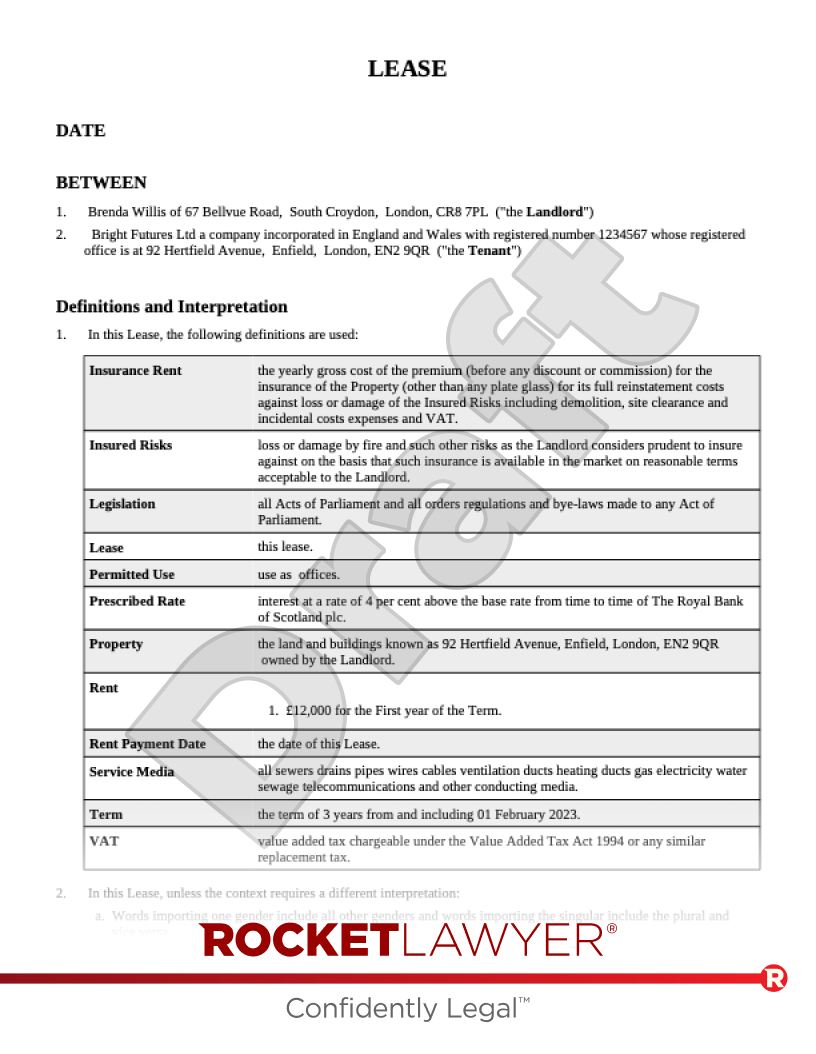
What are commercial leases?
Commercial leases are legally binding contracts between businesses (the tenants) and property owners (the landlords). It gives tenants the right to use that property for their business for an agreed period of time in return for paying rent.
Unlike residential leases, commercial leases have far fewer protections. The law assumes you're a business and know what you're agreeing to. A lease will cover all the rights and obligations for both you and the landlord.
What should I consider before looking for a property?
If you're setting up a new business or expanding an existing one, you'll need to find the right property for your needs. Before you start searching or speak to a commercial agent, it's vital to be clear on a few key points:
-
how much space you need
-
what the use of the property will be
-
your financial position
Answering these questions will help you decide whether you want to purchase a property outright or lease one.
What are the main things to check before signing?
Before the final lease is drafted, you'll usually agree on 'heads of terms'. It's also crucial to do your own checks (due diligence) on the property's costs and condition.
Heads of terms
Heads of terms are the main, high-level points of the deal, agreed upon before lawyers start drafting the full Commercial lease. While they aren't usually legally binding (apart from confidentiality or exclusivity), these points are very difficult to renegotiate later. It's crucial to get these right from the start. For more details, read Commercial lease heads of terms.
What can I use the property for?
Check the permitted use for the property. The lease will state what this is (eg 'office use only' or 'a cafe'). You must check that this matches your business needs and, just as importantly, that the local planning permission allows for this use. Don't assume you can change the use later.
You also need to check for any other restrictions that could be vital for operating your business. For example, are there limits on loading and unloading times or on parking?
For retail leases in Scotland, you may also be restricted in relation to opening hours, business signage, and other aspects because of the location of the premises.
Who is responsible for the property's condition?
Most commercial leases are full repairing and insuring (FRI) leases. This means the tenant is responsible for all repairs.
You may need to carry out a full survey if you're taking a lease of the whole property and are responsible for its interior and exterior. This survey will highlight any defects or areas of disrepair. This is important because when the lease comes to an end, it will be your responsibility to make good any defects and leave the property in good repair and condition.
If the survey shows the property is in a poor state of repair, you should attach a schedule of condition to the lease. This is a photographic record that limits your repair obligations to keeping the property in the same state you found it in, not making it better.
In Scotland, leases will often include a provision that, on signing, you have accepted that the premises are in good condition and fit for purpose. You'll then be responsible for repairs, maintenance, and decoration. However, the landlord must still keep the property wind and watertight.
For more information, read Commercial property repair obligations.
What do I need to know about the rent?
You will pay rent under the lease; however, you should check if value added tax (VAT) will be added on top. By default, rent on a commercial property is exempt from VAT. But a landlord can opt to tax the property. If they've done this, they must charge VAT (at the standard rate) on the rent and any service charge.
Landlords usually do this so they can reclaim the VAT on their own property costs. If your business is VAT-registered, you can usually reclaim this charge from HMRC. If you're not, this becomes a 20% extra cost you can't get back. Always ask if the property is 'opted to tax' before agreeing to the rent.
The lease may also contain a rent review clause. These are common in leases of three years or more. Be careful of an upwards-only rent review, as this means your rent won't go down, even if market rent levels decrease. In Scotland, it's also common for retail leases to calculate rent as a percentage of the business's turnover. For more information, read Commercial rent review.
Will I need a rent deposit or guarantee?
A landlord will usually ask for a deposit. You may be asked to enter into a Rent deposit deed. This gives the landlord the right to withdraw sums from the deposit to cover any costs if you default on your lease obligations (eg for any damages or late rent payments). If this happens, the landlord will usually insist that you top up the deposit. You should get the deposit back when the lease ends, provided you've fulfilled all your obligations.
The landlord may also ask you to provide a guarantor. This is common if the lease is taken in the name of a new business with no trading history, or if the landlord is unsure that you can pay the rent. The guarantor's references and credit will be checked, and they will become legally responsible for paying the rent if your business can't. For more information, read Guarantors.
What are the key costs?
The monthly rent and deposit aren't the only costs. You must budget for several other expenses, which can be significant. Some of the other main costs to look out for include:
-
business rates - this is a separate property tax paid directly to the local council
-
service charge - if you're leasing part of a larger building (like an office block or shopping centre), you'll have to pay a service charge to cover the costs of shared areas and services like security, lifts, and cleaning
-
insurance - the landlord insures the building, but you'll have to pay your share of the premium. You'll also need your own insurance for your contents and public liability
-
legal fees - you'll have to pay for a lawyer to review and negotiate the lease
-
land tax - you must pay a one-off tax on new leases. The tax you pay depends on where the property is. In England, it's stamp duty land Tax (SDLT). In Wales, it's land transaction tax (LTT). In Scotland, it's land and buildings transaction tax (LBTT). While the principles are similar (based on the rent and any premium), the rates and 0% thresholds are different in each country
How long does a commercial lease last, and can it be ended early?
The length of the lease (ie its term) is a key point of negotiation. In England and Wales, there's no statutory minimum or maximum length for a lease. In Scotland, new leases are limited to a maximum of 175 years.
While very long leases exist, the current market trend is towards shorter terms, with five to 10 years being very common. Many tenants also negotiate for break clauses to add flexibility. How the lease ends, however, works very differently depending on whether your property is in Scotland or in England and Wales.
Lease term and break clauses
A lease will have a fixed end date. However, you or the landlord might negotiate for a break clause. This gives one or both parties the right to end the lease early, as long as they give the correct notice.
Security of tenure (England and Wales)
In England and Wales, most business tenants have security of tenure under the Landlord and Tenant Act 1954. This is a very important right that allows tenants to request a new lease on similar terms when the original lease ends. A landlord can only refuse to give you a new lease on specific, limited grounds. However, landlords can (and usually do) ask you to contract out of these rights. If you agree, you must sign a formal notice before you sign the lease, confirming you understand you're giving up your right to renew.
For more information, read Security of tenure.
Tacit relocation (Scotland)
In Scotland, tacit relocation is relevant for commercial leases. This means that if neither the landlord nor the tenant gives the other the correct formal notice to end the lease before the expiry date, the lease automatically continues on the same terms. This is a major trap for unwary tenants (and landlords). If you don't serve the notice on time, you could be legally stuck in the property and liable for another full year's rent.
For more information, read How to terminate commercial leases.
What are the tenant's main responsibilities?
Your main responsibilities will be set out in the lease covenants (ie promises). The most important ones usually relate to repairs, alterations, and assigning the lease.
Repairs and dilapidations
As mentioned, most leases are FRI leases. This means you're responsible for keeping the entire property in good repair. When the lease ends, the landlord will present you with a schedule of dilapidations. This is a list of all the repairs needed to bring the property back up to the standard required by the lease. This can often result in a bill for thousands of pounds, which is why getting a survey and a schedule of condition at the start is so important. For more information, read Commercial property repair obligations.
Alterations and assignment
You can't just make changes to the property without permission. A lease will normally require you to get the landlord's formal, written consent before you can:
-
make any alterations (eg putting up or taking down internal walls)
-
assign the lease (ie transfer it to someone else)
-
sublet the property (ie rent it, or part of it, to another business)
Health and safety
As the business operator, you're responsible for the day-to-day health and safety of the premises. This includes things like fire safety (eg having the right alarms, extinguishers, and marked exits), the safety of electrical appliances, and managing dangerous substances like asbestos. For more information, read Commercial property repair obligation.
If you're ready to make your lease, you can use our Commercial lease. You can also read more about Commercial property repair obligations, or Ask a lawyer if you have any questions about your specific situation.