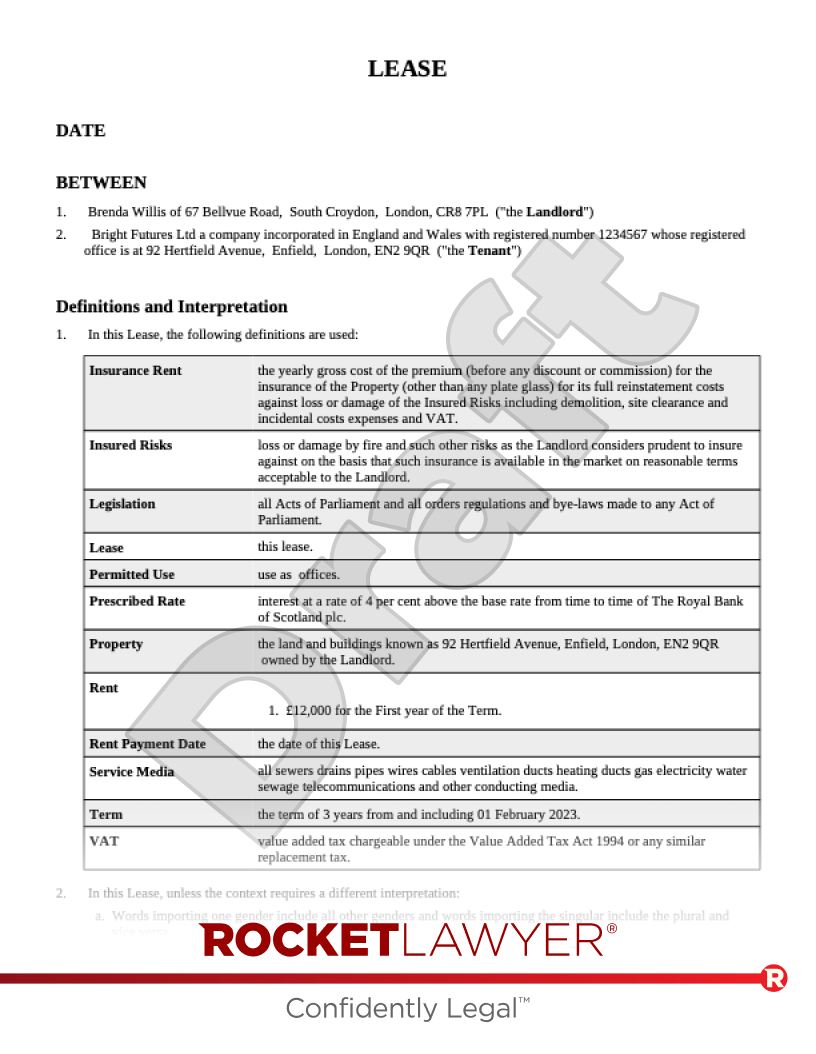
What is commercial lease termination?
Commercial lease termination is the formal process of ending a tenancy for a business property. This can happen:
-
at the end of the fixed term
-
during the fixed term (eg if a break clause is used or a party breaches the lease)
-
by mutual agreement between the landlord and tenant
The process is often different from ending a residential tenancy, particularly as the rules for business tenancies vary across England, Wales, and Scotland.
How can a landlord end a commercial lease during the fixed term?
A landlord can only end a lease early (ie before the fixed term expires) if the lease agreement specifically allows them to. The main ways are by using a forfeiture (or irritancy) clause or a break clause.
Forfeiture (England and Wales)
This allows a landlord to end the lease early if the tenant has breached a lease condition (eg non-payment of rent or breaking other rules) and the lease contains a forfeiture clause.
For non-payment of rent, you should wait the time specified in the forfeiture clause before seeking to recover possession of the property.
For other breaches (eg unauthorised alterations or failure to repair), you must serve a Section 146 notice on the tenant. This notice must give them a reasonable time to fix the breach. If the tenant fails to rectify the breach within the reasonable timeframe, you may repossess the property.
You can typically repossess the property through peaceable re-entry (ie physically re-entering the property and changing the locks) or by obtaining a court order (this is lengthier but safer).
For information, read Forfeiture and dealing with breaches of covenant.
Irritancy (Scotland)
In Scotland, the equivalent of forfeiture is called irritancy. This right must also be specified in the lease. If the tenant breaches the lease (eg by falling into rent arrears), the landlord can use this clause to end the tenancy. The steps you must take depend on the type of breach.
If you're ending the lease for non-payment of rent, you must follow a very strict, two-stage process:
-
the pre-irritancy notice - you must serve a formal warning notice (a 'pre-irritancy notice') to the tenant. This must state the exact amount owed and give them a minimum of 14 days to pay in full
-
the termination notice - if the tenant doesn't pay the full amount within that 14-day warning period, you can then serve a second notice that formally terminates the lease
For other breaches (like failing to repair or unauthorised alterations), the process is less strict, with less formal time limits. However, you must still serve a warning notice on the tenant that:
-
specifies the exact breach
-
gives the tenant a reasonable time to fix the issue
-
warns that the lease will be terminated if they fail to fix it
A 'reasonable' time depends entirely on the nature of the breach (eg it would be much longer for a major structural repair than for removing unauthorised signage). If the tenant doesn't fix the issue within that time, you can then move to end the lease.
Ask a lawyer if you have any questions or concerns about the irritancy of a lease.
Using a landlord's break clause
If the lease contains a landlord's break clause, you can end the lease early by following the procedure set out in the clause. This usually involves serving written notice on the tenant a certain amount of time in advance. Break clauses often have strict conditions that must be met perfectly for the notice to be valid. For more information, read Commercial break clauses.
How can a landlord end a commercial lease after the term has expired?
How a landlord ends a lease after the fixed term has expired depends entirely on whether the lease has security of tenure (in England and Wales) or if it's continuing by tacit relocation (in Scotland).
Leases with security of tenure (England and Wales)
If your tenant has security of tenure, you can't just ask them to leave when the fixed term ends. The lease continues automatically (this is called 'holding over') until it's ended in a specific way.
To end the tenancy, you must serve a Section 25 notice on the tenant. This notice must:
-
be served between six and 12 months before the date you want the tenancy to end
-
state whether you oppose a new lease or are willing to grant one
If you oppose a new lease, your notice must state which of the specific legal grounds found in Section 30 of the Landlord and Tenant Act 1954 you are relying on. These grounds are limited and include:
-
the tenant's persistent delay in paying rent
-
the tenant's failure to comply with repairing obligations
-
the landlord wanting to redevelop the property
-
the landlord wanting to occupy the property for their own business
The tenant can challenge this in court.
Leases without security of tenure (England and Wales)
If the lease was 'contracted out' of security of tenure, it ends on the expiry date. You do not need to serve a Section 25 notice. If the tenant stays, they become a tenant at will (ie a very basic tenancy), and you can usually end this arrangement by giving reasonable notice (often just a few days or weeks).
Tacit relocation (Scotland)
In Scotland, the concept of security of tenure doesn't apply in the same way. When a fixed-term commercial lease expires, it may continue automatically through 'tacit relocation' (ie implied consent), usually on a year-to-year basis.
To prevent this, the landlord must serve a valid 'notice to quit' on the tenant well before the lease expiry date. The notice periods are set by the Sheriff Courts (Scotland) Act 1907. While you should always check your lease first, the most common statutory notice periods are:
-
premises let for four months or longer - 40 clear days' notice
-
premises let for less than four months - notice of 1/3 of the term
-
land of more than two acres (on a lease of three or more years) - at least one year and not more than two years' notice
How can a tenant end a commercial lease early?
A tenant generally only has two options for ending a commercial lease before the fixed term expires:
Using a tenant's break clause
Many commercial leases have a tenant's break clause. This allows you, the tenant, to end the lease at a specific point (eg after two years of a three-year term).
To use it correctly, you must follow the conditions in your lease exactly. You can use a Break clause notice to trigger your tenant's break clause. For more information, read Commercial break clauses.
Surrendering the lease
Surrender is when a landlord and tenant mutually agree to end the lease early. A landlord is not obliged to agree to this. A lease can be surrendered via an:
-
express surrender - where both parties sign a deed of surrender. This is the safest method as it creates a clear legal record. If the original lease was a deed (as most leases over three years are), the surrender must also be a deed. The landlord may demand a payment (a 'premium') in exchange for agreeing
-
implied surrender - where the conduct of both parties is so inconsistent with the lease continuing that the law treats it as ended (eg the tenant moves out, returns the keys, and the landlord accepts them and immediately re-lets the property). This is very complex, and a tenant simply leaving or a landlord just securing an empty property is not enough to count as a surrender
How can a tenant end a commercial lease after the term has expired?
The steps a tenant must take to end a lease at the end of the fixed term depend on the law where the property is located.
Leases with security of tenure (England and Wales)
If you have security of tenure and want to leave when the fixed term expires, you must serve a Section 27 notice on the landlord. This must give at least three months' notice and can't end the lease before the fixed-term expiry date.
Leases in Scotland (tacit relocation)
In Scotland, if you do nothing, your lease may automatically continue (or 'relocate') through tacit relocation, usually for another year.
To prevent this, you must give your landlord a valid 'notice to quit' within the required notice period set out above.
Terminating a commercial lease is a complex process with significant legal consequences. The rules are strict, and a minor error can lead to costly disputes. Do not hesitate to Ask a lawyer if you have any questions about your specific situation.