MAKE YOUR FREE Occupation Contract for a Flat in Wales
What we'll cover
What is an Occupation Contract for a Flat in Wales?
An Occupation Contract is the Welsh version of a Tenancy agreement. Occupation Contracts for Flats in Wales set out the terms on which a flat is rented to a residential contract holder (ie tenant) and provide the contract holder with key information about their tenancy rights. For more information, read Occupation contracts in Wales.
For use in Wales only.
When should I use an Occupation Contract for a Flat?
Use this Occupation Contract for a Flat:
-
to rent out a flat that you own to someone who will use it as their main home
-
for residential property only
-
to create a fixed-term standard occupation contract only
-
to create an Occupation Contract with a fixed term of 2 years and 11 months or less
-
for dwellings in Wales only
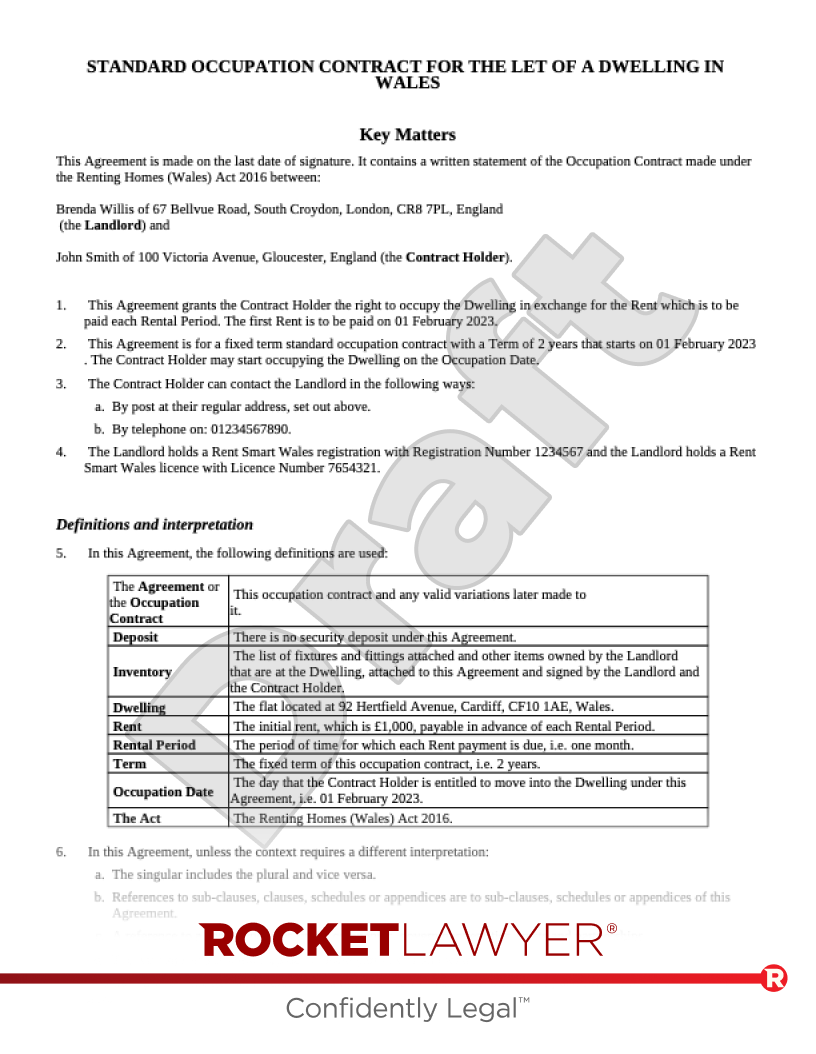
Sample Occupation Contract for a Flat in Wales
The terms in your document will update based on the information you provide
 Rocket Lawyer members have customised over 6.4M documents
 Legally binding and enforceable
 Complies with relevant laws
 Ask a lawyer questions about your document
 Sign this document online for free with RocketSign®
STANDARD OCCUPATION CONTRACT FOR THE LET OF A DWELLING IN WALES
Key Matters
This Agreement is made on the last date of signature. It contains a written statement of the Occupation Contract made under the Renting Homes (Wales) Act 2016 between:
(the Landlord) and
of , , (the Contract Holder)
- This Agreement grants the Contract Holder the right to occupy the Dwelling in exchange for the Rent which is to be paid each Rental Period. The first Rent is to be paid on .
- This Agreement is for a fixed term standard occupation contract with a Term of that starts on . The Contract Holder may start occupying the Dwelling on the Occupation Date.
- The Contract Holder can contact the Landlord in the following ways:
- By post at their
- The Contract Holder has paid the Landlord a deposit of £. Information about the holding of the deposit will be provided to the Contract Holder in accordance with this Agreement.
- The Landlord holds a Rent Smart Wales registration with Registration Number .
Definitions and Interpretation
- In this Agreement, the following definitions are used:
| The Agreement or the Occupation Contract | This occupation contract and any valid variations later made to it. |
| Deposit | The security deposit paid to the Landlord in respect of this occupation contract, i.e. £. |
| Inventory | The list of fixtures and fittings attached and other items owned by the Landlord that are at the Dwelling, attached to this Agreement and signed by the Landlord and the Contract Holder. |
Dwelling | The flat located at , , Wales. |
| Rent | The initial rent, which is £, payable in advance of each Rental Period. |
Rental Period | The period of time for which each Rent payment is due, i.e. . |
Term | The fixed term of this occupation contract, i.e. . |
Occupation Date | The day that the Contract Holder is entitled to move into the Dwelling under this Agreement, i.e. . |
The Act | The Renting Homes (Wales) Act 2016. |
- In this Agreement, unless the context requires a different interpretation:
- The singular includes the plural and vice versa.
- References to sub-clauses, clauses, schedules or appendices are to sub-clauses, schedules or appendices of this Agreement.
A reference to a person includes firms, companies, government entities, trusts and partnerships.
The headings and subheadings do not form part of this Agreement.
- Words importing one gender include all other genders and words importing the singular include the plural and vice versa.
- If two or more persons are together the Contract Holder or the Guarantor, their obligations to the Landlord shall be joint and several, where this is possible in accordance with provisions in the Act that deal with joint contract holders.
- This Agreement is for private residential accommodation and includes the Inventory.
Explanatory Information for the Contract Holder
Written Statements
- The Landlord is required by the Renting Homes (Wales) Act 2016 to provide the Contract Holder with a written statement of the Agreement for the occupation of the Dwelling made between the Landlord and the Contract Holder.
- The written statement must be provided to the Contract Holder within 14 days of their Occupation Date or prior to their Occupation Date. If it is not provided within 14 days, the Contract Holder may be entitled to compensation equivalent to one day’s rent for each day for which the written statement was late, up to a maximum of 2 months’ rent.
- The Landlord cannot charge the Contract Holder for the written statement.
- This written statement is signed as evidence of the Agreement but the Agreement exists at the time that the parties (i.e. the Landlord and the Contract Holder) agree on its terms. The signing of this written statement indicates that the parties agree to form an occupation contract on the terms set out in this Agreement.
- This written statement includes:
- The terms of the occupation contract.
- The explanatory information (i.e. this section, headed ‘Explanatory Information for the Contract Holder) that the Landlord must provide to the Contract Holder.
- If the Landlord and the Contract Holder agree on any alterations to this Agreement after it is signed, a new written statement of the varied Agreement or a written copy of the new term(s) must be provided to the Contract Holder within 14 days of the date on which the changes were agreed on. For more information on permissible variations of this Agreement, see the section headed ‘Variation of this Agreement’ below.
- Written statements may be provided in electronic form only if the Contract Holder has agreed to receive written statements in electronic form.
- If a written statement is incorrect or complete the Contract Holder may be entitled to compensation from the Landlord.
Types of Terms in the Written Statement
- Key Matters are pieces of essential information required to form the Agreement. They are:
- The address of the Dwelling.
- The Occupation Date.
- The amount of Rent to be paid.
The Rental Period.
The fact that this Agreement is made for a fixed term standard occupation contract.
Identifying any periods during which the Dwelling cannot be occupied by the Contract Holder.
- Fundamental Terms are specific terms automatically included as terms of an occupation contract.
- There are two types of Fundamental Term:
Fundamental Terms that cannot be altered and which must always be included in an occupation contract in full. These are the Core Fundamental Terms set out under the heading ‘Variation of this Agreement’.
Fundamental terms that may be changed (i.e. altered or omitted) only if the Landlord and Contract Holder agree to the changes and the changes benefit the Contract Holder. These consist of all Fundamental Terms that are not included in the list of Core Fundamental Terms.
- There are two types of Fundamental Term:
- Supplementary Terms are terms that are automatically included as terms of an occupation contract, which may be changed (i.e. altered or omitted) to the benefit of either the Landlord or the Contract Holder if the Landlord and the Contract Holder agree to the changes. Changes to Supplementary Terms must never be incompatible with a Fundamental Term.
- Additional Terms are terms that may be included in an occupation contract if they are agreed to by the Landlord and the Contract Holder. They may cover anything not covered elsewhere. Additional Terms must never be incompatible with a Fundamental Term, a Supplementary Term, or a Key Matter.
- Any included Additional Terms or altered Supplementary Terms that are considered unfair (within the meaning of the Consumer Rights Act 2015) will, under section 62 of the Consumer Rights Act 2015, not bind the Contract Holder.
The Occupation Contract
- This Agreement is for a fixed term standard contract. It will initially last for the specified Term.
- The Landlord cannot evict the Contract Holder during the Term without a court order for possession (i.e. a possession order), unless the Contract Holder abandons the Dwelling. A possession order will only be made by the court if the Landlord has followed all correct procedures (e.g. the provision of eviction notices with appropriate notice periods) and either:
The Contract Holder has broken one or more terms of the Agreement and, in the circumstances, evicting the Contract Holder is reasonable,
An estate management ground under section 160 of the Act applies and the Landlord needs to move the Contract Holder from the Dwelling; suitable alternative accommodation is available at the appropriate time if required; and eviction is, in the circumstances, reasonable, or
The Contract Holder is in serious rent arrears as defined in the Act. This is the case:
If the rental period is a week, a fortnight, or four weeks, when at least eight weeks’ rent is unpaid.
If the rental period is a month, when at least two months’ rent is unpaid.
If the rental period is a quarter, when at least one quarter’s rent is more than three months in arrears.
If the rental period is a year, when at least 25% of the rent is more than three months in arrears.
- At the end of the Term, if the Contract Holder still occupies the Dwelling, the Contract Holder now occupies the Dwelling under a new periodic standard occupation contract that the Contract Holder and the Landlord are automatically treated as having made.
- A person who lives with the Contract Holder at the Dwelling may have a right to succeed to this Agreement in line with the law on succession if the Contract Holder dies.
The Contract Holder’s and the Landlord’s Obligations in Relation to the Dwelling
- The Contract Holder must abide by their promises made to the Landlord in the terms of this Agreement.
- The Landlord must abide by their promises made to the Contract Holder in the terms of this Agreement.
- Additionally, the Contract Holder must:
Not allow more than the maximum number of people to occupy the Dwelling as permitted by Part 10 of the Housing Act 1985, so that the Dwelling does not become overcrowded.
Not allow anti-social behaviour or other prohibited conduct, as defined in the Act (e.g. excessive noise, abuse or assault (physical or verbal), or domestic violence abuse (which includes physical, emotional, sexual, psychological, emotional, and financial abuse)), to be carried out by anyone who lives in and visits the Dwelling. The Contract Holder can be responsible for the behaviour of all such persons.
Assistance and Issues
- Information about occupation contracts, dispute resolution, and other related matters can be found on the Welsh Government’s website. The Contract Holder should seek answers here if they have questions about the Agreement.
- If any problems occur with the Dwelling, the Contract Holder should first contact the Landlord to see if the problem can be quickly resolved.
- If problems cannot be resolved in discussion with the Landlord, the Contract Holder may be able to seek advice from an advice agency (e.g. Citizens Advice Cymru or Shelter Cymru) or from an independent legal advisor.
- Disputes may be resolved through the county courts if they cannot otherwise be acceptably settled.
Fundamental Terms of the Occupation Contract
Withholding Rent
- The Contract Holder may set off the Landlord’s liability to pay any required compensation under section 87 of the Act. This means that they may withhold rent to the value of the compensation that they’re owed.
The Deposit
- The Deposit nor any other type of security may be required of the Contract Holder in any form other than money or a guarantee.
- The Deposit paid in respect of this Agreement (whether paid by the Contract Holder or by another person on their behalf) must be dealt with by the Landlord in accordance with an authorised deposit scheme.
- Within 30 days after the day on which the Deposit was paid, the Landlord must provide the Contract Holder and anyone who has paid the Deposit (or part of the Deposit) on their behalf with the Required Information (i.e. that specified by the Welsh Ministers in regulations introduced in accordance with section 45 of the Act) about the chosen authorised deposit scheme, and they must abide by the initial requirements of the scheme. The Required Information relates to:
The authorised deposit scheme the Landlord is using.
How the Landlord is complying with the scheme’s initial requirements.
How Chapter 4 Part 3 of the Act (Deposits and Deposit Schemes) operates, e.g. information about the rights in relation to the deposit of the Contract Holder and of any person who has paid the Deposit on their behalf.
Prohibited Conduct
- Contract Holders must not engage in any anti-social behaviour or other prohibited conduct.
- In particular, Contract Holders must not engage or threaten to engage in conduct that is capable of causing nuisance or annoyance to:
Any person who has a right to live in the Dwelling or in accommodation (e.g. another dwelling) in the locality of the Dwelling.
Any person who is engaged in a lawful activity in the Dwelling or in the locality of the Dwelling.
The Landlord.
A person acting in connection with the Landlord’s exercise of their housing management functions (whether this person is employed by the Landlord or not), e.g. an agent.
The Contract Holder must not engage or threaten to engage in any other conduct that directly or indirectly relates to or affects the Landlord’s housing management functions.
The Contract Holder must not allow, encourage, or incite any person living in or visiting the Dwelling to act in the ways specified in this term.
- In particular, Contract Holders must not engage or threaten to engage in conduct that is capable of causing nuisance or annoyance to:
- The Contract Holder must not use the Dwelling, any common parts, or (if applicable) any other parts of the building that compromises the Dwelling for criminal purposes, nor may they threaten to do so.
- The Contract Holder must not allow, encourage, or incite any other person to act in the ways specified in this term.
Control and Use of the Dwelling
- The Contract Holder has a right to occupy the Dwelling without the Landlord’s interference. The Landlord must not interfere with this right, either by act or omission.
- Things that do not constitute interference with the Contract Holder’s right to occupy the Dwelling without the Landlord’s interference include:
The Landlord’s exercise of their rights under this Agreement.
The Landlord’s failure to comply with their Landlord’s Repair Obligations (as set out in section 100(2) of the Act), including the Landlord’s obligation to keep the Dwelling fit for human habitation.
The Landlord is considered to have interfered with this right if a person who acts on their behalf, or who has an interest superior to the Landlord’s in the Dwelling or in part of the Dwelling, interferes with the Contract Holder’s right under this term by a lawful act or omission.
- Things that do not constitute interference with the Contract Holder’s right to occupy the Dwelling without the Landlord’s interference include:
- The Landlord has a right to enter the Dwelling at any reasonable time, provided they have given the Contract Holder at least 24 hours’ notice of their intention, in order to
Inspect the Dwelling’s condition and state of repair, or
Carry out repairs or other works required for the Landlord to comply with their Landlord’s Repair Obligations under this Agreement.
- If the Dwelling forms only part of a building and the Landlord must carry out repairs or works in a part of the building other than the Dwelling to comply with their Landlord’s Repair Obligations under this Agreement, the Landlord will not be liable for their failure to comply with the relevant Landlord’s Repair Obligation if this is due to their lack of and inability to obtain (after making a reasonable effort to do so) sufficient rights over the non-Dwelling part of the building to enable this.
Landlord’s Repair Obligations
- The terms under this heading comprise the Landlord’s Repair Obligations.
- The Landlord must ensure that the Dwelling and, if the Dwelling is only part of a building, the structure and exterior and common parts of the building, are fit for human habitation as determined with regard to The Renting Homes (Fitness for Human Habitation) (Wales) Regulations 2022.
- The Landlord must ensure that the Dwelling is fit for human habitation:
On the Occupation Date, and
Throughout the Contract Holder’s occupation under this Agreement (including the Term and the subsequent automatically created periodic standard contract).
The Landlord is not liable for a failure to make the Dwelling fit for human habitation if:
The Dwelling cannot be made fit for human habitation at reasonable expense, or
The Dwelling is not fit for human habitation wholly or mainly because of an act or omission by the Contract Holder or any permitted occupiers, including acts or omissions that amount to lack of care (i.e. failure to take proper care of the Dwelling or (if relevant) the common parts of the building that it forms a part of that the Contract Holder is permitted by to use).
- The Landlord must ensure that the Dwelling is fit for human habitation:
- The Landlord must keep the Dwelling in repair to a standard of repair that is reasonable with regard to the age and character of the Dwelling and to the period during which it is likely to be available for occupation as a home. Specifically, the Landlord must:
Ensure the Dwelling’s structure and exterior (e.g. drains, gutters, and external piping) are kept in repair.
Ensure the Dwelling’s service installations (i.e. installations for the supply of water, gas, or electricity; for sanitation; for space heating; or for water heating) are kept in repair and in proper working order.
If the Dwelling forms only part of a building, ensure that the parts of the building’s structure and exterior (e.g. drains, gutters, and external piping) in which the Landlord has an estate or interest are kept in repair, if disrepair or failure of these affects the Contract Holder’s enjoyment of the Dwelling or their enjoyment of any common parts of the Dwelling that this Agreement entitles them to use.
If the Dwelling forms only part of a building, ensure that service installations that directly or indirectly serve the Dwelling, which the Landlord has an estate or interest in or that the Landlord owns or controls, are in repair and proper working order if disrepair or failure of these affects the Contract Holder’s enjoyment of the Dwelling or their enjoyment of any common parts of the Dwelling that this Agreement entitles them to use.
- If any damage is caused by works and repairs carried out in order to comply with the Landlord’s Repair Obligations, the Landlord must make good the damage.
- The Landlord cannot impose any obligations on the Contract Holder in response to their enforcing or relying on the Landlord’s Repair Obligations.
- The Landlord is not liable for breach of the Landlord’s Repair Obligations:
If they fail to keep in repair anything that the Contract Holder is entitled to remove from the Dwelling.
- If they do not rebuild or reinstate the Dwelling, part of the Dwelling, or (if the Dwelling forms only part of a building) any part of the building in which the Landlord has an estate or interest, which has been damaged or destroyed by a Relevant Cause. Relevant Causes are:
Fires.
Storms.
Floods.
Other inevitable accidents.
If the disrepair of a service installation or its failure to be in working order is wholly or mainly attributable to the Contract Holder’s or a permitted occupier’s lack of care.
- The Landlord’s Repair Obligations (excluding the obligation to ensure that the Dwelling is fit for human habitation on the Occupation Date) will not arise until the Landlord is aware that the relevant repairs or works are required. To comply with their Landlord’s Repair Obligations, the Landlord must make the required repairs or works within a reasonable time after the day that the Landlord becomes aware that they are necessary.
- If the Landlord’s interest in the Dwelling is transferred to another person (i.e. a new landlord), and the old landlord was aware of repairs or works needing to be carried out, the new landlord is treated as becoming aware of these on, but not before, the date the on which the interest is transferred.
- If the Landlord fails to comply with their Landlord’s Repair Obligations and this failure causes a permitted occupier (including lodgers or sub-holders if they are allowed to live in the Dwelling as a lodger or under a sub-occupation contract that is made in accordance with this Agreement) personal injury, loss, or damage to personal property, the permitted occupier may enforce the relevant Landlord’s Repair Obligation in their own right by bringing proceedings in respect of their injury, loss, or damage.
Dealing
- Dealing, for the purposes of this section, includes:
Creating a tenancy (e.g. a sub-tenancy).
Creating a licence (e.g. a sub-licence) that confers a right to occupy the Dwelling.
Transferring.
Mortgaging or otherwise charging.
- The Contract Holder is prohibited from dealing with this Agreement, the Dwelling, or part of the Dwelling. If there are joint contract holders, each joint contract holder is also prohibited from dealing with their rights and obligations under this Agreement. There are exceptions to the prohibitions in this term for dealing that is:
In ways permitted by the Agreement, or
In accordance with a family property order, as defined in section 251 of the Act.
- If the Contract Holder (or one of the joint contract holders, if applicable) breaches one of the prohibitions on dealing (set out in the term above), the relevant transaction will not bind the Landlord. The breach will nevertheless breach this Agreement.
Joint Contract Holders
- The Contract Holder can make another person a contract holder under this Agreement (i.e. so that they become joint contact holders) if this person agrees and the Landlord consents.
Note that, under section 84 of the Act, the Landlord may not unreasonably withhold such consent or grant consent subject to unreasonable conditions.
Any new joint contract holders introduced in accordance with this term are subject to the Contract Holder’s obligations under the Agreement, and receive the benefit of the Contract Holder’s rights under this Agreement, from the day on which they become a joint contract holder.
- If a joint contract holder ceases to be a contract holder under this Agreement (due to their death or another reason, but not due to the transfer of rights or obligations in accordance with this Agreement):
The remaining joint contract holders are fully entitled to all of the Contract Holder’s rights under this Agreement.
The remaining joint contract holders have the burden of all obligations owed by the Contract Holder to the Landlord under this Agreement.
Once no longer a party to the Agreement, the departed joint contract holder is not liable for any obligation or entitled to any right under this Agreement.
Nothing in this term shall affect the departing joint contract holder’s rights or their liability related to obligations under this Agreement before they cease being a party to this Agreement.
Ending This Agreement
- The only ways in which it is permissible for this Agreement to be ended are in accordance with:
Enactments, which include Acts of Parliament, Acts of Senedd Cymru, or regulations made by the Welsh Ministers.
The Fundamental Terms of the Agreement (which incorporate and are in accordance with fundamental provisions set out in Part 9 of the Act), or
Other terms of this Agreement that are in accordance with Part 9 of the Act.
- Terms that are in accordance with Part 9 of the Act include those in the section of this Agreement headed ‘Options for ending this Agreement’, below.
- The two terms immediately preceding this term do not affect the operation of the law of frustration or the Contract Holder’s or the Landlord’s rights to rescind the contract.
- The only instances in which the Landlord can make a claim to recover possession of the Dwelling (i.e. a possession claim) are set out in Chapters 3 and 7 of Part 9 of the Act. They are those in the section below headed ‘Options for ending this Agreement’ with the titles:
In the section below headed ‘Options for ending this Agreement’, set out under the titles:
Termination by the Landlord due to the Contract Holder’s breach of contract.
Termination by the Landlord on estate management grounds.
Termination by the Landlord due to the Contract Holder’s serious rent arrears.
Termination by the Landlord due to the Contract Holder’s breach of contract when the Contract Holder induced the Landlord to enter the Agreement by false statement.
- When the Landlord is required to give the Contract Holder a possession notice before making a possession claim (in relation to the Contract Holder’s breach of contract; estate management grounds; or the Contract Holder’s serious rent arrears), the notice must:
State the Landlord’s intention to make a possession claim.
Specify the ground on which the possession claim will be made.
Give particulars of this ground, and
Give the date after which the Landlord may make the possession claim.
- If there are joint contract holders and one or more joint contract holders act to end this Agreement without one or more other of the joint contract holders, the Agreement will not be ended.
- If an order requiring the Contract Holder to give up possession of the Dwelling on a specific day (i.e. a possession order) is made by the court, this Agreement will end:
On the day specified in the possession order, if the Contract Holder gives up possession on or before the specified day.
On the day on which the Contract Holder gives up possession of the Dwelling, if this is after the date specified in the possession order but before the possession order has been executed
On the day that the possession order is executed, if the Contract Holder has not given up possession of the Dwelling before this time.
Immediately before the new occupation contract’s occupation date if a new occupation contract is created where there were joint contract holders under the Agreement and:
The possession order contained a condition requiring the Landlord to offer a new occupation contract for the Dwelling to one or more of the joint contract holders, but not all of them, and
Those who are offered the new contract continue to occupy the Dwelling on and after the new contract’s occupation date.
Options for Ending This Agreement
- Termination by agreement: this Agreement will end if the Landlord and the Contract Holder agree to end the Agreement. In such situations, the Agreement will end:
On the day on which the Contract Holder gives up possession of the Dwelling in accordance with the agreement made for termination, or
If possession is not given up and a substitute occupation contract is made (i.e. an occupation contract for the same or substantially the same Dwelling under which the contract holder is the same person), on the occupation date of the new occupation contract.
- Termination by the Contract Holder due to a Landlord’s repudiatory breach: if the Landlord commits a repudiatory breach of this Agreement (i.e. a breach that is sufficiently serious to justify immediate termination of the Agreement, as ultimately decided by the court) and the Contract Holder gives up possession of the Dwelling as a result of this breach, the Agreement ends when possession is given up.
- Termination due to the Contract Holder’s death, if there is a sole contract holder:
- If the Contract Holder (who is one individual) dies, this Agreement ends either:
One month after the Contract Holder’s death, or
If earlier, when the Landlord is given notice of the Contract Holder’s death by the authorised persons (i.e. the Contract Holder’s personal representatives or any permitted occupiers of the Dwelling who are 18 years old or over acting together).
This Agreement will not end if a sole Contract Holder dies and one of the following applies:
Somebody is qualified under section 74 of the Act to succeed the Contract Holder, or
A family property order (as defined in section 251 of the Act) requires that the Agreement is transferred to somebody else. If such an order ceases to have effect after the Contract Holder’s death and no one is qualified to succeed to the Agreement, the Agreement ends at the later of:
The time the family property order ceases to have effect, or
The time that the Agreement would usually end if there is no relevant family property order.
- If the Contract Holder (who is one individual) dies, this Agreement ends either:
- Early termination: the Contract Holder can end this Agreement:
- Before the earlier of:
The Occupation Date, or
The date that the Landlord gives the Contract Holder a written statement.
To end the Agreement under this term, the Contract Holder must give the Landlord notice that states that they are ending the Agreement. When the Contract Holder gives such notice they no longer have any liability under this Agreement and they are entitled to have any deposit, rent, or other consideration given under this Agreement returned to them.
- Before the earlier of:
- Termination by the Landlord due to the Contract Holder’s breach of contract: the Landlord can make a possession claim on this ground if the Contract Holder breaches a term of the Agreement. A possession order will only be made following a claim on this ground if the court considers it reasonable to do so, as determined in accordance with Schedule 10 of the Act.
- Restrictions applicable to possession claims on this ground include:
The Landlord must give the Contract Holder a possession notice specifying the grounds of the intended possession claim before the claim is made.
The Landlord must wait until one month from the date that they give the Contract Holder the possession notice before starting a possession claim.
There is an exception to this one-month notice period when the Contract Holder’s breach of contract was a breach of their obligations relating to anti-social behaviour and other prohibited conduct (set out in the section headed ‘Prohibited conduct’, above). In such cases, a possession claim may be started by the Landlord on or after the day on which they give the Contract Holder the possession notice.
The Landlord must not make a possession claim after the end of the six-month period starting with the day on which the Landlord gives the Contract Holder the possession notice.
- Restrictions applicable to possession claims on this ground include:
- Termination by the Landlord due to the Contract Holder’s breach of contract when the Contract Holder induced the Landlord to enter the Agreement by false statement: if a Relevant False Statement is used by the Contract Holder to induce the Landlord to enter into the Agreement, this to be treated as a breach of contract by the Contract Holder.
In this situation, the Landlord may make a possession claim on the ground of the Contract Holder’s breach of contract (following the provisions set out for this ground above).
A Relevant False Statement is made knowingly or recklessly by either the Contract Holder or somebody acting at their instigation.
- Termination by the Landlord on estate management grounds: the Landlord can make a possession claim on one or more of the estate management grounds set out in Part 1 of Schedule 8 of the Act.
A possession order will only be made following a claim on estate management grounds if the court considers it reasonable to do so, as determined in accordance with Schedule 10 of the Act, and if the court is satisfied that suitable (as determined in accordance with Schedule 11 of the Act) alternative accommodation is available (or when then possession order takes effect will be available) to the Contract Holder.
If a possession order is granted on one or more estate management grounds only, the Landlord is required to pay the Contract Holder compensation equal to the reasonable expenses that the Contract Holder is likely to incur by moving from the Dwelling. There is an exception to this requirement for possession orders made only on one or both of Ground A or Ground B (i.e. the redevelopment grounds).
Restrictions applicable to possession claims on estate management grounds include:
The Landlord must give the Contract Holder a possession notice specifying the relevant estate management ground(s) of the intended possession claim before the claim is made.
The Landlord must wait until one month from the date that they give the Contract Holder the possession notice before starting a possession claim.
The Landlord must not make a possession claim after the end of the six-month period starting with the day on which the Landlord gives the Contract Holder the possession notice.
When relying on Ground B, using a redevelopment scheme that is approved under Part 2 of Schedule 8 of the Act subject to conditions, the Landlord can give a possession notice specifying this ground to the Contract Holder before the conditions are met.
The Contract Holder must not be given a possession notice specifying Ground G (i.e. accommodation not required by successor) before the end of the six-month period, or after the end of the twelve-month period, that starts on the day on which the Landlord became aware of the previous Contract Holder’s death.
The Contract Holder must not be given a possession notice specifying Ground H (i.e. departing joint contract holder) after the end of the six-month period that starts on the day on which the relevant joint contract holder’s rights and obligations under the Agreement ended.
- Termination by the Landlord due to the Contract Holder’s serious rent arrears: the Landlord can make a possession claim on the ground that the Contract Holder is in serious rent arrears.
Serious rent arrears is, for the purposes of this provision, defined in accordance with the Act as:
If the rental period is a week, a fortnight, or four weeks, when at least eight weeks’ rent is unpaid.
If the rental period is a month, when at least two months’ rent is unpaid.
If the rental period is a quarter, when at least one quarter’s rent is more than three months in arrears.
If the rental period is a year, when at least 25% of the rent is more than three months in arrears.
A possession order must be made by the court following a possession claim on the ground of serious rent arrears, unless inappropriate due to a defence based on the Contract Holder’s rights under the European Convention on Human Rights (the ECHR), if the court is satisfied that the Contract Holder:
Was in serious rent arrears on the day on which the Landlord served them the possession notice, and
Is in serious rent arrears on the day on which the court hears the possession claim.
Restrictions applicable to possession claims on the ground of serious rent arrears include:
The Landlord must give the Contract Holder a possession notice of the intended possession claim, specifying serious rent arrears as the relevant ground, before a possession claim is made.
The Landlord must wait until 14 days from the day on which they give the Contract Holder the possession notice before starting a possession claim.
The Landlord must not make a possession claim after the end of the six-month period starting with the day on which the Landlord gives the Contract Holder the possession notice.
Variation of This Agreement
- This Agreement may not be varied, except:
By agreement between the Landlord and the Contract Holder, or
By or as a result of an Enactment, including Acts of Senedd, Acts of Parliament, or regulations made by the Welsh Ministers.
- Any variations of this Agreement, except those due to Enactments, must be in accordance with the following limitations:
- Certain Fundamental Terms (i.e. the Core Fundamental Terms) of this Agreement may not be varied (with the exception of variations due to Enactments). These Core Fundamental Terms are:
The requirement to use an authorised deposit scheme and to provide the Required Information about the deposit scheme, in accordance with the section of this Agreement headed ‘The Deposit’.
The prohibitions on anti-social behaviour and other prohibited conduct, set out in the section of this Agreement headed ‘Prohibited conduct’.
The single term setting out what happens if a joint contract holder ceases to be a contract holder under this Agreement, located under the section of this Agreement headed ‘Joint contract holders’.
The four terms at the beginning of the section headed ‘Ending this Agreement’, which set out when termination of this Agreement is permissible. This includes the term setting out the only instances in which the Landlord can make a claim to recover possession.
The term dealing with termination due to the Contract Holder’s death if there is a sole contract holder.
The term requiring that false statements that induced the Landlord to enter into the Agreement are treated as breaches of contract.
All of the terms in this section, headed ‘Variation of this Agreement’, excluding the rule that the Agreement may be varied by agreement between the Landlord and the Contract Holder.
Any permitted variations of Fundamental Terms (i.e. variations of Fundamental Terms that are not Core Fundamental Terms), with the exception of variations due to Enactments, will only have effect if the variation does not make the Fundamental Term incompatible with any of the Core Fundamental Terms and:
The fundamental provision of the Act that the Fundamental Term incorporates is still incorporated into the term, without modification, or
The effect of the change is an improvement in the Contract Holder’s position, where the fundamental provision that the Fundamental Term incorporates is not incorporated or is incorporated with modification.
Any variation of terms of this Agreement will only have effect if the variation does not make the varied term incompatible with a Fundamental Term of this Agreement, unless the relevant Fundamental Term is also validly varied (i.e. in accordance with this Agreement) in a way that allows incompatibility to be avoided. This does not apply to variations due to Enactments.
- Certain Fundamental Terms (i.e. the Core Fundamental Terms) of this Agreement may not be varied (with the exception of variations due to Enactments). These Core Fundamental Terms are:
Written Statements and the Provision of Information
- The Landlord has various obligations related to written statements of the occupation contract (e.g. this document). These include:
The Landlord must provide the Contract Holder with a written statement of their occupation contract (i.e. of this Agreement) before the end of the 14 -ay period that starts on the Occupation Date.
If the identity of the Contract Holder under this Agreement changes, the Landlord must provide the new contract holder with a written statement of the occupation contract before the end of the 14-day period that starts on either:
The day on which the Contract Holder’s identity changed, or
If later, the day on which the Landlord becomes aware that the Contract Holder’s identity has changed.
- The Contact Holder may request a further written statement of the occupation contract at any time. If they do so, the Landlord must provide this written statement of the occupation contract before the end of the 14-day period that starts on either:
The day on which the Contract Holder pays the fee, if the Landlord charges a fee, or
The day of the request, if the Landlord does not charge a fee.
- If this Agreement is varied, before the end of the relevant period (i.e. the 14-day period that starts on the day on which the Agreement is varied), the Landlord must provide the Contract Holder with either:
A written statement of the term or terms that were varied, or
A written statement of the occupation contract as varied (i.e. the updated version of the whole occupation contract).
- The Landlord may only charge a fee for a written statement in certain circumstances:
The Landlord must not charge the Contract Holder a fee in exchange for providing a written statement of the occupation contract at the start of the occupation contract or when the Contract Holder’s identity changes.
The Landlord may charge a reasonable fee for providing additional written statements of the occupation contract (i.e. in situations other than the start of the occupation contract or a change to the Contract Holder’s identity).
The Landlord must not charge the Contract Holder a fee when providing a written statement (of the varied terms or of the varied occupation contract) when the Agreement is varied.
- The Landlord has an obligation to provide the Contract Holder with certain information about themselves.
Specifically:
The Landlord must, before the end of the 14-day period that starts on the Occupation Date, give the Contract Holder notice of an address to which they can send documents intended for the Landlord.
If the Landlord’s identity changes, the new landlord must, before the end of the 14-day period that starts on the day on which the new person becomes the Landlord, give the Contract Holder notice of the identity change and of an address to which they can send documents intended for the new landlord.
If the Landlord’s address to which the Contract Holder can send documents intended for the Landlord changes, the Landlord must, before the end of the 14-day period that starts on the day on which the address changes, give the Contract Holder notice of the new address.
If the Landlord does not comply with one of their obligations under this term they are liable to pay compensation to the Contract Holder, in accordance with section 87 of the Act.
This compensation will be payable in respect of the Relevant Date (i.e. the first day of the period before the end of which the Landlord had to give the information to the Contract Holder) and in respect of every day after the Relevant Date until either:
The day that the Landlord gives the Contract Holder the notice of the information, or
If earlier, the last day of the period of 2 months starting on the Relevant Date.
Interest will be payable on the compensation if the Landlord does not give the Contract Holder notice of the information on or before the last day of the period of 2 months starting on the Relevant Date. Interest starts to run on the last day of this 2-month period at the rate that prevails under section 6 of the Late Payment of Commercial Debts (Interest) Act 1998 at the end of that day.
Notices
- Any notices, statements, or other documents that either party is required or authorised to give or make under this Agreement must:
- Be in writing, and
Be delivered or otherwise given in accordance with the provisions in sections 236 and 237 of the Act.
Supplementary Terms of the Occupation Contract
Rent
- If the Contract Holder requests a receipt of their Rent payments or payments of other consideration, the Landlord must provide written receipt of these payments within 14 days of the request.
- The Contract Holder does not need to pay Rent for any day or part day during which the Dwelling is not fit for human habitation, as determined with regard to The Renting Homes (Fitness for Human Habitation) (Wales) Regulations 2022.
Control and Use of the Dwelling
- The Contract Holder may permit other people (i.e. permitted occupiers) to live at the Dwelling as a home as long as these people are not lodgers (as defined in the Act) or sub-holders (i.e. contract holders under a sub-occupation contract).
- The Contract Holder must not carry out any business or trade at the Dwelling without the Landlord’s explicit consent.
- The Landlord can enter the Dwelling at any reasonable time, provided they have given the Contract Holder at least 24 hours’ notice of their intention, for the purpose of carrying out repairs to items (e.g. fixtures and fittings) listed in the Inventory, if the Contract Holder has not fulfilled their Contract Holder’s Repair Obligations in relation to those items.
- The Landlord must be given immediate access to the Dwelling if an emergency occurs which creates a need for the Landlord to enter the Dwelling without notice.
If this access is not provided, the Landlord may enter without the Contract Holder’s permission. If this occurs, the Landlord must use all reasonable endeavours to notify the Contract Holder as soon as reasonably practicable after entry that they have entered the Dwelling.
Emergencies, for the purposes of this term, include things that:
Require urgent work to be carried out to prevent severe damage, further damage, or destruction of the Dwelling or of other dwellings in its vicinity, or
Would result in an imminent risk to the health and safety of the Contract Holder, any permitted occupiers, or any other persons in the vicinity of the Dwelling, if not dealt with immediately by the Landlord.
Prohibition of Discrimination Against People With Children and Benefits Claimants
- Right for children to live at or visit the Dwelling: the Contract Holder may permit a person who has not reached the age of 18 to live in or visit the Dwelling.
- The Landlord must not interfere with or restrict the exercise of the Contract Holder's right under this term, unless the interference or restriction is a proportionate means of achieving a legitimate aim.
- Right to claim benefits: The Landlord must not prohibit the Contract Holder from being a benefits claimant within the meaning given by section 8J of the Renting Homes (Fees, Discrimination etc.) (Wales) Act 2019.
Contract Holder’s Repair Obligations
- The terms under this heading comprise the Contract Holder’s Repair Obligations.
- The Contract Holder must:
Take proper care of the Dwelling and the fixtures and fittings within it and all items listed in the Inventory.
Keep the Dwelling itself in reasonable decorative order.
- The Contract holder must not:
Remove from the Dwelling without the Landlord’s consent any fixtures, fittings, or items listed in the Inventory.
Keep anything in the Dwelling that may pose a risk to the health and safety of:
The Contract Holder themselves,
Any permitted occupiers,
Anybody visiting the Dwelling, or
Anybody living in the Dwelling’s vicinity.
- The Contract Holder is not liable for any fair wear and tear to the Dwelling or the fixtures and fittings within it.
- The Contract Holder must notify the Landlord of any defect, disrepair, damage, or fault as soon as is reasonably practicable.
- The Contract Holder must, within a reasonable time period, repair or replace any fixtures, fittings, or items listed in the Inventory that have defect, disrepair, damage, or fault which the Contract Holder reasonably believes is not the Landlord’s responsibility to remedy. This includes when the defect, disrepair, damage, or fault is caused wholly or mainly by the Contract Holder’s, any permitted occupiers’, or a visitor to the Dwelling’s act or omission that amounts to a lack of care.
Changes to the Dwelling and to Utilities
- The Contract Holder can only make alterations to the Dwelling with the Landlord’s consent. Alterations include:
Adding or altering fixtures and fittings.
Installing aerials or satellite dishes.
Installing, removing, or structurally altering sheds, garages, or other structures in the Dwelling.
Decoration to the Dwelling’s exterior.
- The Contract Holder may change the Dwelling’s suppliers of:
- Electricity.
- Gas.
- Water.
- Sewerage services.
- Telephone services.
- Internet services.
- Television services.
- The Contract Holder must not, unless they have the Landlord’s consent to do so:
Leave the Dwelling at the end of their occupation without a supplier of electricity, gas, or other fuel (if applicable) or of water (including sewerage services). This does not apply to any of these utilities that the Dwelling did not have on the Occupation Date.
Have or arrange to have installed or removed any specific service installations at the Dwelling (i.e. installations for supplying water, gas or electricity, or other fuel (if applicable) for sanitation purposes; for space heating; or for water heating).
Security and Safety of the Dwelling
- The Contract Holder must notify the Landlord as soon as is reasonably practicable if they become aware that the Dwelling has been or will be unoccupied for 28 or more consecutive days.
- The Contract Holder must take reasonable steps to ensure that the Dwelling is secure.
- The Contract Holder can change locks of the Dwelling’s internal or external doors as long as this does not amount to less security being in place than before the change. The Contract Holder must notify the Landlord as soon as is reasonably practicable of any changes and provide the Landlord with a working copy of the new key, if the changes mean that a new key is needed to access the Dwelling or part of the Dwelling.
Dealing
- The Contract Holder may only allow somebody to live in the Dwelling as a lodger with the Landlord’s consent.
When This Agreement Ends
- The Contract Holder has certain obligations at the end of this Agreement. Specifically, when they vacate the Dwelling they must:
Remove from it all property belonging to them or to any permitted occupiers who are not entitled to remain in occupation of the Dwelling.
Restore any property of the Landlord’s to the position it was in on the occupation date.
Return to the Landlord all keys that enable access to the Dwelling that were used by the Contract Holder or by any permitted occupier who is not entitled to remain in occupation.
- The Contract Holder has the right to be repaid by the Landlord any prepaid Rent or other consideration related to the time after the day that this Agreement ends. Repayment must be within a reasonable time of the end of the Agreement.
Provision of Information: Inventory
- The Landlord must give the Contract Holder an Inventory in relation to the Dwelling on or before the same date that the Landlord is required to provide them with a written statement of the occupation contract.
- The Inventory must set out the contents of the Dwelling, including fittings and fixtures. It must describe all items’ condition at the Occupation Date.
- The Contract Holder is entitled to provide comments to the Landlord (i.e. comments specifying disagreement with the information in the Inventory).
The Inventory is deemed accurate if the Landlord does not receive any comments from the Contract Holder within 14 days of the Inventory being provided.
If the Landlord does receive comments within 14 days of the Inventory being provided, they must either:
Amend the Inventory in line with the comments and send the amended Inventory to the Contract Holder (i.e. agree to the Contract Holder’s changes),
Inform the Contract Holder that they do not agree with the comments and re-send them the original Inventory with a copy of the comments attached to it, or
Amend the Inventory in line with some of the comments and send the amended Inventory to the Contract Holder along with a record of the comments that have not been agreed with (i.e. agree to some of the Contract Holder’s changes only).
Notices
- The Contract Holder must keep safe any notices, orders, or other documents delivered to the Dwelling and addressed to the Landlord (or more generally to the Dwelling’s owner).
- The Contract Holder must give the original copies of these documents to the Landlord as soon as is reasonably practicable.
Additional Terms of the Occupation Contract
Bills and Utility Payments
- The Contract Holder will comply with all laws and requirements relevant to utility provision, the Dwelling’s particular suppliers, and the Contract Holder’s use of utilities.
Pets
The Contract Holder is a responsible pet owner.
The relevant pets are of a kind that is suitable to be kept in the Dwelling, and
The relevant pets are not likely to:
Cause damage to the Dwelling or its contents,
Pose a risk to anybody’s health and safety, or
Cause a nuisance to neighbours.
Insurance
- The Landlord will insure the Dwelling, and its contents that belong to the Landlord, with a reputable insurance company.
- If the Dwelling is damaged or destroyed by a risk that is covered by the Landlord’s insurance of the Dwelling, and this was not caused by the Contract Holder’s wilful actions, default, or negligence, and the effect of the damage or destruction is that the Dwelling is no longer fit for occupation, the Contract Holder does not need to pay Rent until the Dwelling is again fit for occupation.
Signatures
This Agreement serves as a written statement of the occupation contract between the Landlord and the Contract Holder. It is signed by:
The Landlord:
| _________________________________ | _________________________________ |