What are the rules for rent and rent payments?
The rent will usually reflect the market rent for similar properties in the local area. The Tenancy agreement (including occupation contracts in Wales) will fix the rent for an initial period.
Rent periods and advance payments in England
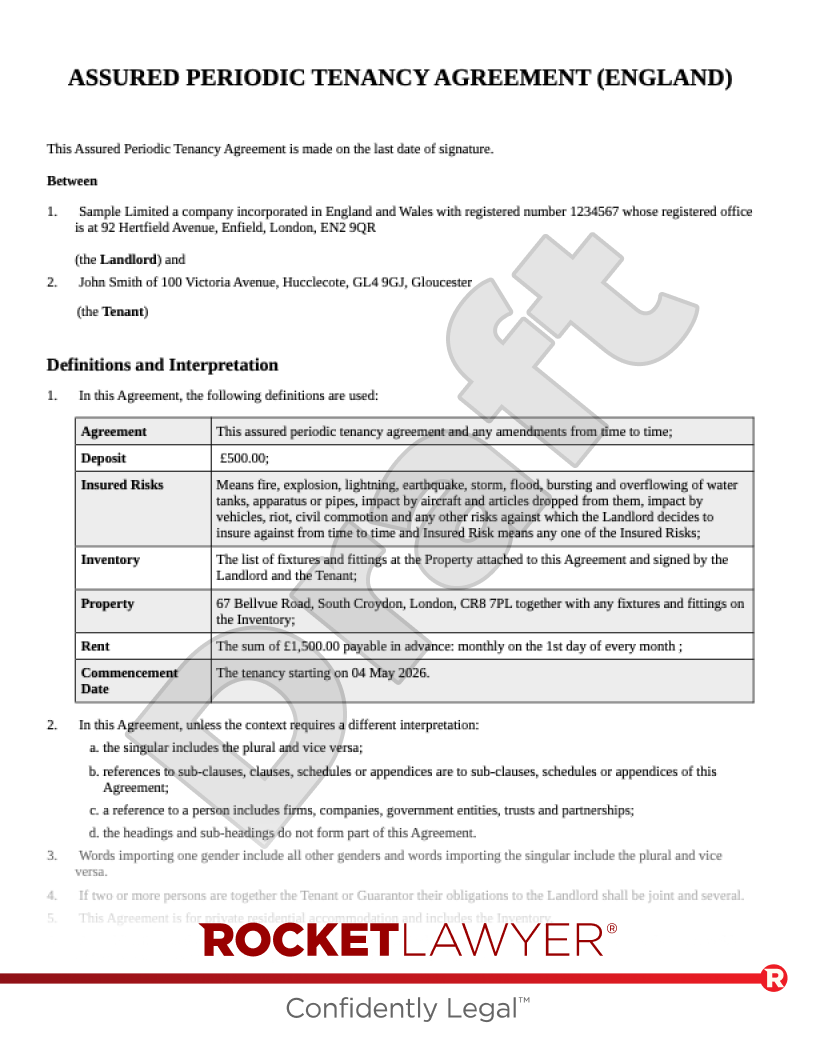
In England, since 1 May 2026, most private tenancies are assured periodic tenancies. These are rolling tenancies with rent periods that must not exceed one month. This means you cannot have a rent period that is, for example, quarterly or six-monthly.
Before the tenancy starts, you can only ask the tenant to pay their first month’s rent (or the first 28 days if they pay weekly) once the contract is signed. You cannot ask for more than this amount in advance.
Once the tenancy begins, you aren’t allowed to include terms in the agreement that force a tenant to pay rent in advance. However, if a tenant chooses to pay some of their rent early on their own, they’re allowed to do so.
How and when rent is paid
Rent is usually paid in advance to the landlord or their agent. A tenant’s spouse or civil partner can pay the tenant’s rent, as these rent payments are treated as being made by the tenant. Any rent payment made by someone else on behalf of the tenant (eg a parent, child, or friend) must be authorised or ratified by the tenant.
Tenants should pay the rent in accordance with their tenancy agreement. Their agreement should specify how much the rent is, when it is payable, and where the rent is to be paid (eg to the landlord’s specified bank account). The rent can be paid in a number of ways, including:
-
in cash - a Rent receipt should always be requested when making rental payments in cash
-
by cheque - if a cheque is lost in the post, it’s the tenant's responsibility to make good the rent payment
-
by bank transfer - the rent payment is considered to be made as soon as it leaves the tenant’s bank account
The rent becomes due on the morning of the day identified in the tenancy agreement as the payment date. However, the rent does not become overdue until midnight on that day. The landlord can only take action for late payment of rent once the payment becomes overdue. While rent can be payable on Sundays, any rent that is due on a bank holiday will not be payable until the next business day.
If a tenant is late paying the rent, a Rent demand letter should be sent as a provider. This must specify the landlord's name and address.
What are the rules for a rent increase?
The process for increasing rent depends on where your property is located.
England
Under the Renters’ Right Act 2025, after 1 May 2026, rent review clauses can no longer be used to increase the rent. Even if your existing tenancy agreement contains a rent review clause, it will stop applying from that date.
To increase the rent, landlords must follow the procedure set out in section 13 of the Housing Act 1988. Rent can only be increased once a year, and landlords must give at least two months’ written notice using a formal Rent increase (section 13) notice before the increase takes effect.
Any increase must reflect the open market rent. If a tenant believes the proposed rent is higher than the market rate, they can challenge it through the First-tier Tribunal.
For more information, read Rent increases and section 13 notices.
Wales
If you’re a landlord in Wales, you can increase the rent. However, the process depends on the type of occupation contract you have in place.
For secure contracts and periodic standard contracts, you can only increase the rent once per year. To do this, you must use the correct form, giving the contract holder at least two months’ notice.
For standard occupation contracts, you can increase the rent if the contract holder agrees to the increase or by virtue of a rent increase provision included in the contract.
For more information, read Variations of rent in Wales.
Scotland
If you’re a landlord in Scotland with a private residential tenancy, you can only increase rent once per year. To do so, you must give at least three months' notice and use the correct form. If your tenant thinks the increase is unfair, they can apply to the Private Renting Housing Panel to set a fair rent. A private residential tenancy can only be terminated if one of the 18 grounds for eviction applies. For more information, read Private renting rent increases in Scotland.
What are the limits on deposits?
It is a good idea to ask the tenant to pay a deposit at the start of the tenancy to cover cleaning, breakage, and damage that may occur during the tenancy.
England and Wales
In England and Wales, landlords can take a holding deposit to reserve the property while they carry out checks. However, this cannot exceed one week’s rent. Holding deposits must either be refunded or put towards the security deposit.
Any security deposits taken by landlords must comply with tenancy deposit protection rules.
The maximum tenancy deposit you can ask a tenant to pay depends on the total annual rent for the property:
-
up to five weeks’ rent if the total annual rent for the property is less than £50,000
-
up to six weeks’ rent if the total annual rent for the property is £50,000 or above
The deposit must be protected in a government-approved deposit protection scheme. These schemes are:
The schemes offer an alternative dispute resolution (ADR) service which is free of charge. A dispute will only go to court if both landlord and tenant cannot agree to use the ADR service.
You will also need to provide the tenant with certain prescribed information.
Scotland
In Scotland, a deposit must not be more than two months' rent. If you take a deposit from your tenant, it must be paid into an approved deposit protection scheme. This must be done within 30 working days of the tenancy start date. The Government-approved schemes are:
For more information, read Deposit protection schemes.
Once a deposit has been registered, you will also need to provide the tenant with certain prescribed information.
How should I handle bills and utilities?
Your tenancy agreement should clearly state who is responsible for paying utilities. You should also consider these practical steps:
-
insurance - ensure that you have suitable cover for letting under both the buildings and the contents insurance. Failure to inform your insurers may invalidate your policy
-
bills - arrange your outgoings such as service charges, maintenance contracts, and so on, to be paid by direct debit or standing order
-
council tax and utilities - arrange for the transfer of the council tax and utility bills to the tenant; take gas and electricity meter readings to ensure that utilities have been paid to date
-
telephone - you will probably also want to transfer the telephone into the tenant’s name
For more information, read Utility bills.
If you need to update your terms, you can make a Tenancy agreement. Do not hesitate to Ask a lawyer if you have any questions.