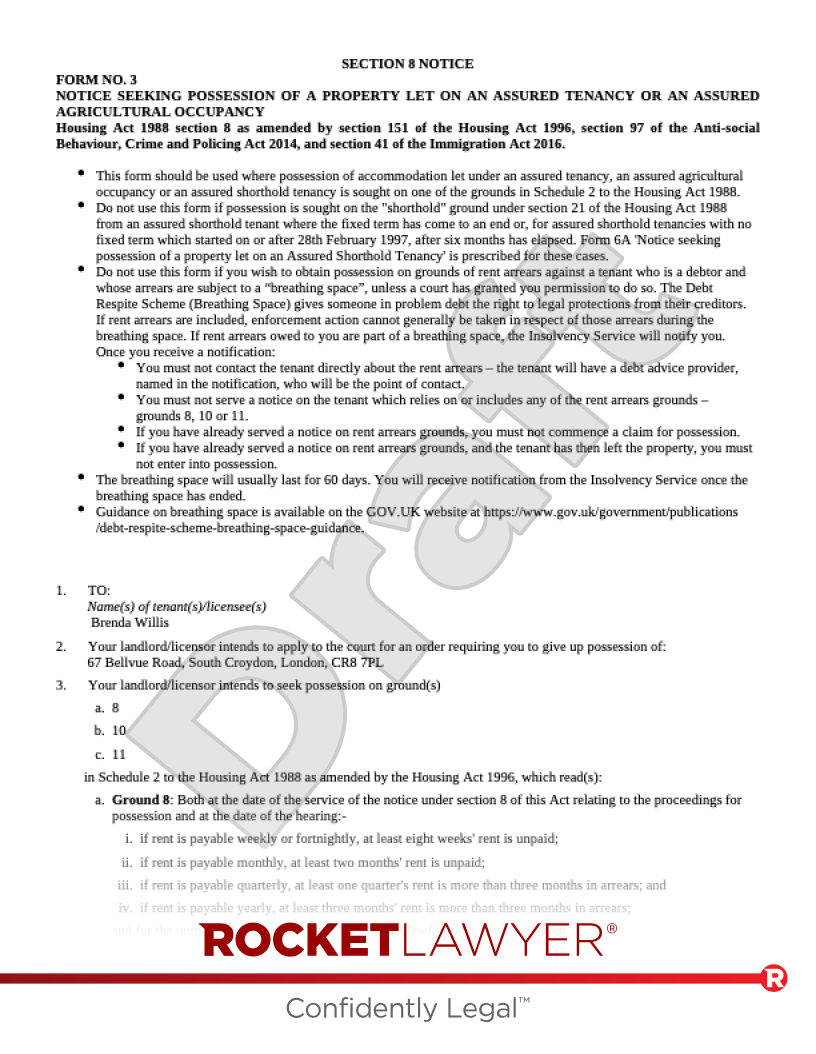
What are the grounds for possession?
The current grounds for possession can be found under Schedule 2 of the Housing Act 1988, as amended by the Renters’ Right Act 2025. There are a total of 37 legal grounds for possession that landlords can use for a Section 8 eviction notice. Grounds will fall under one of two categories:
-
mandatory - meaning the courts must make a possession order if a mandatory ground is proven
-
discretionary - meaning the courts may make a possession order if a discretionary ground is proven
Different grounds will require different notice periods (more on this below).
You must serve (ie deliver) the section 8 notice before the notice period is set to start. If you use more than one ground, you need to serve the notice according to the ground with the longest notice period.
If you’re unsure whether any of the grounds for eviction apply, Ask a lawyer.
What are the mandatory grounds for possession?
The mandatory grounds are considered the most powerful because a court is obliged to grant a possession order once you prove the ground applies. You must strictly follow the notice period and any other rules associated with the ground to ensure your eviction claim is valid.
The current mandatory grounds for possession are:
-
Ground 1 - the landlord or their spouse/civil partner needs possession of the property as they wish to occupy the property as their main home
-
Ground 1A - the landlord wishes to sell the property
-
Ground 1B - the private landlord is a social housing provider who is selling the property, and that property is under a rent-to-buy agreement (ie a tenancy under a government-approved scheme entered into at a reduced-rate rent with the intention to buy after a set time-period to allow tenants to save for a deposit)
-
Ground 2 - the property is subject to a mortgage, and the mortgage lender (eg a bank) is now selling the property
-
Ground 2ZA, 2ZB, 2ZC, and 2ZD - all relate to the specific circumstances where the property is sublet and the original tenancy is ending
-
Ground 3 - the tenancy has a fixed term of eight months or less, and the property was used as a holiday let in the 12 months before the current tenancy
-
Ground 4 - the tenancy has a fixed term of up to 12 months and was used as a student letting (mandatory) within 12 months prior to the current tenancy
-
Ground 4A - the property is let as a house in multiple occupation (HMO) for full-time students, and the landlord requires the property for new students in line with the next academic year
-
Ground 5 - the property is held to be available for a minister of religion to reside and perform their duties, and it is now required for occupation by a minister of religion
-
Grounds 5A, 5B, 5C, 5D, 5E, 5F, 5G, and 5H - all relate to circumstances where the property is being held or used as accommodation for specific employment or social housing purposes
-
Ground 6 - the property requires demolishing or substantial construction works that cannot be performed whilst the tenant occupies the property
-
Ground 6A - a social landlord is seeking possession of a property that was used as alternative accommodation for a tenant whose original rented property was under redevelopment and is now re-available
-
Ground 6B - the landlord needs to take possession of the property to comply with enforcement action
-
Ground 7 - the tenant has died
-
Ground 7A - the tenant has engaged in antisocial behaviour (eg committing a criminal offence, a serious offence of specified legislation, or a nuisance)
-
Ground 7B - the tenant doesn’t have a right to rent and is disqualified from renting the property due to their immigration status
-
Ground 8 - the tenant is in serious rent arrears. What is considered to be serious arrears will be dependent on when their rent becomes due, but it generally requires at least three months’ unpaid rent
For more detailed information on these grounds for eviction, read the government’s guidance on the grounds for possession.
What are the discretionary grounds for possession?
If you’re relying on a discretionary ground, the court doesn't have to grant you possession, even if you prove the facts of the ground. They’ll assess whether it’s reasonable to evict the tenant. The current discretionary grounds are:
-
Ground 9 - suitable alternative accommodation will be available to the tenant
-
Ground 10 - the tenant is in rent arrears at the time the section 8 notice is served and at the time court proceedings start
-
Ground 11 - the tenant is persistently late in making rent payments
-
Ground 12 - the tenant broke their obligations under the Tenancy agreement (other than not paying rent)
-
Ground 13 - the tenant’s behaviour caused the property (or common parts in a shared property) to deteriorate
-
Ground 14 - the tenant is causing a nuisance, causing annoyance, or making illegal or immoral use of the property
-
Ground 14A - the tenants are a couple (ie married, in a civil partnership, or cohabiting as a couple) and one partner is domestically abusing the other through violence
-
Ground 14ZA - the tenant, or an adult living in the property, is convicted of a riot offence requiring a Crown Court trial (ie an indictable offence)
-
Ground 15 - the tenant’s poor treatment of the landlord’s furniture, causing deterioration
-
Ground 17 - the tenancy was granted because of a false statement a tenant made
-
Ground 18 - the tenancy relates to supported accommodation, and the tenant has failed or refused to engage with the support services provided
For more detailed information on these grounds for eviction, read the government’s guidance on the grounds for possession.
How much notice do I need to give under the eviction grounds?
The amount of notice you must give your tenant depends on the specific ground you’re using.
Under the Renter’s Right Act 2025, notice periods for most possession grounds have been extended, meaning landlords must generally give tenants more time before starting possession proceedings. This change is intended to provide tenants with a greater opportunity to respond, resolve issues, or secure alternative accommodation before eviction action is taken.
Notice periods for the mandatory grounds for eviction
You must give the following notice periods for mandatory grounds, which are the reasons where a court must grant possession if the ground is proven.
Ground |
Reason |
Notice period |
| 1 |
Landlord or family moving in |
Four months |
| 1A |
Sale of the property |
Four months |
| 1B |
Sale of a rent-to-buy property |
Four months |
| 2 |
Repossession by a mortgage lender |
Four months |
| 2ZA-2ZD |
Superior lease or landlord interest ends |
Four months |
| 4 |
Student accommodation is needed for new students |
Four weeks |
| 4A |
Purpose-built student accommodation |
Four weeks |
| 5-5D |
Employment-related occupation |
Two months |
| 5E-5F |
Supported housing requirements |
Four weeks |
| 5G |
Accommodation for homelessness duty |
Four weeks |
| 5H |
Stepping stone accommodation |
Four months |
| 6 |
Redevelopment |
Four months |
| 6A |
Compliance with enforcement action |
Four months |
| 7 |
Death of the tenant |
Two months |
| 7A |
Serious antisocial behaviour or criminal conviction |
Immediate |
| 7B |
No right to rent |
Two weeks |
| 8 |
Serious rent arrears |
Four weeks |
Notice periods for the discretionary grounds for eviction
You must give the following notice periods for discretionary grounds, during which the court will decide whether evicting the tenant is reasonable.
Ground |
Reason |
Notice period |
| 9 |
Suitable alternative accommodation is available |
Two months |
| 10 |
Any amount of rent arrears |
Four weeks |
| 11 |
Persistent late payment of rent |
Four weeks |
| 12 |
Breach of the tenancy agreement |
Two weeks |
| 13 |
Deterioration of the property's condition |
Two weeks |
| 14 |
Nuisance, annoyance, or illegal use of the property |
Immediate |
| 14A |
Domestic abuse (social landlords only) |
Two weeks |
| 14ZA |
Offences committed during a riot |
Two weeks |
| 15 |
Deterioration of furniture |
Two weeks |
| 17 |
Tenancy obtained by a false statement |
Two weeks |
| 18 |
Supported housing, and the tenant is not cooperating with the support |
Four weeks |
What are the restrictions on using the eviction grounds?
You can’t always serve these notices whenever you like. For certain 'no-fault' style grounds, like Ground 1 (moving in) or Ground 1A (selling), there’s a protected period. This means you usually don't have the right to serve these notices during the first 12 months of a tenancy.
Further, if you do use these grounds to regain your property, the property will be subject to a re-letting ban. This means that you aren't allowed to let out or even market the property for rent for 12 months after the notice expires.
There are a few other hurdles to clear before you can use most grounds, such as:
-
ensuring you’ve properly protected the tenant’s deposit in a government-backed scheme
-
complying with the requirements of the deposit protection scheme when you first received the deposit
-
providing the tenant with the required prescribed information for tenancy deposits
If you try to bypass these rules or use a ground dishonestly, your local council can issue a fine of up to £7,000. It’s always best to double-check you’re eligible to use a ground before you start the paperwork by speaking to a lawyer. Note that these requirements do not apply to Grounds 7A or 14 for antisocial behaviour.
For more information, read Evicting a tenant and Enforcement of possession orders.
For more information on the Renters’ Rights Act 2025 and the changes it brings, read The landlord's guide to the Renters' Rights Act.
For more information on section 8 notices and how to use them, read Evicting a tenant. If you need help deciding which grounds you should use in a section 8 notice, you can Ask a lawyer. Alternatively, consider using our Tenant eviction service for help with the section 8 eviction process.