What are residential rent arrears?
The term ‘residential rent arrears’ refers to overdue rent owed by tenants.
Rent arrears can occur for many reasons, such as the tenants struggling to keep up with rent or refusing to make payments.
How to take action against residential rent arrears?
If a tenant misses one rent payment, this can be easily resolved. However, it's important to ensure that missed rent payments do not become a recurring issue.
You should let the tenant know that you take missed rent seriously and that you intend to take appropriate steps at an early stage.
You should establish why the rent has not been paid. There may be various technical issues that were not within the tenant's control. For example, the bank's system was not working, or the tenant had switched bank accounts and forgot to reinstate a standing order or direct debit.
Remember to continuously keep in contact with the tenant. Keep records and copies of all communication and evidence, as this may be necessary if you decide to take court action.
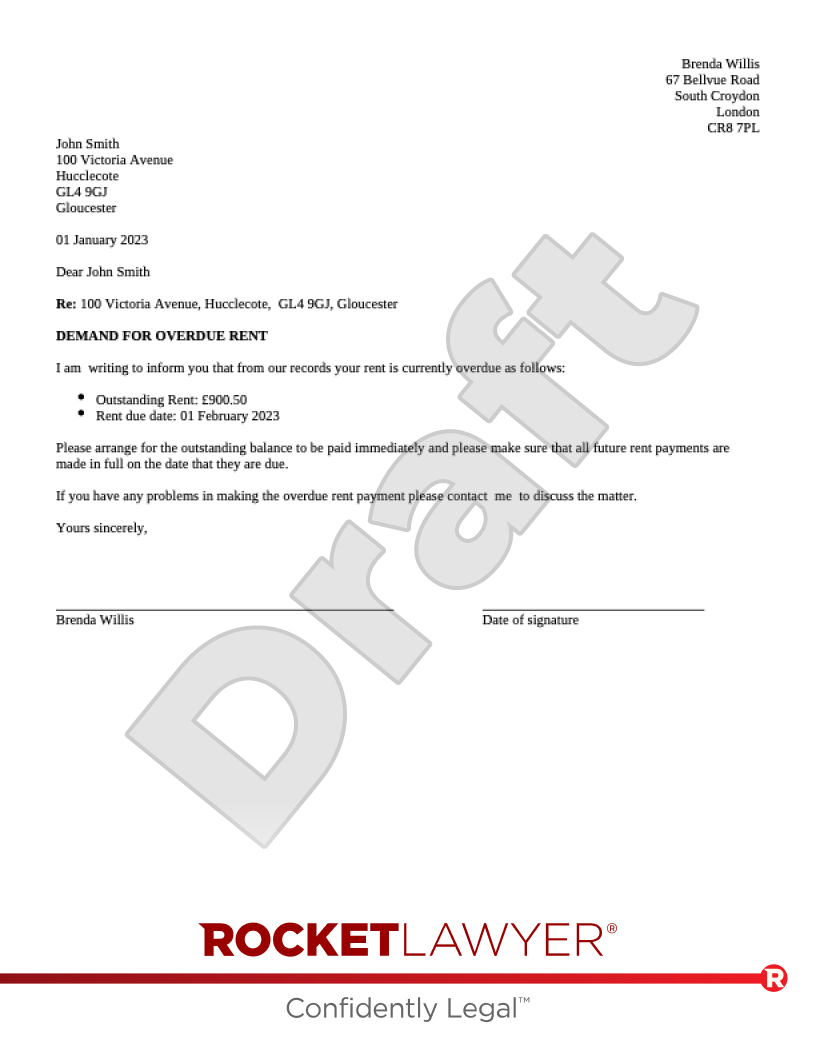
Most tenants will respond quickly when reminded about a missed payment. You can send them a Rent demand letter. This letter enables you to request immediate payment of the outstanding rent from your tenant.
If the rent is still outstanding after you have reached out to the tenant, you may need to take further action, including sending a Final rent demand letter.
Interest on rent arrears
This information only applies in England and Wales.
Under the Tenant Fees Act 2019, interest on late payment of rent can be charged if the rent has been outstanding for at least 14 days. Interest can be charged at a maximum of 3% above the Bank of England base rate. Interest is calculated from the date the rent payment was due up to the date the payment was received. Any interest on rent arrears will be recoverable as rent in arrears. For more information, read Tenant fees.
Check your Tenancy agreement to see if you can charge interest on any rent arrears owed.
What are the next steps for continuous rent arrears?
If your tenant becomes financially unable to rent the property, it may be best to end the tenancy. This is a good option if all parties (ie the landlord and tenant) agree. Ending the tenancy ends liability for rent payments and allows the landlord to move on and find new tenants. It's common to agree to end the tenancy as soon as replacement tenants have been found to minimise the financial impact. Where both parties agree to end the tenancy, this is known as surrendering a tenancy. For further information, read Surrendering a tenancy.
If your tenant doesn't agree to surrender (ie end) the tenancy, you will need to serve an Eviction notice.
Landlords must be careful not to pressure tenants into agreeing to end a tenancy, as this could be perceived as harassment or illegal eviction, both of which carry criminal sanctions.
For more information on evictions and possession proceedings, read Evicting a tenant (for England), Repossessing property in Wales (for Wales), and Grounds for eviction in Scotland (for Scotland).
You may need to help your tenant assess their options. Many cases of rent arrears arise due to becoming unemployed or loss of income. If this is the case, ask your tenant if they have made inquiries about housing support or applying for Jobseeker's Allowance. Depending on their circumstances, your tenant may already be receiving some form of financial support from the state. It's worth encouraging your tenants to check which payments and credits they may be eligible to receive.
How to set up repayment plans?
If the problem is likely to be short-term, you could discuss a Rent repayment plan. If you have a good relationship with your tenant and both parties are keen to continue the tenancy, it may be possible to agree on a temporary rent adjustment and/or a way to spread the repayment of any accrued debt.
What if the problem is long-term?
If the problems are likely to be long-term, it will be necessary to discuss whether your tenant will be able to afford to stay in the property and if they want to. It may become apparent that your tenant can’t afford the agreed rent. You should consider the costs of maintaining and ending the tenancy, including the costs of finding new tenants and any remedial works which may be necessary.
Talk to your tenant about how much they are able to pay and work out whether it's in both of your interests to negotiate an adjusted rent until their finances improve. If it seems likely that the tenancy will end as a result of arrears, discuss ending the tenancy early. Your tenant may want to move to somewhere more affordable before they accrue excessive arrears.
How to get a court order?
The process for this depends on where the property and the tenant are located.
Property in England
If arrears continue to build, and no agreement can be reached, it may be necessary to obtain a court order to end the tenancy. This can result from persistent underpayment of rent. However, under the Renters’ Rights Act 2025, this is only available where the tenant is in arrears of at least three months (where the rent is paid monthly) or 13 weeks (where rent is paid weekly or fortnightly), both at the time the notice is served and at the date of the possession hearing. In such cases, the landlord must serve a Section 8 notice under one of the rent arrears grounds (eg Ground 8) and must prove to the court that the tenant is in arrears.
For more information, read Evicting a tenant and Enforcement of possession orders. If you have any questions, Ask a lawyer.
Property in Wales
If rent arrears continue to build up, and no agreement can be reached, landlords may need to obtain a court order to end the contract. Under the Renting Homes (Wales) Act 2016 an occupation contract (ie the main type of tenancy agreement in Wales) can be brought to an end if:
-
the contract holder has breached their contract (eg by not paying rent)
-
there are serious rent arrears (whether rent arrears are considered serious depends on when the rent is paid and how much rent is unpaid)
The amount of notice a landlord has to give depends on the repossession ground. For more information, read Repossessing property in Wales.
Property in Scotland
If arrears continue to build and the tenant is a private-sector tenant (ie not a public sector tenant), and no agreement can be reached, it may be necessary to end the tenancy by going to the First-tier Tribunal (Housing and Property Chamber). The First-tier Tribunal can order an eviction or possession order and require the tenant to pay the rent arrears.
The Tribunal may suggest that you and the tenant undertake mediation. While mediation is not compulsory, it may be a method that allows you to resolve the dispute at hand. The cost of mediation will usually be split between the parties involved.
It can take a long time to regain possession through the First-tier Tribunal. It can be delayed further if the tenants become difficult or uncooperative. It is important that if you decide to go through the Tribunal process, you need to act quickly and collect as much evidence as possible from the outset.
For more information, read First-tier Tribunal for Scotland (Housing and Property Chamber) and costs.