What registrations and licences are needed?
All private landlords in Scotland must register as a landlord with the local council that covers the area the rental property is in. Once you’re listed on the Scottish Landlord Register, you’ll be given a registration number, which must be displayed on adverts to rent your property. Your landlord registration must be renewed every three years. It’s a criminal offence to let your property without being registered, and you could face severe penalties. For more information, read Landlord registration in Scotland.
If you want to rent your property out to three or more unrelated people who share a kitchen or bathroom, you must get a House in Multiple Occupancy (HMO) licence. For more information, read HMOs.
What are the rules for tenancy deposits and rent?
As a landlord, you can ask tenants to pay a security deposit of no more than two months’ rent. You must also register your tenant’s deposit with an approved tenancy deposit scheme within 30 days of the tenancy starting. If you don’t, the tenant can apply to the First-tier Tribunal for Scotland (Housing and Property Chamber), and you might find yourself ordered to pay the tenant up to three times the value of their deposit. For more information, read Prescribed information for tenancy deposits in Scotland.
If you are taking rent in advance, you can request no more than six months’ rent.
Do not charge tenants for anything other than deposits or rent (including holding deposits), as this is illegal and tenants can reclaim such fees through legal action.
What are a landlord's repair and safety duties?
Landlords in Scotland have a duty to repair and maintain their property. You cannot avoid this duty (ie exclude it in your contract). Properties in Scotland must meet the repairing and tolerable standards and must be safe.
The repairing and tolerable standards
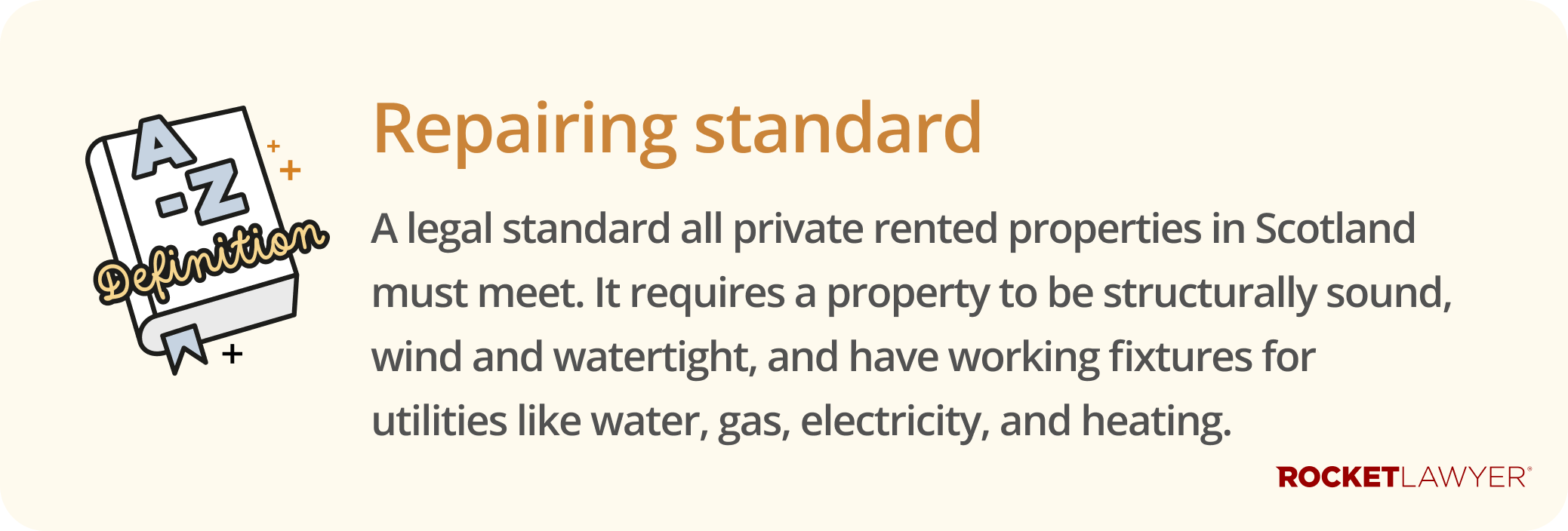
The repairing standard is set out in the Housing (Scotland) Act 2006 as amended by the Housing (Scotland) Act 2014, and requires, amongst other things, that:
-
the property is wind and watertight
-
the property is reasonably fit for human habitation
-
the property and its installations (for water, gas, electricity, and heating) are in a reasonable state of repair
-
any fittings, fixtures, or appliances supplied by the landlord (eg carpets, light fittings, and white goods) to be in good working order, and
-
any furniture provided by the landlord (eg beds and sofas) be capable of being used safely for the purpose for which it was designed. All furniture must comply with applicable fire safety regulations
In practice, this means you are responsible for repairing anything you provide as part of the tenancy, including boilers, cookers, and furniture. However, if a tenant damages an item or part of the property beyond normal wear and tear, they are usually responsible for the cost of the repair. Having a detailed Inventory at the start of the tenancy is vital for tracking the property's condition.
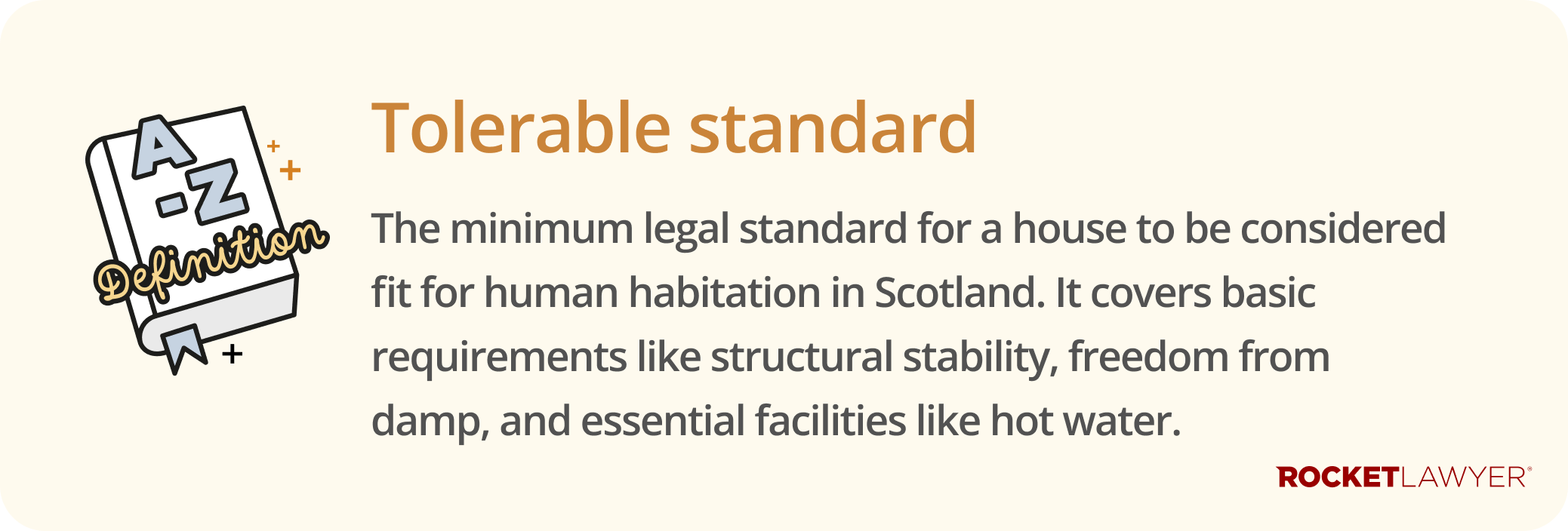
A key part of the repairing standard is that the property must first meet the tolerable standard. Under the Housing (Scotland) Act 1987, the tolerable standard sets a minimum benchmark for habitability. It requires rented properties to:
-
be structurally stable (eg not be subsiding)
-
be free from rising or penetrating damp
-
have sufficient ventilation, natural, and artificial light or heating
-
have an acceptable supply of fresh water
-
have an indoor toilet and access to hot water
-
have suitable smoke, fire, and carbon monoxide alarms
When you need access to make repairs, you must give the tenant at least 48 hours’ notice (unless urgent access is needed) and generally get the tenant’s permission before entering the property.
For more information, see the Scottish government’s guidance on the repairing and tolerable standards.
Fire safety
You must ensure your property has, at a minimum:
-
one smoke alarm in the living room or the room the tenant uses most during the day
-
one smoke alarm in every hallway or landing
-
one heat alarm in the kitchen
All alarms in the property must be installed on the ceiling, powered by mains or lithium batteries, and be interlinked. This means that if one alarm goes off, all alarms go off.
If the property has a fuel-burning appliance (eg boiler, wood burner, or fireplace), a carbon monoxide detector must be installed in the room containing the appliance. Carbon monoxide detectors do not need to be interlinked.
Note that specific fire safety rules apply to HMOs.
For more information, see the Scottish government’s guidance on fire safety.
Gas safety
If the property has gas appliances, the Gas Safety (Installation and Use) Regulations 1998 and Gas Safety (Installation and Use) (Amendment) Regulations 2018 apply. You have to:
-
maintain all gas fittings, appliances, pipework, and flues in a safe condition
-
ensure that all installation, maintenance, and safety checks are carried out by a Gas Safe registered engineer
-
ensure that an annual safety check is carried out on each gas appliance/flue by a Gas Safe registered engineer
-
keep records of all gas safety checks for at least two years
You must give new tenants a copy of any existing gas safety records when they move in. If gas safety checks are carried out during the tenancy, you must give each tenant a copy of the record within 28 days.
For more information, see the Scottish government's guidance on installations for the supply of gas.
Electrical safety
Landlords in Scotland must ensure that their property is electrically safe. This applies to the installation of electricity supply in the property, all electrical fixtures and fittings, and any electrical appliances provided by the landlords under the tenancy (eg microwaves).
A qualified electrician must carry out electrical safety inspections at least once every five years (or every three years in HMOs) to ensure the electrical installation and all electrical items in the property are safe. An electrical safety inspection consists of:
-
an Electrical Installation Condition Report (EICR) - to assess the safety of electrical installations, and
-
a Portable Appliance Test (PAT) - to assess the safety of portable appliances (ie movable electrical equipment, like refrigerators, toasters, and washing machines)
You must give new tenants a copy of any existing electrical safety records when they move in. If electrical safety checks are carried out during the tenancy, you must give each tenant a copy of the record within 28 days.
For more information, see the Scottish government's guidance on installations for the supply of electricity.
Legionella risk assessment
Under the Control of Substances Hazardous to Health Regulations 1989, you must carry out a Legionella risk assessment. This helps determine the level of risk, if any, of water in the rental property becoming contaminated with Legionella.
Anyone who is competent to do so (eg the landlord) can carry out the Legionella risk assessment, which involves assessing the risks from hot and cold water systems.
For more information, including on how to carry out a Legionella risk assessment, see the Health and Safety Executive’s (HSE’s) guidance on Legionella.
What information must I give my tenant?
Before/at the start of the tenancy
You must provide your name and address to your tenant (eg by setting this out in your Tenancy agreement). You must also provide your tenant with copies of the following documents, whether digitally or in hard copy:
-
a written copy of the correct Tenancy agreement and the supporting notes (or the easy-read notes if you’re using a model tenancy provided by the Scottish Government)
-
prescribed information on the tenancy deposit scheme their deposit was paid into, and the repayment conditions
-
an up-to-date Energy Performance Certificate (EPC)
-
an EICR and a PAT report (for any electrical items you supply)
-
a gas safety certificate (if there are any gas appliances), and
-
evidence you’ve taken reasonable steps to assess the risk of Legionella
While not legally required, it is prudent to record the state of the property and all fixtures and fittings within it in an Inventory at the start of the tenancy. This can help avoid later disputes.
During the tenancy
You must give your tenant at least three months’ written notice before you increase the rent. Bear in mind that your tenant is allowed to challenge the increase if they think it’s too high. For more information, read Private renting rent increases in Scotland.
Ending the tenancy
If you want to end the tenancy, you must give your tenant a notice to leave based on at least one ground for eviction. You must also give the correct amount of notice based on the ground for eviction. For more information, read Tenants’ rights in Scotland.
Do not hesitate to Ask a lawyer if you have any questions about your obligations as a landlord in Scotland.