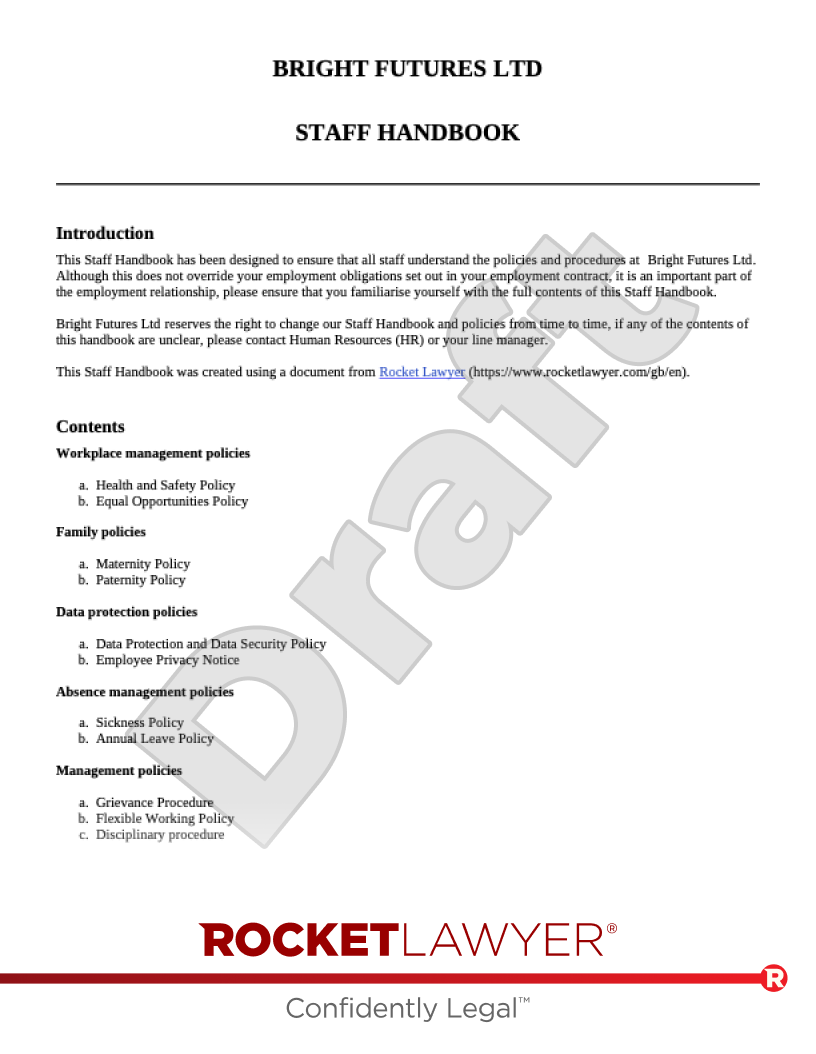
What types of family leave are employees entitled to?
Eligible employees have a variety of family-friendly rights, including:
-
maternity or adoption leave of up to one year. The first 39 weeks of leave are paid at a statutory rate. For the first six weeks, the rate is 90% of the normal salary. For the remaining 33 weeks, the rate is £194.32 (as of 6 April 2026) or 90% of average weekly earnings (whichever is lower). For more information, read Maternity leave and Adoption leave and pay
-
two weeks of paid paternity leave (at either 90% of their average weekly earnings or £194.32, whichever is lower). From 6 April 2026, paternity leave becomes a day one right, meaning employees can give notice of paternity leave from the first day of employment. Employees can now also take paternity leave after taking shared parental leave. Read Shared parental leave for more information
-
unpaid parental leave for up to 18 weeks before a child’s eighteenth birthday. From 6 April 2026, ordinary parental leave becomes a day one right, meaning employees no longer need one year of service to qualify. Normally, only four weeks of parental leave can be taken in any year
-
paid neonatal care leave of up to 12 weeks within the first 68 weeks of a child’s birth or adoption placement (at either 90% of their average weekly earnings or £194.32, whichever is lower). Read Neonatal care leave and pay for more information
-
parental bereavement leave of up to two weeks within one year following the death (or stillbirth) of a child. Parental bereavement leave can be paid or unpaid. For more information, read Parental bereavement leave
-
bereaved partner’s paternity leave of up to 52 weeks of unpaid leave where the mother or primary adopter dies. For more information, read Bereavement leave and time off for dependants
-
reasonable unpaid time off to deal with domestic emergencies. Read Bereavement leave and time off for dependants for more information
-
unpaid carer’s leave of up to one week per year to provide or arrange for the long-term care of a dependant. For more information, read Carer’s leave
What about flexible working?
Employees have the right to request flexible working (including to work part-time or from home) to take care of a dependent from the first day of employment. Employers must consider such requests properly and may only refuse them where there is a clear and lawful business reason.
Employees can make two requests in any 12-month period, and employers must consult with the employee before refusing a request.
Because flexible working requests likely contain sensitive personal data (ie data that comes within the 'special categories' of personal data), employers must ensure that it is processed in accordance with their Data protection policy and Employee privacy notice. To avoid discrimination claims, such requests should only be refused where the decision can be objectively justified on clear business grounds. You should consider having in place a written Flexible working policy.
For more information, read Flexible working.
What are the key risks when managing family rights in the workplace?
Family-friendly rights are complex and can give rise to tricky discrimination issues. Successfully managing these rights requires employers to balance their legal obligations with their operational needs.
Difficult areas for employers, which may cause disputes, include:
-
the effect of leave on holiday - employees continue to accrue all holiday throughout their leave. Managing a backlog of several weeks of leave upon an employee's return requires careful planning to avoid understaffing or breach of contract
-
the effect of leave on bonuses - while you can usually pro-rata a bonus to exclude time spent on unpaid leave, any performance bonus must typically account for the period the employee was at work and the period of compulsory maternity leave
-
pension rights during leave - employers must generally continue to make pension contributions based on the employee’s normal pay during any period of paid family leave, even if the actual pay received is lower (eg statutory maternity pay)
-
changing arrangements after leave
-
redundancy and protection from dismissal - employees on certain types of family leave have a protected period where they must be offered any suitable alternative vacancy as a priority. For more information, read Redundancy and pregnancy or maternity leave
Note that, under the Employment Rights Act 2025, the protected period for pregnant employees, employees on maternity leave, and mothers returning to work will be extended. Except in specific circumstances, it will be unlawful to dismiss a returner for a minimum of six months after they return to work. This is expected to come into force in 2027.
For more help with any of these issues, Ask a lawyer.