What is industrial action?
An industrial action is when a group of workers collectively engage in an action that hinders their employer’s business, to exert leverage over the employer during negotiations (eg regarding pay or other working conditions).
Common types of industrial action include:
-
striking
-
picketing (ie workers striking and standing outside the workplace, telling people why they are striking)
-
an overtime ban, where workers refuse to work more than their basic hours
-
a 'go-slow', where work is done but at a much slower pace than usual
-
work-to-rule, where workers follow their employment contract so strictly that it slows down the business
What is a strike?
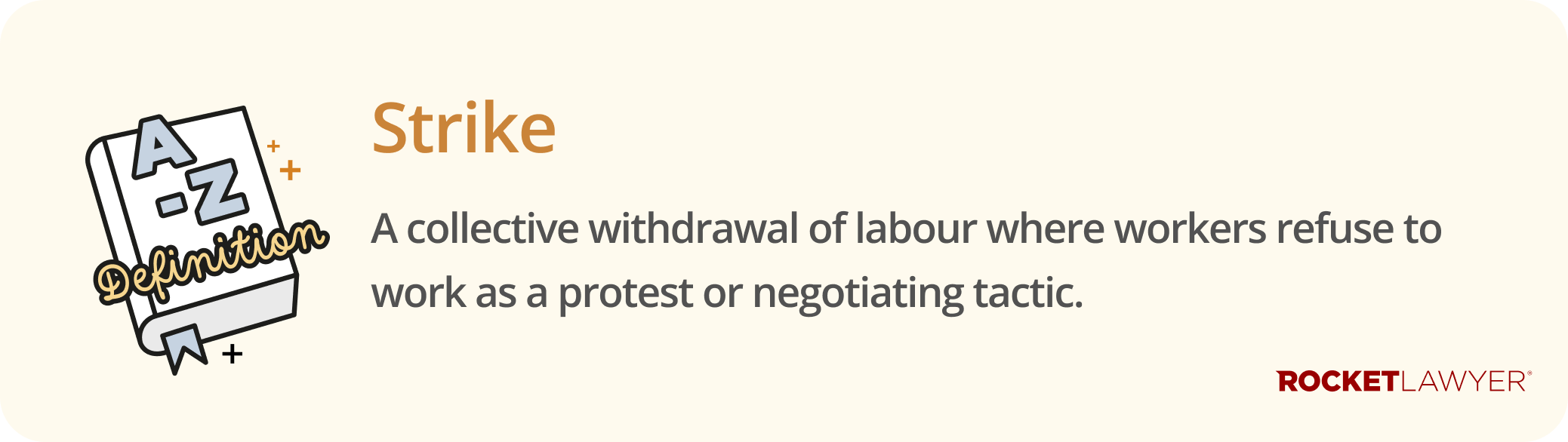
Strikes are the most common type of industrial action. A strike is when a group of employees collectively refuses to work.
It's usually a last resort used when negotiations between a trade union and an employer have broken down. Because a strike involves a total withdrawal of labour, you usually won't get paid for the time you're on strike, and your employer may deduct this from your wages.
Employees typically strike when collective negotiations over pay or conditions reach an impasse. For example, if workers in industries such as healthcare or transport feel their wages have fallen in real terms, they may request a pay raise through their union. If the employer denies this request, a strike serves as a high-pressure negotiating tactic to demonstrate the workforce's commitment to securing better terms.
Is striking allowed?
You have the right to take part in industrial action (including striking), so long as it is properly organised. Organisers and employees participating in a strike receive a degree of protection under the law if their industrial action meets certain criteria (ie is ‘protected’). To be protected, industrial action must generally:
-
be organised by a trade union
-
be related to a trade dispute (ie a dispute between workers and their employer about employment terms, such as pay or physical working conditions)
-
not be one of the types of action specifically excluded from protection (eg a secondary action, where workers strike in sympathy with employees of a different employer), and
-
comply with the specific balloting and notice requirements
Is dismissal for striking automatically unfair?
Under the Employment Rights Act 2025, being dismissed for taking part in protected industrial action is automatically unfair. Previously, this protection only lasted for the first 12 weeks of a strike, but that limit was scrapped for any action starting on or after 18 February 2026. This means you're protected for the entire duration of the strike.
Because this is an automatically unfair reason for dismissal, you don't need to have worked for your employer for any specific length of time to bring a claim. It's a day-one right. If an employer fires you because you took part in a legal strike, they have broken the law, and you can take them to an employment tribunal.
What happens if industrial action is not protected?
Individuals organising or participating in industrial action that is not protected (ie unofficial or 'wildcat' strikes, or secondary action) may be subject to financial penalties. These individuals may also (or alternatively) be subject to disciplinary proceedings brought by the employer for a breach of their Employment contract (eg for failing to work without a valid reason). Because unofficial action is not protected, taking part in it can be a fair reason for dismissal. However, any such proceedings must still be carried out in accordance with a fair disciplinary process (eg following the employer’s Disciplinary procedure), as the employee’s regular employment rights will still apply.
Who can strike?
Generally, employees who are members of the relevant trade union (ie the ‘bargaining unit’ on whose behalf the union can act or make decisions) can strike. It does not matter if they did not vote in the ballot. Certain non-union members may also be able to participate.
Certain individuals cannot strike - for example, members of the armed services and members of the police force. Additionally, breaching an employment contract in a way likely to endanger human life or valuable property may constitute a criminal offence, meaning striking will not be suitable in such circumstances.
What are the balloting and notice requirements for strikes?
A trade union will hold a ballot (ie a vote) so that the union’s members can vote on whether or not to strike (or to take other industrial action). Ballots must follow specific rules to be valid. The union must:
-
hold the ballot before the industrial action starts
-
give the employer at least one week’s notice of the start of the ballot
-
invite all trade union members who are eligible to vote
-
use a postal, electronic or in-person ballot (the latter two since 25 August 2026)
-
share final tallies of the votes with everyone eligible to vote
-
inform the employer as soon as possible of the result
-
have an independent ballot supervisor (if over 50 union members are being balloted)
For a ballot to be successful, at least 50% of all eligible members must cast a vote. This is known as the turnout threshold. Once this turnout is met, the union only needs a simple majority of those who actually voted to say 'yes' in support of the strike. The extra requirement for important public services to secure 40% support from all members was scrapped by the Employment Rights Act 2025 on 18 February 2026.
Industrial action must be taken within 12 months of a successful ballot to be covered by that ballot.
Once a strike is planned, the union must generally give the employer at least 10 days’ notice before the start of the strike.
For more information on the changes to trade unions and voting, read What the Employment Rights Act means for you.
Legal considerations during strikes
Both employers and staff must navigate specific rules regarding pay and workplace operations during industrial action. While the Employment Rights Act 2025 expands worker protections, the financial and practical impact on a business remains governed by the following rules.
Do employees need to be paid while they’re striking?
Staff members who are on strike usually do not need to be paid by their employers during this time. A trade union will sometimes replace a staff member’s pay while they’re striking, but this isn’t compulsory, and the amount provided may be less than the staff member’s usual pay.
However, payments related to various types of leave must still be paid by an employer if an entitlement arises during a strike. For example:
-
sick pay must still be paid as usual if an eligible staff member is sick during a strike
-
a staff member taking annual leave during a strike should still receive their regular holiday pay
-
pay during family leave (eg adoption leave or maternity leave) should be paid as usual during a strike
What happened to minimum service levels?
The Strikes (Minimum Service Levels) Act 2023 was repealed on 18 December 2025. Employers in sectors like health, transport, and fire and rescue services can no longer use work notices to legally require employees to work during a strike.
Can agency workers cover striking workers?
Temporary agency workers cannot be provided to an employer to cover the role of an employee who is taking part in a protected strike.
If a temporary agency worker is already in place during a strike as a regular part of business operations (eg to cover an employee on family leave), they may continue working for the employer during the strike.
What if staff members can’t get to work due to strikes?
Strikes affect an employer’s customers as well as the employer itself. In the case of transport strikes (eg train or tube strikes), these customers are often other employers’ staff members, who the strikes may prevent from getting to work.
An employer is not generally obliged to pay a staff member who cannot attend work, whether this is because a strike prevented them from travelling. However, payment is legally required if:
-
the staff member’s contract guarantees that they’re paid in the relevant situation (eg when they cannot travel to work due to strikes)
-
they staff member is off sick (usual sick pay rules apply)
-
the employer closes the workplace during a strike, even though the staff member was willing to travel to work
To maintain morale, employers can consider alternatives, such as:
-
allowing working from home (even just on a temporary basis)
-
allowing alternative or shorter hours to be worked
-
suggesting holiday is taken
-
changing shift patterns so that staff members who are able to make it to work during a strike are scheduled to work during the strike
-
rearranging events that require in-person attendance (eg client meetings or trainings)
What is a trade union?
A trade union is an organisation of workers who join together to improve their pay and working conditions. While you must usually join and pay a membership fee to access full individual support, the work a union does often benefits everyone in a workplace. The union’s main purpose is to represent and negotiate on behalf of its members and further their interests. To do this, it can:
-
negotiate collectively about employment terms like pay and working conditions (eg by organising strikes)
-
represent members in discussions about large events (eg significant redundancies or business transfers)
-
accompany members to meetings with their employer (eg disciplinary or grievance meetings and appeals)
Because a recognised union represents a specific 'bargaining unit' (a defined group of staff), its influence extends to the wider workforce. For example, if a union negotiates a pay rise through 'collective bargaining', that increase usually applies to every worker in that group, regardless of whether they are a union member.
Unions can also negotiate collective agreements with employers on behalf of their members to establish workplace-wide rules. However, the terms of a collective agreement aren't automatically part of your employment contract unless they're specifically written into it or your employment contract is changed later (eg using an Employment terms amendment).
What rights do union members have?
You have a legal right to decide for yourself whether to join a union, and your employer cannot punish you for your choice. It is against the law for an employer to:
-
refuse to employ someone because they belong to a trade union
-
offer incentives to induce someone to leave a union or to stop them taking part in union activities
-
dismiss someone or select them for redundancy because of their trade union membership, or taking part in union activities
-
treat someone unfavourably (ie subject them to detriment) due to their trade union membership or participation in union meetings
Beyond these protections, being a trade union member gives you specific positive rights in the workplace. For example, you have the right to be accompanied by a trade union representative to certain employment meetings (eg redundancy consultations). You also have the right to participate in protected industrial actions, such as strikes, without facing legal or financial penalties from your employer.
Upcoming changes to trade unions under the Employment Rights Act 2025
The Employment Rights Act 2025 is being rolled out in phases. While many protections are already in force, further changes to trade union rights will be introduced throughout Q4 2026 and 2027. Key upcoming changes include:
-
removing the 50% threshold for industrial action ballots is expected, but no in-force date confirmed yet
-
giving union officials the right to enter workplaces to meet and recruit workers
-
requiring employers to tell staff about their right to join a union
-
increasing rights for union representatives
-
increased protection against detriment for taking part in industrial action
-
extending laws that protect members from being blacklisted or treated unfairly
-
a new industrial relations system to help employers and unions work together more effectively
-
allowing workers to use electronic voting for union recognition and derecognition ballots
For more details on the timeline, read What the Employment Rights Bill means for you.
Legally holding or participating in a strike, or managing a business whose employees are striking, can be complex. Before initiating any industrial action or taking any action against an employee who is taking part in industrial action, consider Asking a lawyer for advice or contacting the Acas helpline. If you feel you've been treated unfairly for union activity, you can make a Grievance letter.