MAKE YOUR FREE Eviction Notice
What we'll cover
What is an Eviction Notice?
As a landlord, there may be times when you need to give your residential tenants (known as ‘contract holders’ in Wales) notice to vacate your property using an Eviction Notice. Eviction Notices inform tenants that their tenancy is going to end and the landlord is going to take possession of the property.
For the avoidance of doubt, references to ‘tenants’ also apply to ‘contract holders’ unless otherwise specified.
For use in England and Wales only.
These Eviction Notices for England comply with the Renters’ Rights Act 2025.
When should I use an Eviction Notice?
Use this Eviction Notice to formally bring a residential tenancy in England or Wales to an end. This includes, but is not limited to, if:
-
a tenant has breached their Tenancy agreement (eg by causing damage)
-
a tenant is in serious rent arrears
-
you need to sell the property (in England only)
-
you need to evict student tenants who live in an HMO (in England only)
-
other section 8 grounds for eviction (in England only)
-
the tenancy is coming to the end of its term (in Wales only)
-
a tenant is in serious rent arrears
Sample Eviction Notice
The terms in your document will update based on the information you provide
 These documents have been customised over 330.1K times
 Documents and communicates
 Complies with relevant laws
 Ask a lawyer questions about your document
 Sign this document online for free with RocketSign®
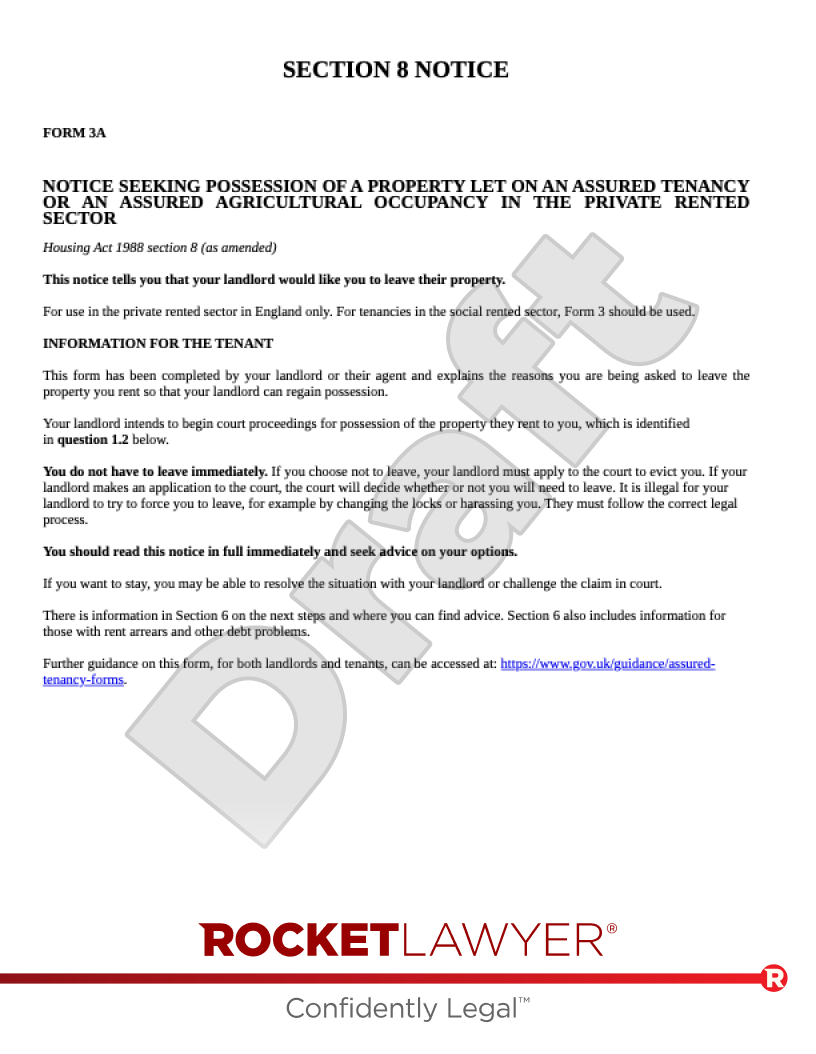
SECTION 8 NOTICE
FORM 3A
NOTICE SEEKING POSSESSION OF A PROPERTY LET ON AN ASSURED TENANCY OR AN ASSURED AGRICULTURAL OCCUPANCY IN THE PRIVATE RENTED SECTOR
Housing Act 1988 section 8 (as amended)
This notice tells you that your landlord would like you to leave their property.
For use in the private rented sector in England only. For tenancies in the social rented sector, Form 3 should be used.
INFORMATION FOR THE TENANT
This form has been completed by your landlord or their agent and explains the reasons you are being asked to leave the property you rent so that your landlord can regain possession.
Your landlord intends to begin court proceedings for possession of the property they rent to you, which is identified in question 1.2 below.
You do not have to leave immediately. If you choose not to leave, your landlord must apply to the court to evict you. If your landlord makes an application to the court, the court will decide whether or not you will need to leave. It is illegal for your landlord to try to force you to leave, for example by changing the locks or harassing you. They must follow the correct legal process.
You should read this notice in full immediately and seek advice on your options.
If you want to stay, you may be able to resolve the situation with your landlord or challenge the claim in court.
There is information in Section 6 on the next steps and where you can find advice. Section 6 also includes information for those with rent arrears and other debt problems.
Further guidance on this form, for both landlords and tenants, can be accessed at: https://www.gov.uk/guidance/assured-tenancy-forms.
The tenant(s) details
1.1 Full name(s) of tenant(s)
1.2 Your landlord is seeking possession of the following property:
, ,
Earliest date your landlord can apply to court to regain possession
2.1 Your landlord cannot begin court proceedings for possession earlier than:
Latest date your landlord can apply to court to regain possession
The latest date that your landlord can apply to court for a possession order is 12 months from the date of service of this notice. After this the notice will no longer be valid.
This time limit may be extended if you enter a breathing space under the Debt Respite Scheme (Breathing Space Moratorium and Mental Health Crisis Moratorium) (England and Wales) Regulations 2020.
Landlord’s reasons for asking you to leave
Your landlord must explain why they are seeking possession of the property. This means they must give you reasons why they want you to leave the property and give you at least the minimum amount of notice to do so.
They can only use certain reasons called ‘possession grounds’. The possession grounds are in Schedule 2 to the Housing Act 1988 (as amended) and can be found in full in Form 3A: Legal wording for possession grounds which can be accessed at: https://www.gov.uk/guidance/assured-tenancy-forms
Question 4.1 is optional. It lists some common possession grounds which have been summarised to aid your understanding. It does not include every possible ground. Your landlord may tick the relevant box(es) here if they apply.
Questions 4.2 and 4.3 are mandatory. Your landlord will set out the grounds that they are relying on in question 4.2 and an explanation for using those grounds in question 4.3.
4.1 Common reasons for seeking possession include:
☐ You have rent arrears of more than 13 weeks or 3 months (depending on whether your tenancy is weekly, fortnightly or monthly) (Ground 8)
☐ You have some unpaid rent or are persistently late paying rent (Grounds 10 or 11)
☐ Your landlord wants to use or sell the property (Grounds 1 or 1A)
☐ Your landlord wants to rent their property to new students or workers (Grounds 4A, 5A or 5C)
☐ Your landlord plans to re-develop their property (Ground 6)
☐ Antisocial behaviour or breach of other legal requirements (Grounds 7A or 14)
☐ You have breached the terms of your tenancy agreement (Ground 12)
☐ You have allowed the condition of the property or furniture to deteriorate (Grounds 13 or 15)
☐ You do not have the right to live in the UK (Ground 7B)
☐ Other (ground(s) not listed above)
4.2 Possession ground(s) as set out in schedule 2 to the Housing Act 1988
Below are the grounds your landlord is using to try to regain possession of the property. Read this carefully and seek advice if you do not understand.
4.3 Landlord’s explanation of why each possession ground is being used
This is your landlord's explanation of how and why they believe they are legally able to use the grounds for possession in questions 4.1 and 4.2.
Contact details of the landlord, licensor, or agent
5.1 Signed
5.4 Name of landlord, licensor, or agent
5.5 Address of the landlord, licensor, or agent
First line of address:
Town or city:
Postcode:
5.6 Phone number
5.7 Email
Information for tenants
Whether you want to leave or stay, you should seek advice immediately.
If you want to stay, you may be able to resolve the situation directly with your landlord.
Before your landlord can apply to the court for a possession order they must give you at least the minimum amount of notice. The amount of time depends on the reason they want to regain possession. For the minimum amount of notice required for the ground(s) that your landlord is using see Form 3A: Receiving the notice seeking possession – guidance for tenants accessed at: https://www.gov.uk/guidance/assured-tenancy-forms.
If your landlord goes to court, you will have the opportunity to dispute the possession claim.
There is more information on the process for possession (known as the possession action process) at: https://www.gov.uk/guidance/renting-outyour-property-guidance-for-landlords-and-letting-agents/repossessingyour-privately-rented-property-on-or-after-1-may-2026.
When seeking to regain possession, landlords must also adhere to duties set out in Section 16E of the Housing Act 1988. Further information can be found in Form 3A: Receiving the notice seeking possession – guidance for tenants, accessed at: https://www.gov.uk/guidance/assured-tenancy-forms.
Where to seek advice
There are places you can find advice about this notice:
- www.shelter.org.uk or Shelter’s emergency helpline on 0808 800 4444
- Get free legal advice through the Housing Loss Prevention Advice Service at https://www.gov.uk/guidance/legal-aid-for-possession-proceedings
- A citizens advice adviser by calling 03444 111 444 or online. You can find out more at: https://www.citizensadvice.org.uk/about-us/ contact-us/
- A housing advice centre or law centre.
- You can get legal advice from a legal representative. Find a solicitor at https://solicitors.lawsociety.org.uk/
- Civil Legal Advice (CLA) may be able to direct you to legal advice on housing. You can contact them at www.gov.uk/civil-legal-advice, by calling 0345 345 4345 (Monday to Friday, 9am–8pm and Saturday 9am–12:30pm), or by texting ‘legalaid’ and your name to 80010 to ask CLA to call you back. It costs the same as a normal text message.
If you’re worried about becoming homeless contact your local authority for support. You can find your local authority at: www.gov.uk/find-local-council
Advice on owing rent (rent arrears) or any other problem debt
If you need advice on owing rent (rent arrears) or any other problem debt, you can contact:
- A citizens advice adviser by calling 03444 111 444 or online. You can find out more at: https://www.citizensadvice.org.uk/about-us/ contact-us/
- Housing Loss Prevention Advice Service at https://www.gov.uk/ guidance/legal-aid-for-possession-proceedings
- Your local authority for details of where you may find assistance. You can find your local authority at: www.gov.uk/find-local-council
- Money Helper (formerly the Money Advice Service) for guidance on finding a free debt adviser on its website: https://www.moneyhelper.org.uk/en or over the phone by calling 0800 138 777.
If you are experiencing problem debt, a debt adviser may consider a Breathing Space to be an appropriate option for you while you work with them to identify a solution to your debts. The Breathing Space Scheme provides a temporary pause on creditor enforcement action to give you time to speak to a debt adviser about how to address your debts.
If you are in a Breathing Space moratorium under the Debt Respite Scheme, your landlord must speak to your debt adviser instead of contacting you directly about you owing rent.
A standard breathing space lasts up to 60 days. During this time, your landlord cannot give you notice to start the possession process on grounds related to owing rent (rent arrears). Once your Breathing Space comes to an end, your landlord will be notified and can continue or begin any enforcement action on the rent owed.
If the notice is not about owing rent and if you are in a Breathing Space, show your debt adviser this notice to notify them of the change in your circumstances.
Breathing space is not a payment holiday and you should still pay ongoing liabilities, including ongoing rent payments, as they fall due.
Contains public sector information licensed under the Open Government Licence v3.0. Crown copyright. Published by Rocket Lawyer, 2026
About Eviction Notices
Learn more about making your Eviction Notice
-
How to make an Eviction Notice
Making an Eviction Notice online is simple. Just answer a few questions and Rocket Lawyer will build your document for you. When you have all of the details prepared in advance, making your document is a quick and easy process.
What information you need to make your Eviction Notice will depend on the document in question. However, the types of questions you may be asked include:
Party details
-
The landlord’s details (eg your name and address).
-
The tenant’s details (eg their name).
Property details
-
What is the address of the property?
Notice
-
Why is the tenant being evicted?
-
What is the date on which the Eviction Notice is set to expire?
-
-
Common terms in an Eviction Notice
Eviction Notices are used by landlords to regain possession of a property in England or Wales. While the terms of an Eviction Notice differ depending on the document in question, examples of common provisions include:
Information for tenants
An Eviction Notice will usually provide details of the Notice’s legal basis (ie under which act the Notice is being served). It also provides information about the eviction process and the Eviction Notice itself to the tenant.
Notice details
The body of the Eviction Notice will set out details relating to the Notice itself, including:
-
the tenant’s details
-
the address of the property the tenant is renting
-
the expiry date of the Notice
-
-
Legal tips for making an Eviction Notice
Make sure you use the right document for your needs
Various Eviction Notices exist, and you should make sure to create one that is suitable for your needs and circumstances. Not only should you base this on the country the rental property is in (ie England or Wales), but you should also reflect why you are asking the tenant to leave. Using the incorrect document may cause problems down the line. For more information, read the FAQ ‘What type of Eviction Notice should I use?’ and our guides on Evicting a tenant and Repossessing property in Wales.
Understand when to seek advice from a lawyer
Ask a lawyer if:
-
you’re unsure about what Eviction Notice you should use
-
your document doesn’t meet your specific needs
-
you need an Eviction Notice for Scotland
-
Eviction Notice FAQs
-
What is included in an Eviction Notice?
This Eviction Notice template covers:
-
the landlord’s details
-
the tenant’s (or contract holder’s) details
-
the ground for eviction
-
the eviction notice period
-
relevant information onevictions
-
-
Why do I need an Eviction Notice?
If you need to regain possession of your property, either because of something the tenant did (eg failing to pay the rent) or despite their not having done anything wrong, you must use an Eviction Notice. You need to make sure that you use the correct Eviction Notice to legally evict tenants.
By using the appropriate Eviction Notice, you ensure that you are evicting the tenant correctly and ensure that you can re-let the property easily and without any delays.
-
What type of Eviction Notice should I use?
There are various ways of repossessing property – including a section 8 notice in England and section 173 and section 188/182 notices in Wales. Using the correct Eviction Notice template will help to ensure that you take possession of the property safely and legally.
England - section 8 notices
You can use a Section 8 notice to evict tenants on an assured periodic tenancy (the main type of private residential tenancy since 1 May 2026). Section 8 notices can be served if there are specific reasons for the eviction. These are also known as 'grounds' for possession. These include situations where tenants have not paid their rent or have caused damage to the property. You can rely on multiple grounds of possession.
For more information, read Evicting a tenant and Grounds for eviction and possession.
Wales - section 173 notices
You should use a Section 173 notice to end a periodic standard contract. You can generally only use a section 173 notice to end a contract after the first six months, and when you have not broken your responsibilities as a landlord.
Wales - section 188 or 182 notices
You can use a Section 188 notice to end a fixed-term standard contract for serious rent arrears. Similarly, you can use a Section 182 notice to end a periodic standard contract for serious rent arrears. Whether a rent arrears is serious depends on how regularly the rent is paid. For example, for monthly contracts, at least two months’ rent must be unpaid. Read Repossessing property in Wales to find out more.
Scotland
In Scotland, tenants can only be evicted if at least one of 18 eviction grounds applies. These Eviction Notices should not be used in Scotland. If you require an Eviction Notice for Scotland, Ask a lawyer.
-
How much notice should I give the tenant?
This will depend on where the property is located and the type of Eviction Notice you are using to end the tenancy.
England
Under a section 8 notice, the required notice period depends on the ground you base it on. For example, four weeks’ notice is required for Grounds 8, 10, and 11.
For more information, read Evicting a tenant and Grounds for eviction and possession.
Wales
If you use a section 173 notice, you must typically give contract holders at least six months’ notice.
If you use a section 188 or 182 notice, you have to give contract holders at least 14 days’ notice of your intention to start a repossession claim. If the contract holder has not moved out after the notice period (and rent continues to be owed), you can apply to the courts for a possession order.
For more information, read Repossessing property in Wales.
For more information on repossessions in general, see our Tenant eviction FAQs for England and Wales.

Our quality guarantee
We guarantee our service is safe and secure, and that properly signed Rocket Lawyer documents are legally enforceable under UK laws.
Need help? No problem!
Ask a question for free or get affordable legal advice from our lawyer.