
What will I receive on incorporation?
Once your company is officially registered, you’ll have several essential documents that form its legal foundation. It's vital to keep secure digital and physical copies of these records.
These documents are:
-
a certificate of incorporation
-
your memorandum of association
-
your articles of association (or ‘articles’)
-
share certificates (if the company is limited by shares)
Each of these plays a key role in your new business.
What is a certificate of incorporation?
Your certificate of incorporation is the most important document you'll receive from Companies House. Think of it as your company's official birth certificate. It provides conclusive proof that your company legally exists and has been incorporated under the Companies Act 2006. It is essential for tasks like opening a company bank account.
It also confirms:
-
your full, registered company name
-
your unique company registration number (CRN)
-
the date of incorporation
-
the type of company (eg limited)
-
where it was registered (eg England and Wales or Scotland)
-
the issuing Registrar (eg Cardiff for companies registered in England and Wales, Edinburgh for companies registered in Scotland)
The certificate will bear the official seal of the Registrar of Companies at Companies House.
Your certificate of incorporation doesn't have an expiry date; it remains valid for as long as your company is active and compliant.
What is the memorandum of association?
The memorandum of association (or ‘MOA’) is a simple statement made by the initial shareholders (also known as ‘subscribers’ or ‘members’) confirming that they intend to form a company and their agreement to take at least one share in it. This is a standard, one-page document that cannot be amended once the company is formed.
What are a company’s articles?
The Articles of association are your company’s internal rulebook. They set out how the company will be run, who manages it, and how decisions are made.
Companies House doesn't ‘send’ you the articles. Instead, the articles of association you chose during the application process (either the standard 'model articles' or custom ones) are officially registered and placed on the public record, becoming legally effective the moment your company is incorporated.
Note that your company’s articles can be amended after incorporation (but you will need to update Companies House).
For more information, read Company incorporation and articles of incorporation.
Do I need to issue share certificates?
Yes, if your company has shares. Share certificates are legal documents that prove ownership of shares in your company. It is the company's responsibility to create and issue these Share certificates to each shareholder, not Companies House's. This should be done as soon as possible. For more information, read Share transfers and issuing new shares.

What are the first steps for a newly registered company?
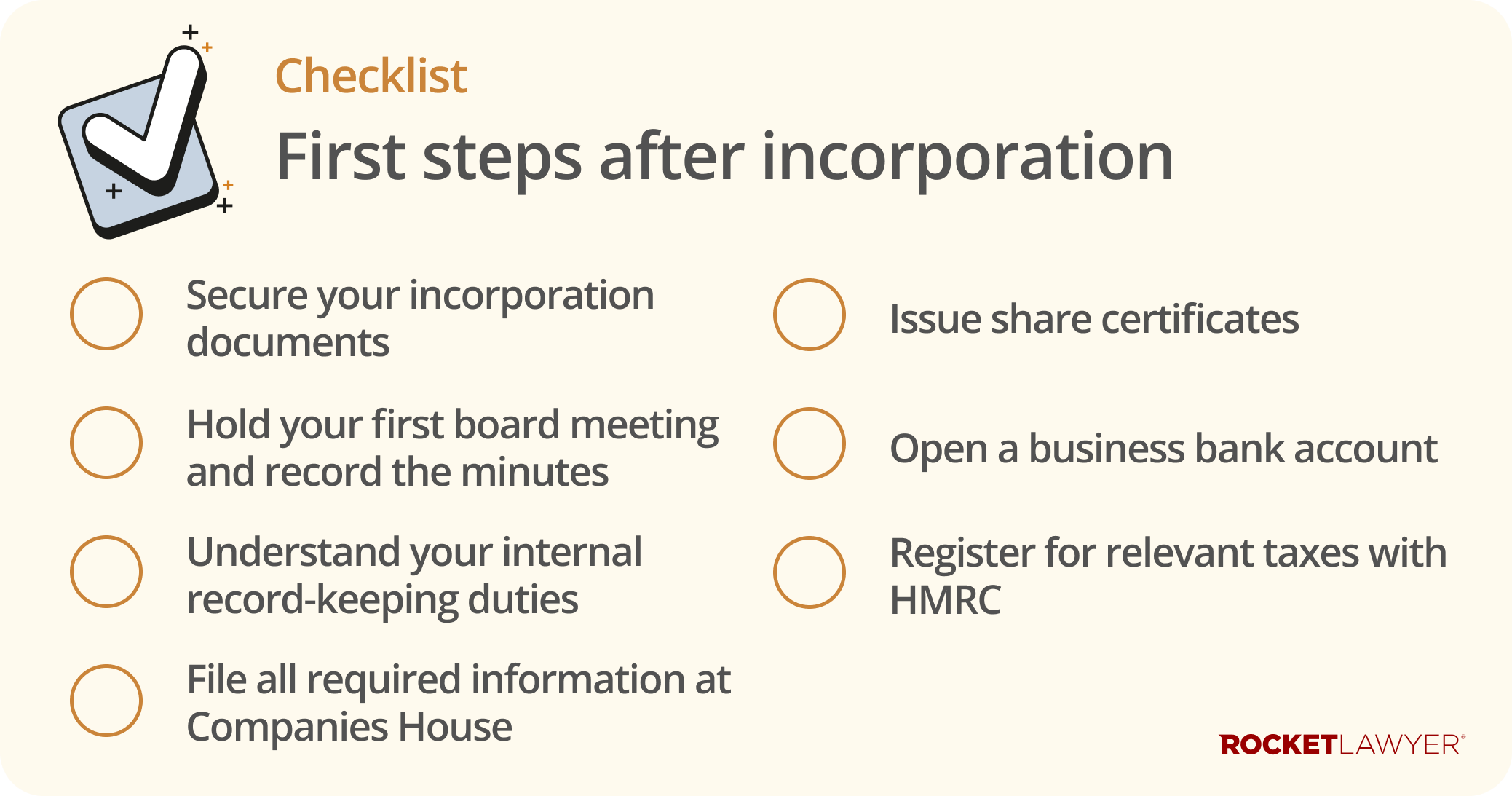
With your documents in order, you need to take several immediate actions to get your business up and running smoothly.
Hold your first board meeting
You should hold your first board meeting as soon as possible. This is where directors make key initial decisions, such as appointing a chairperson, formally issuing the share certificates, and approving the opening of a company bank account. It’s vital to keep a written record of these decisions by creating Board minutes. For more information, read Board meetings and board minutes.
Open a business bank account
Your limited company is a separate legal entity from you, so it must have its own bank account. You cannot use a personal account for company finances. You'll need to provide the bank with your certificate of incorporation and CRN to open the account.
Understand your record-keeping duties
Companies House maintains the central, official public register for your directors and people with significant control (PSCs). You do not need to keep internal registers for these specific roles.
However, you must maintain your own internal register of members (ie register of shareholders). The list of shareholders at Companies House is not the legal register; your internal register is the definitive proof of who owns the company.
You also need to keep other internal records, including minutes of all board meetings and copies of important shareholder resolutions. For a full breakdown of what you need to keep, read Company books and records.
Update Companies House registers
Companies House maintains the official public register for all companies. You must file the full names and details of all your shareholders and of anyone who has significant control over your company to Companies House.
A person with significant control (PSC) is anyone who holds more than 25% of the shares or voting rights, has the right to appoint or remove a majority of the board, or otherwise exercises significant influence.
This information is a crucial part of the public record and is key to ensuring corporate transparency, and must be kept up to date. For more information, read Company appointments.
What are my company’s ongoing responsibilities?
Running a limited company comes with ongoing legal duties set out in the Companies Act 2006. Failing to meet these responsibilities can result in fines for the directors or the company being struck off the register.
Filing with Companies House
You must keep your company's information on the central register up to date. This includes filing:
-
a confirmation statement at least once a year
-
annual accounts every year
-
details of any changes to your company's directors, shareholders, PSCs, or registered office address
For more information, read Filing your confirmation statement, Annual accounts and tax return and Important Companies House filings.
Registering for taxes with HMRC
You must register for corporation tax within three months of starting to do business. You may also need to register for:
-
Value Added Tax (VAt) - this is compulsory if your turnover exceeds the current threshold
-
PAYE if you plan to hire staff, including yourself as a director
Can I change my company's name after incorporation?
Yes, you can change your company's name after it's been incorporated. This is usually done by passing a special resolution of the shareholders.
The new name must follow all the rules for company names and only becomes official once it's registered at Companies House. You can file the change online or by post. For more information, read How to choose a name for your business.
If you plan on hiring staff, you will need to provide them with key documents and policies. You can make an Employment contract and an Employee handbook to ensure you're compliant. Do not hesitate to Ask a lawyer if you have any questions about your ongoing responsibilities.