
What is company incorporation?

Company 'registration', 'formation', and 'incorporation' are all terms used for the legal process of establishing a new company. Under the Companies Act 2006, a business doesn't legally exist or have the status of ‘company’ until it has successfully filed all necessary documentation and been entered into the register at Companies House. This process is crucial because it grants the company its own legal personality, enabling it to enter into contracts, own assets, and incur debts independently of its owners.
This guide outlines the process for incorporating a private limited company (or ‘LTD’), which is one of the most popular business structures in the UK. For more information on LTDs, read Private limited companies.
Key stages of company registration
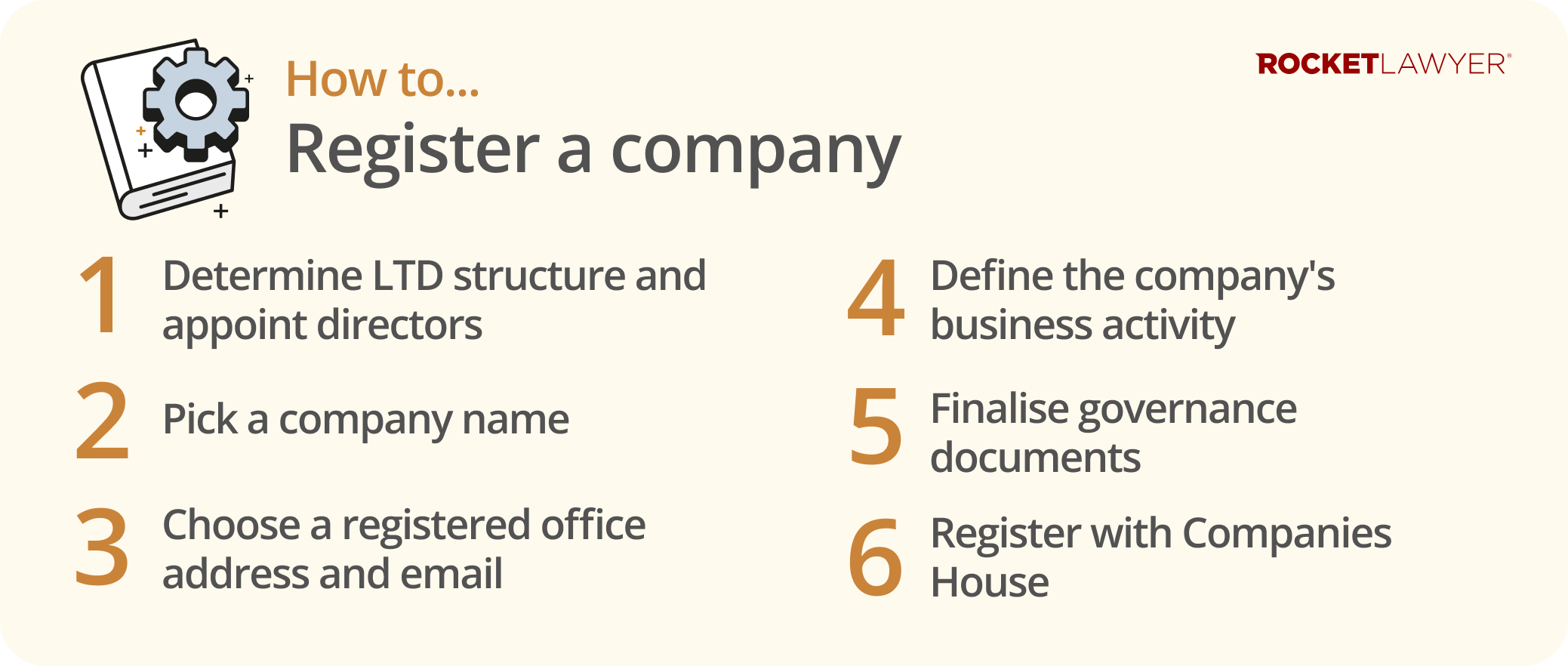
The overall process of incorporation involves six fundamental stages that must be completed before you file with Companies House. You'll need to make decisions regarding your company's ownership and structure, prepare the necessary governance documents, and gather essential legal information.
Step 1: Choose your limited company type
The first practical decision you'll make is determining the exact legal nature of your company.
What type of company should I register?
While all are private limited companies, there are two main types you can register with Companies House:
-
company limited by shares - this is the most common type for businesses that trade to make a profit. It's owned by members known as ‘shareholders’, and the personal risk of each shareholder is limited to the amount unpaid on their shares
-
company limited by guarantee - this structure is typically used by non-profit organisations, clubs, and charities. It doesn't have shares or shareholders. Instead, members (known as ‘guarantors’) agree to contribute a specific sum if the company cannot pay its debts
For more information, read Private limited companies.
Step 2: Appoint company officers and identify key people
Before applying, you must appoint the individuals who will run and own your company and identify anyone who controls it.
You need at least:
-
one director (who must be a natural person aged 16 or over)
-
one shareholder (for a company limited by shares) or guarantor (for a company limited by guarantee)
You must also identify all persons with significant control (PSC). This is anyone who has ultimate control over the company, typically holding more than 25% of the shares or voting rights.
You'll need to provide Companies House with the full name, nationality, date of birth, occupation, and service address for each appointed person (including PSC).
For a detailed explanation of all company roles, responsibilities, and eligibility rules, read Company appointments.
Decide on initial share capital (for companies limited by shares)
If you're registering a company limited by shares, you must decide how many shares you want to issue and at what nominal value.
A very simple way to form a company is to issue one share at registration, valued at £1, with the sole director serving as the sole shareholder. Additional shares can be issued at a later date.
For more information on this, read Share transfers and issuing new shares. For more on the different types of shares, read Types of shares.
Decide on the guaranteed amount (for companies limited by guarantee)
If you're forming a company limited by guarantee, you won't have shareholders. Instead, you need at least one guarantor. The guarantor agrees to pay a specific, nominal sum, known as the guaranteed amount (often £1 or £10), if the company cannot pay its debts. This amount represents the limit of the member's financial liability.
Step 3: Check if your ideal company name is available
You must select a unique name for your limited company that complies with a specific set of rules. You can't start the registration process until you have confirmed the name isn't already taken or too similar to one that's already registered.
Your company name must not:
-
be the same as an existing company's name
-
be offensive or suggest that the company is carrying out criminal activity
-
contain a 'sensitive' word or expression (like 'Royal' or 'Bank') without getting prior permission
-
suggest a connection to the UK government or local authorities
Always check the Companies House register to confirm availability and the trade marks register of the UK Intellectual Property Office to make sure your chosen name is not the same as an existing trade mark.
To find out more about the specific rules for naming your company, you can read How to choose a name for your business.
Step 4: Choose a registered office address and email
You must provide two official points of contact for your company: a physical postal address for statutory documents and a private email address for official communication. Both addresses are essential for legal compliance.
What is a registered office address?
The registered office address is the official, physical location in the UK where your company receives all its statutory mail, including legal notices and communications from HMRC. This address will be public on the Companies House register.
The address must be a physical UK address located in the same country your company is registered in (eg if your company is registered in Scotland, its registered office address must also be in Scotland). The address must also be 'appropriate', meaning that post is likely to reach someone acting for the company, and the sender can get confirmation of delivery.
Note that you cannot use a PO Box (or similar) as your registered office address.
If you don't want your residential address to be publicly available, you should use a different address, such as an accountant's or solicitor's office, and ensure you have their permission first.

Right to suppress your home address
Directors and PSCs have the right to suppress their residential address from public inspection at Companies House.
To remove your home address, you can apply by post (using form SR01) and pay a fee for each document you wish to suppress. You must provide an alternative correspondence address if you are still appointed to an active company, such as a current director. This will replace your home address on the public register.
If your home address has been used as the company's registered address, you can still apply to remove it, but you must officially change the registered office to a new address first.
What is a registered email address?
From 4 March 2024, all new companies must provide an appropriate registered email address to Companies House. The registrar will use this email address solely to send official communications, like reminders and notices, directly to the company. The registered email address is not made public on the register, but you must ensure it's monitored regularly to avoid missing important legal information.

Step 5: Define your business activity and confirm your lawful purpose
Before submitting the application, you must confirm the company's purpose and declare its business activities.
What is a standard industrial classification (SIC) code?
A standard industrial classification (SIC) code is a five-digit code that describes your company's main business activity. You must choose the code that best represents what your company does (ie your business activity) and include it in your registration.
The SIC code ensures that the registrar and government agencies correctly categorise your business activity for statistical and regulatory purposes. While most companies only need one, you can include up to four SIC codes if your business has multiple activities. You can find a list of codes on the Companies House website to help you choose the most accurate description for your business.
What is the statement of lawful purpose?
The statement of lawful purpose is a requirement for all new companies. It was implemented in 2024 under the Economic Crime and Corporate Transparency Act 2023 to help tackle economic crime and improve the accuracy of the public register.
When you register your company, all shareholders must include a legal confirmation that the company is being formed for a lawful purpose and that all its intended future activities will be lawful. This statement makes it clear that all companies on the register have a duty to operate in a lawful way. If the statement is not included, Companies House will reject the incorporation.
Step 6: Prepare documents to help run your company
To register your company with Companies House, you need to provide certain constitutional documents that define how your company will operate internally.
The key documents needed for incorporation are the memorandum of association (a statement that founding members intend to form a company) and the Articles of association (the company’s internal rulebook). The articles are vital as they govern director powers, shareholder voting, and other key internal procedures. For more information, read Company incorporation and articles of incorporation.
You'll also need to confirm the company's initial structure via a statutory statement:
-
for companies limited by shares, this is the statement of capital and initial shareholdings. This statement details the total number of shares the company issues, their total nominal value, and which shareholders (or ‘subscribers’) hold them upon incorporation
-
for companies limited by guarantee, this is the statement of guarantee. This statement confirms the initial members and the guaranteed amount each member agrees to contribute if the company cannot pay its debts
How do I register my company?
Once you've prepared all the documents and gathered all the required information from the steps above, you're ready to submit your application to Companies House and pay the applicable fee. You can register your company online, by post using form IN01, through a company formation agent, or via authorised third-party software.
If your application is successful, Companies House will issue you a certificate of incorporation and a company number, confirming your company is legally formed.
If you find the process of gathering all these codes, statements, and documents confusing, do not hesitate to Ask a lawyer for assistance. Our lawyers will guide you through the necessary decisions and ensure that all information is submitted correctly and in compliance with the latest company law.
If you need help preparing for the steps after registration, read What happens after you register your company? Read Choosing your business structure if you’re not sure whether a company is the right business type for you. Do not hesitate to Ask a lawyer if you have any questions or concerns about the company incorporation.