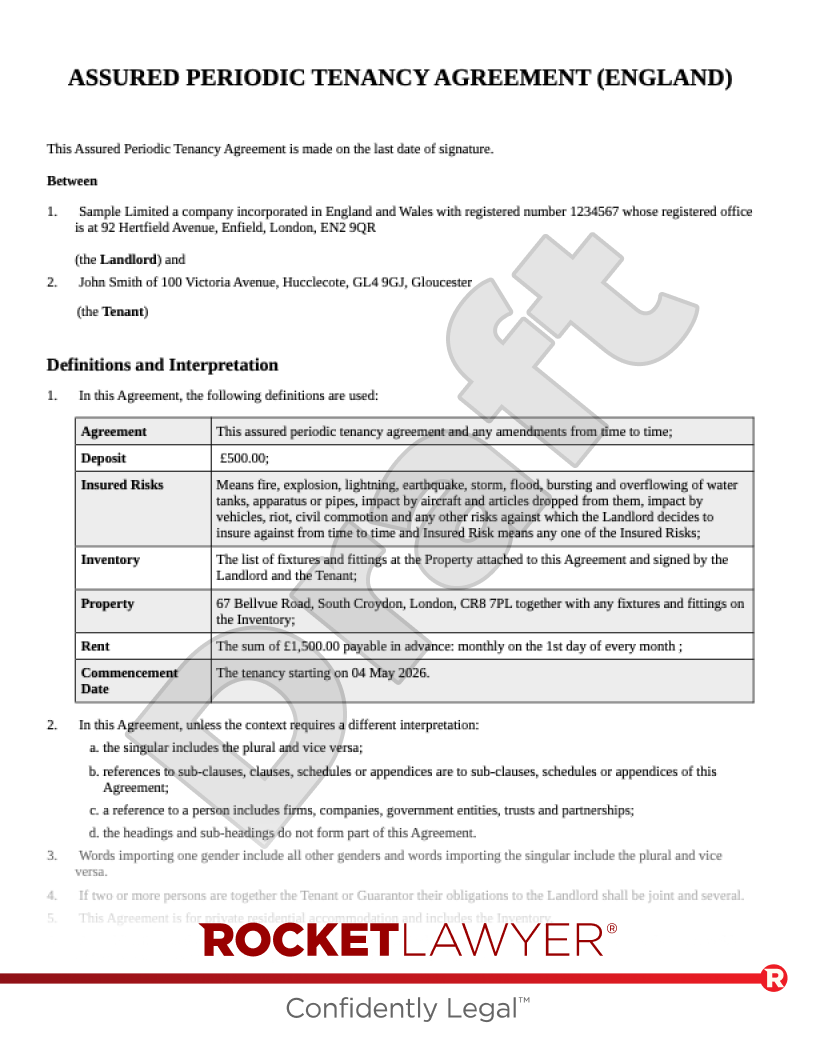
What are tenants’ rights?
Tenant rights are the legal protections that ensure a safe, secure, and fair place to live. These rights cover things like the physical condition of a property, the protection of rent payments, and the right to privacy in a home. In England and Wales, these rentna’s rights are established through various laws and common law principles. They ensure that landlords meet their obligations and follow specific legal procedures when managing a tenancy.
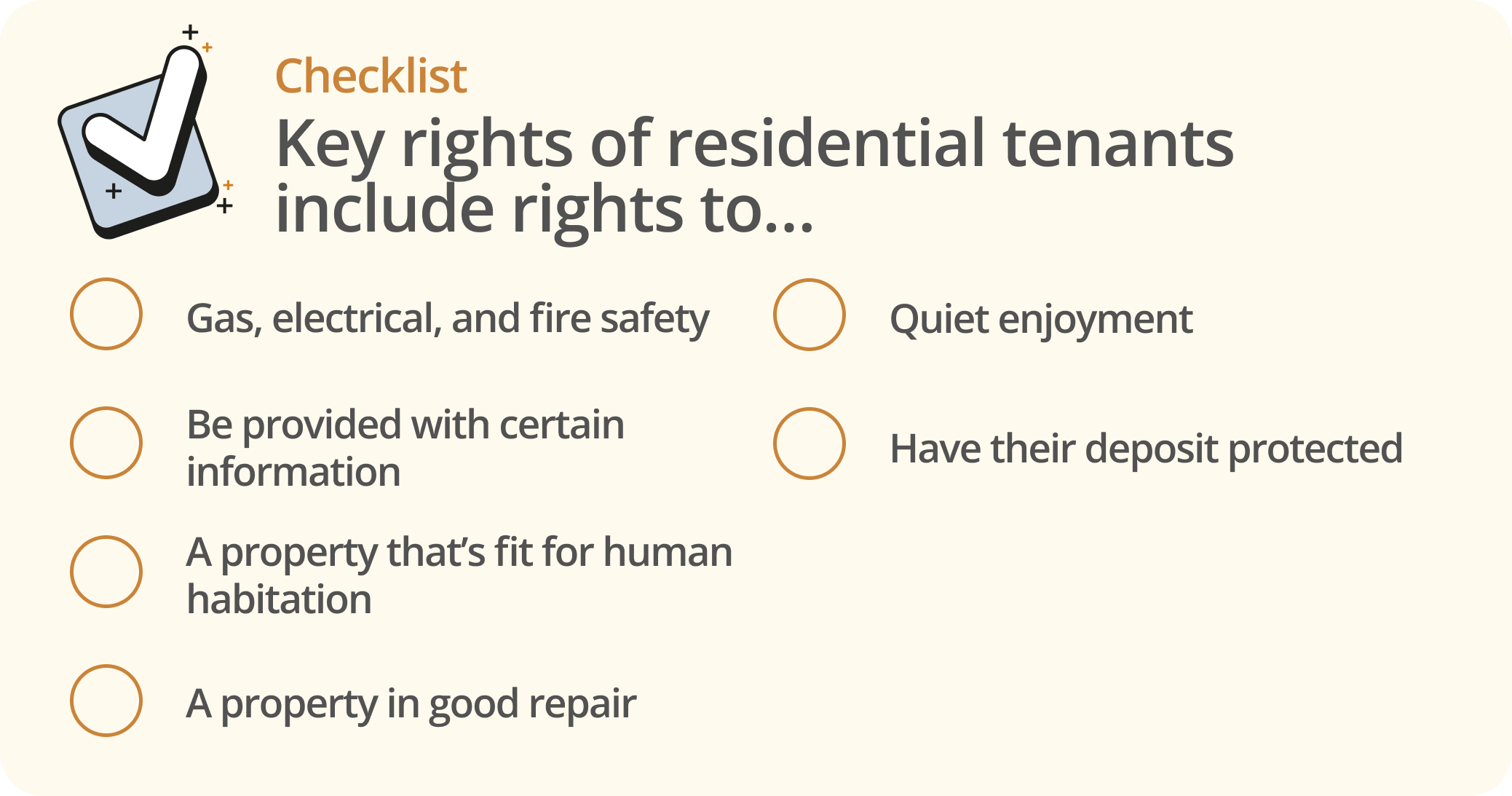
Rights related to safety
Tenants have the right to live in a property that’s safe and secure. Various safety obligations are imposed on landlords, including obligations to ensure:
Gas safety
For example, if the property uses gas:
-
all gas equipment supplied at the property must be installed and maintained by a competent engineer who is Gas Safe registered
-
the landlord must ensure gas safety checks are carried out every year by a Gas Safe registered engineer
-
landlords should keep copies of the gas safety checks for each relevant appliance until at least two further checks have been carried out
-
all tenants must be given an up-to-date copy of a gas safety certificate whenever a safety check is done
For more information on gas safety requirements, read the Shelter guidance on gas safety for England and Wales.
Electrical safety
Tenants have a right to live in a property for which measures are taken to ensure electrical wiring and installations are safe. Examples of specific requirements that landlords must meet to uphold this include:
-
all electrical appliances (eg cookers, washing machines, and heaters) and equipment must meet safety standards
-
electrical installations must be regularly inspected and tested by a qualified person (eg a registered electrician), usually at least once every five years
-
a copy of an inspection report must be kept until the next test is due, and a copy must be given to the tenant
For more information, read Electrical safety in rented property.
Fire safety
Tenants are also entitled to benefit from landlords’ obligations in relation to fire safety. For example:
-
furnishings supplied in the property (eg beds and mattresses, sofas, garden furniture, or curtains) must meet fire safety standards and be made from fire-resistant materials
-
working smoke alarms must be installed in the property:
-
in Wales: at least one smoke alarm must be installed on every floor of a property, which must be connected to the main electrical supply and linked to the other main smoke alarms in the property (ie to at least one other alarm per floor)
-
in England: at least one smoke alarm must be installed on every floor that is used partially or fully as living accommodation (ie space that’s primarily used for living or which people spend a significant amount of time in)
-
For more information about rights to safety, read Legal obligations of a landlord.
Rights related to the provision of information
Tenants have a right to be provided with certain documents and information relating to their tenancy. This includes:
-
certain key related to your tenancy in writing (these differ between England and Wales, but are generally covered by a detailed Tenancy agreement)
-
an up-to-date Energy Performance Certificate (EPC) for the property
-
a current gas safety certificate, if the property uses gas
-
an electrical condition report (EICR)
-
information about the tenancy deposit scheme being used to protect the tenant’s deposit
-
certain basic information about the landlord (eg their name and address)
-
a copy of the government's free How to Rent guide, for properties in England
If the tenant is not given these documents, their landlord may face restrictions when seeking possession of the property (eg may be unable to serve a no-fault Section 173 eviction notice in Wales) and/or face penalties.
The right to a property that is fit for human habitation and in good repair
Tenants have a right to live in a property that is fit for human habitation. This means that the property must be generally safe, healthy, and free from things that could cause serious harm. To uphold this right, a landlord is subject to a collection of obligations related to fitness for human habitation. These differ slightly between England and Wales.
Additionally, Landlords must keep a property in a good state of repair. This includes repairing and keeping in good working condition:
-
the property’s structure and exterior (eg gutters or drains)
-
sanitary fittings
-
appliances and fittings related to the supply of gas, electricity, and water (eg pipes and wires)
These two obligations often overlap. For example, failure to keep a property in good repair may make it no longer fit for human habitation.
For more information, read Fitness for human habitation.
The right to quiet enjoyment
Tenants are entitled to have the complete benefit of their rental property without being disturbed by the landlord or by anyone else acting on the landlord’s behalf. A landlord must let their tenant live in a home without unnecessary interference.
Breaches of the right to quiet enjoyment can include:
-
preventing the tenant from accessing the property
-
damaging the property
-
refusing to carry out necessary safety checks or repairs
-
frequently visiting the property without notice or agreement
-
accessing the premises without the tenant’s permission
Landlords do have a right to enter their rental properties to carry out inspections and repairs. However, unless it is an emergency, in England they must give the tenant at least 24 hours’ notice of an inspection, or reasonable notice of repairs (which could be less than 24 hours in an emergency). In Wales, 24 hours’ notice is required in both situations. In England, notice of an inspection must be in writing.
The right to deposit protection
Tenants may have to pay a tenancy deposit to the landlord before moving into a property. If the tenancy is an assured tenancy or assured periodic tenancy (APT) (in England) or an occupation contract (in Wales), the landlord must put the deposit in a government-approved deposit protection scheme within 30 days following the date it was paid.
Landlords must also provide their tenants with certain required information about the deposit’s handling.
Failure to protect a tenant’s deposit or to give the prescribed information within 30 days may make a landlord liable to return the deposit and pay their tenant compensation of up to three times the amount of the deposit. It also makes use of some eviction notices (eg a a Section 173 notice for Wales) invalid.
When the tenancy ends, tenants must have their deposit returned (minus any permitted deductions, eg to cover intentional damage to the property). This should usually be done within 10 days of reaching an agreement on how much of the deposit will be returned.
For more information, read Deposit protection schemes and Prescribed information for tenancy deposits.
The right to keep a pet
This applies in England only.
Since 1 May 2026, under the Renters’ Rights Act 2025, most tenants in England have a legal right to request to keep a pet in their home. If a tenant wants to keep a pet, they must make a written request to their landlord, including a description of the animal. The landlord cannot unreasonably refuse the request.
The landlord must respond in writing within 28 days of receiving the request. If the landlord needs more information to make a decision, they must request this within those 28 days. Once the information is provided, the landlord has a further seven days to give a final decision.
A landlord’s refusal may be reasonable in some circumstances, like:
-
another tenant living in the property has an allergy
-
the property is too small for a large pet or several pets
-
the pet is illegal to own
-
the landlord is a leaseholder, and the freeholder does not allow pets
Refusals will generally be considered unreasonable if they’re based on the landlord:
-
not liking pets
-
previously having had issues with tenants who had pets
-
having concerns about potential damage or future rentals
-
knowing the tenant needs an assistance animal, such as a guide dog
If a landlord refuses a request, they must explain why in writing. Tenants have the right to challenge a refusal if they believe it is unreasonable by submitting a complaint or starting court proceedings.
While a landlord can keep money from a deposit to cover repair costs caused by pet damage, they cannot claim for the same damage twice (eg from both insurance and the deposit).
The right to challenge a rent increase
This applies in England only.
In England, landlords can only increase rent once a year to the market rate. They must use a specific Section 13 notice to do this. If you think the increase is too high, you can challenge it at a First-tier Tribunal before the new rent starts. The Tribunal will determine the fair market rent for the property. For more information, read Rent increases and section 13 notices.
The right to be protected from rental discrimination
The Equality Act 2010 makes it illegal for landlords or agents to discriminate against tenants based on protected characteristics. These include disability, race, religion, sex, sexual orientation, gender reassignment, and pregnancy or maternity. Landlords must not treat a tenant differently or refuse to rent to them because of these factors.
The Renter’s Rights Act 2025 introduced additional protections. These apply from 1 May in England and 14 June in Wales and make it unlawful for landlords or agents to have blanket bans on letting to tenants who have children or who receive benefits (sometimes known as 'no DSS' policies).
Landlords cannot withhold information about a property, prevent (prospective) tenants from accessing information about the property, refuse viewings, or refuse to grant a tenancy because a person has children or receives benefits (or because the landlord/agent believes this to be the case).
What to do if your tenants’ rights have been breached
If you believe your rights have been violated, you should first contact your landlord to discuss the situation and try to find an amicable way to resolve the issue. However, if you can’t resolve the problem directly with your landlord, specific actions can be taken depending on the type of breach concerned:
If the house isn’t safe
If you think your home is unsafe and your landlord is not respecting their safety obligations, you should contact the housing department at your local council. The housing department will carry out a Housing Health and Safety Rating System (HHSRS) assessment and will be able to take action in the event of serious health and safety hazards.
If repairs aren’t done
If your landlord does not carry out repairs that are needed, you can contact the private rented housing team at your local council. If the issue is serious, they can refer your case to the environmental health department, which will take further action (eg requiring that the landlord carry out the relevant repairs).
If a deposit is not protected
If your landlord fails to protect a deposit, you can claim compensation in court. For more information, read Deposit protection schemes.
If the right to quiet enjoyment is breached
Tenants may be able to take court action against the landlord and ask for damages (ie compensation). However, depending on the level of nuisance caused, it is likely best to try to solve the issue amicably and/or to contact your local council first.
If you’re discriminated against
If a tenant feels they have been discriminated against, they can report the matter to their local housing authority, which has the power to issue fines of up to £7,000.
Ask a lawyer for more information about tenants’ rights or if you think your rights have been infringed, and you’re not sure what to do.