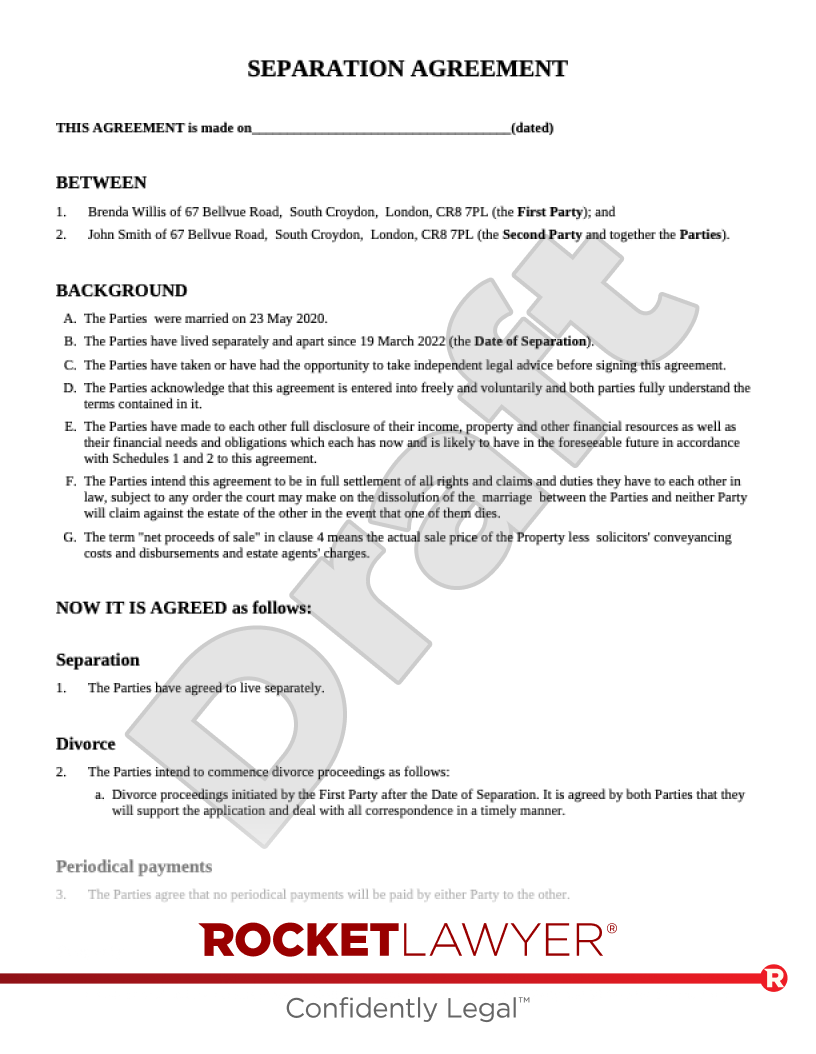
What is a divorce?
A divorce is the official legal process of ending a marriage. When a court grants a final divorce order, the marriage is legally over, and both people are free to remarry.
Divorce vs dissolution
If you're dissolving a civil partnership (known as a dissolution), the steps are largely the same as for a divorce. However, some of the terminology is different. The information in this guide also applies to the process of ending a civil partnership. For clarity, this guide uses the terms ‘divorce’ and ‘spouse’, but these also include ‘dissolution’ and ‘civil partner’ respectively.
What is a no-fault divorce?
A no-fault divorce allows a couple (or just one person) to get a divorce on the sole ground that the marriage has irretrievably broken down.
Irretrievable breakdown means the relationship has permanently broken down, and there's no reasonable chance of you getting back together. You no longer need to provide evidence of such a breakdown (eg due to adultery). You just need to provide a statement confirming the marriage has broken down.
This system was introduced by the Divorce, Dissolution and Separation Act 2020. It aims to reduce conflict between separating couples, which is especially important when children are involved.
What were the old grounds for divorce?
Before 6 April 2022, you had to prove your marriage had irretrievably broken down by relying on one of five grounds. These no longer apply in England and Wales, but are useful to understand the change in the law.
The old grounds were:
-
adultery - your spouse had sexual intercourse with someone of the opposite sex
-
unreasonable behaviour - this could range from serious issues like domestic violence to more vague problems like a lack of emotional support
-
desertion - your spouse left you for at least two years
-
two years' separation - you had been living apart for at least two years, and both agreed to the divorce
-
five years' separation - you had been living apart for at least five years (no agreement was needed)
These grounds often led to one person blaming the other, which could create unnecessary conflict. The no-fault system removes this requirement.
Who can apply for a divorce?
To get a divorce in England and Wales, you must meet a few conditions. You must:
-
have been married for at least one year
-
be able to confirm your marriage has irretrievably broken down
-
have a marriage that's legally recognised in the UK
You can apply for a divorce on your own (a sole application) or with your spouse (a joint application). The parties who apply for a divorce are known as applicants.
What are the steps in the divorce process?
The divorce process follows a set legal timeline. It's designed to give you time to reflect and to sort out financial and child arrangements before the divorce is finalised.
Step 1: Making the divorce application
The first step is to fill in the divorce application (Form D8). You can do this online or using a paper form. You'll need your marriage certificate.
Your application is then checked by the court. Once it's correct, the court will 'issue' it (ie officially start the case) and send you a copy. What happens next depends on how you applied.
If you made a sole application, the court sends your spouse (known as the 'respondent') a copy of the application and an acknowledgement of service notification. The respondent must reply to this within 14 days, saying they've received the papers and whether they intend to dispute the divorce (which is very rare). The 20-week reflection period starts as soon as the court issues your application.
If you made a joint application, the court sends both of you a notice that the application has been issued. You both then need to acknowledge you've received it. The 20-week reflection period starts once the application is issued by the court.
Step 2: The 20-week 'reflection period' and conditional order
After the 20-week period has passed (counting from when the application was issued), you can apply for a conditional order (which used to be called a 'decree nisi').
This is a waiting period designed to give you time to reflect and to start making arrangements for your finances and any children. Once the court receives your application for a conditional order, it'll review it and, if everything is in order, grant the conditional order.
Step 3: The final order
You must wait at least six weeks and one day after your conditional order is granted. After this waiting period, you can apply for the final order (which used to be called a 'decree absolute').
Once the court grants the final order, your marriage is legally over.
How long does a divorce take?
A divorce now takes a minimum of 27 weeks (around seven months). This is made up of the 20-week reflection period between applying and being able to get the conditional order, plus the six-week and one-day waiting period between the conditional order and being able to apply for the final order.
It can take longer if there are delays in processing the orders or if you're also finalising financial arrangements.
Can my spouse stop the divorce?
Under the no-fault system, your spouse cannot defend or contest the divorce simply because they don't want it to happen. Since you don't have to make allegations or prove any grounds for divorce, there's nothing for them to argue against.
They can only dispute the application on very limited technical grounds. For example, they might argue that the court in England and Wales doesn't have the jurisdiction (ie the legal power) to handle the case, that the marriage wasn't legally valid in the first place, or that it has already been legally ended in another country.
What about arrangements for children and money?
It's very important to understand that the divorce application does not sort out your finances, property, or arrangements for your children. These must all be handled separately from the divorce process itself.
You can often make these arrangements by agreeing with your ex-partner and, for financial matters, making your agreement legally binding with a financial order.
For more information, read Divorce financial settlements and orders, Child custody, and Child maintenance.
If you have questions about your specific situation, don't hesitate to Ask a lawyer. We also provide a fixed-price Divorce service to help you through the process.
If you want to consider an alternative to divorce, read Separating from your spouse or civil partner.