What is a financial settlement in a divorce?
A financial settlement (sometimes called a financial arrangement) is an agreement on how you and your ex-spouse will divide your money and property when you divorce. This covers everything from the family home and savings to debts and pensions.
Ideally, you and your ex-spouse can agree on these details yourselves. However, if you cannot agree or if you need to make your agreement legally binding to prevent future claims, you may need to involve the courts.
Voluntary financial arrangements
Most divorcing couples prefer to come to their own arrangements (known as 'voluntary agreements' or 'family-based arrangements') regarding the distribution of money, property, and other assets. This route is generally faster, cheaper, and significantly less stressful than going to court.
How can we reach an agreement?
Identifying your shared assets and deciding who keeps what can be challenging. To help you sort through this, the government's MoneyHelper service offers a divorce and separation calculator to help you identify assets and consider how to split them.
If discussions become tricky or you are struggling to communicate, family mediation can be very helpful. This involves an independent, trained professional who acts as a neutral third party to help you and your partner work out agreements for your finances or children.
In England and Wales, you generally must consider mediation before taking a dispute to court. This typically involves attending a Mediation Information and Assessment Meeting (MIAM) to determine if mediation is suitable for you. For more information, read Mediation.
Recording your agreement
Once you have reached a voluntary agreement, it is crucial to record it properly to avoid future disputes.
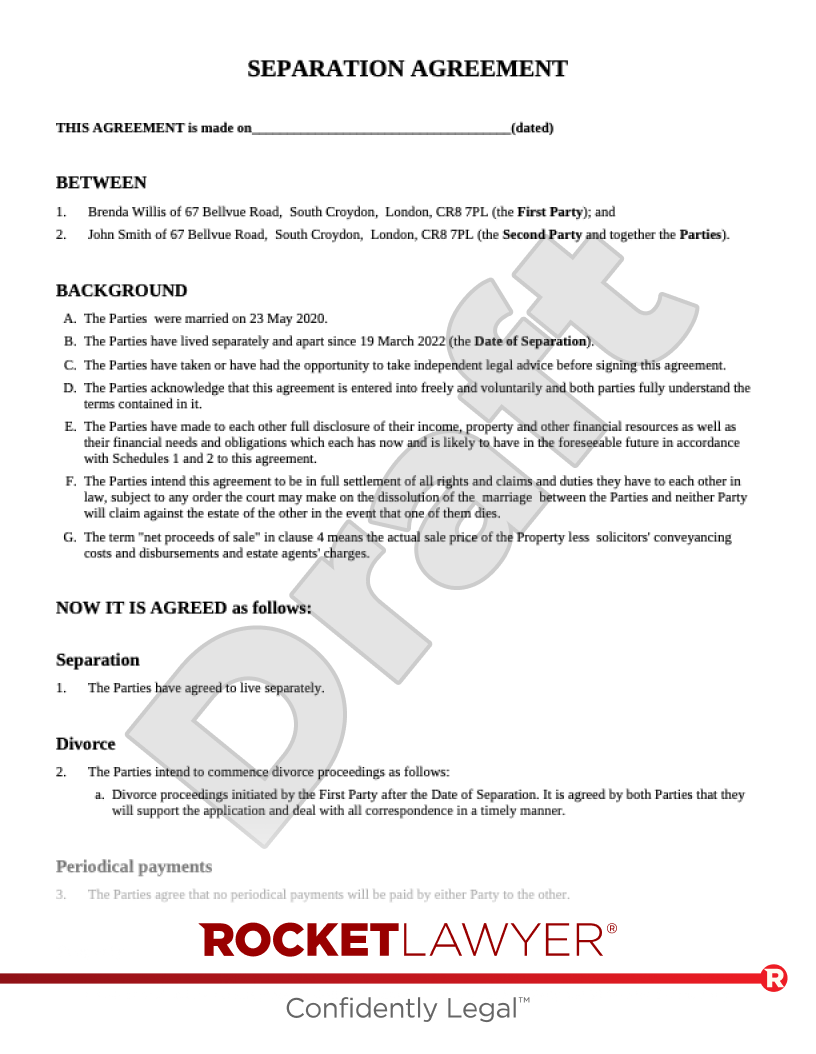
In England and Wales, you can record your initial financial arrangements in a Separation agreement. This document sets out how you will manage your finances while you are separated, but before the divorce is final. Note that a separation agreement is not legally binding in England and Wales.
In Scotland, a separation agreement is also known as a 'minute of agreement'. If such an agreement is formally registered in the Books of Council and Session, it is legally enforceable. If one ex-spouse later breaks the terms of a registered agreement, the other person can apply to the courts to enforce it easily. Ask a lawyer if you need a separation agreement for Scotland.
For more information, read Separating from your spouse or civil partner.
Financial arrangements in England and Wales
If you cannot reach a voluntary agreement, the court will decide how to split your assets using the principles below. Even if you do agree, you should follow these guidelines, as the court will check your agreement against them to ensure it is fair.
In England and Wales, there is no automatic mathematical formula for dividing assets. Instead, the courts have wide discretion to decide what is fair based on the unique facts of your marriage. The focus is on ensuring that the financial needs of both parties, particularly those of any children, are met.
What is matrimonial property?
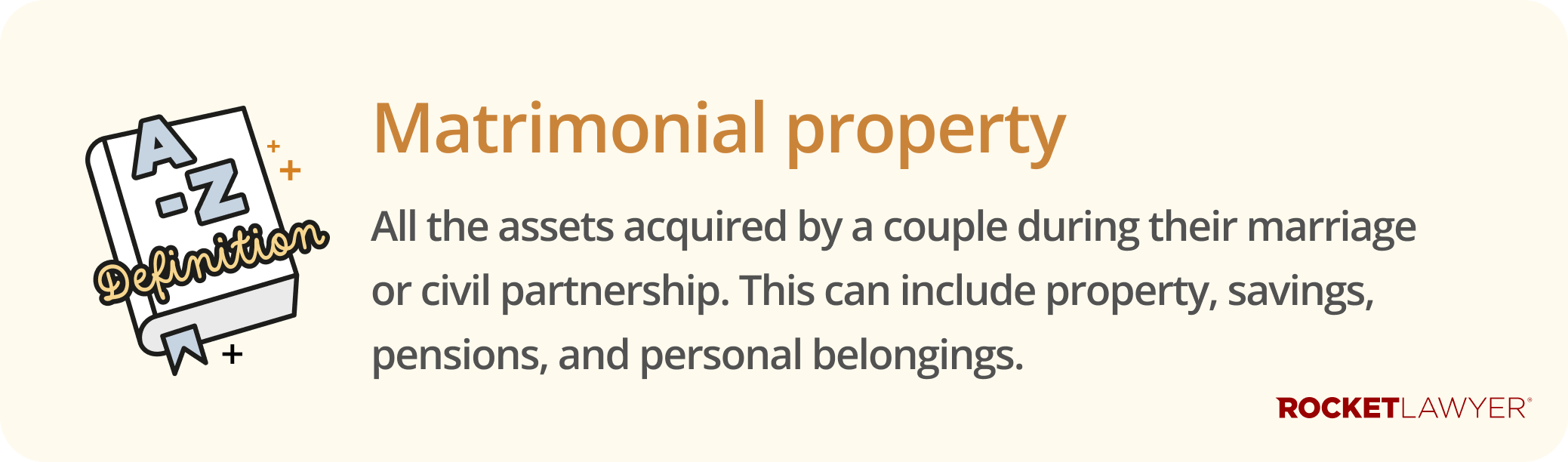
In England and Wales, the courts generally distinguish between two types of assets:
-
matrimonial property - assets you built up during the marriage. This typically includes the family home, pensions, savings, and investments acquired while you were together. The starting point is usually that these assets should be shared equally
-
non-matrimonial property - assets that you acquired before the marriage, after you separated, or received as an inheritance or gift. You might be able to argue that these should be excluded from the financial settlement and kept by the person who originally acquired them
In some circumstances, the courts can decide that non-matrimonial property becomes shared property. For example, if:
-
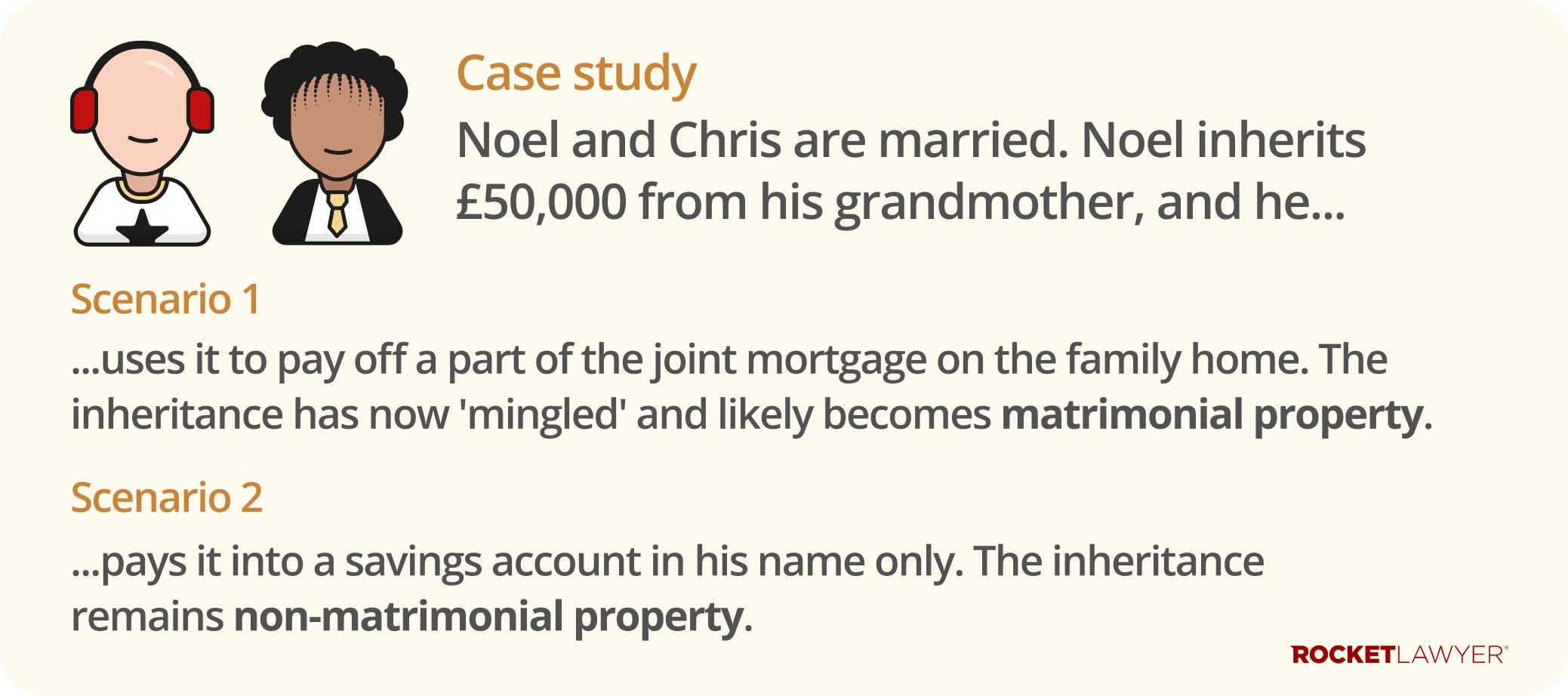
the assets have been 'mingled' - this happens if you mix the asset with family finances (eg using an inheritance to pay off the joint mortgage or putting it into a joint account). Over time, this can turn non-matrimonial property into matrimonial property
-
needs must be met - if the matrimonial assets are not enough to provide for the housing and financial needs of your ex-spouse or children, the court can use non-matrimonial property to make up the shortfall. This is the most common reason to include non-matrimonial property in financial settlements
How are assets divided?
There is no strict 50/50 rule, but the starting point is often an equal split of assets built up during the marriage. However, fairness is the ultimate goal.
When deciding how to split assets, the court looks at the factors detailed in the Matrimonial Causes Act 1973, which include:
-
the welfare of any children (this is the court's first consideration)
-
the income and earning capacity of each person
-
the financial needs and responsibilities of each person
-
the standard of living enjoyed during the marriage
-
the age of each person and the length of the marriage
-
any physical or mental disabilities
-
contributions made to the welfare of the family (including looking after the home)
Consent orders and clean breaks
If you reach an agreement voluntarily, it is not automatically legally binding. To make your agreement enforceable and formally end your financial relationship, you must apply for a consent order. This is a legal document approved by the court that confirms your agreement.
When applying for a consent order, you should usually include a clean break clause. This cuts all financial ties, ensuring neither party can make a claim against the other in the future (eg against future earnings or inheritance). For more detailed information, read Consent orders.
Applying for a financial order
If you cannot agree, or if mediation fails, you can apply to the court for a financial order (sometimes referred to as the ‘contested route’ or an ‘ancillary relief order’). This is a longer and more expensive route than a voluntary agreement.
To start the process, you must typically attend a MIAM first (there are some exceptions, like in cases involving domestic violence). Then, you send a financial order application form (Form A) to your local financial remedy court.
The court process involves three main stages:
-
first appointment - a short hearing where the judge checks the information provided and defines the issues. Before this appointment, you and your ex-spouse will need to fill in a financial statement for a financial order (Form E) to disclose all your assets and debts
-
financial dispute resolution (FDR) - a judge helps you try to reach an agreement without a trial
-
final hearing - if you still cannot agree, a judge decides how to divide your assets
Ask a lawyer for more detailed information on this process and/or read the government’s guidance on getting the court to decide.
Financial arrangements in Scotland
If you cannot reach a voluntary agreement, the court will apply strict legal principles to decide how your assets are shared. Even if you are negotiating privately, you should use these rules as a guide to ensure a fair outcome.
Unlike in England and Wales, Scottish law is generally more rigid regarding dates and definitions. The system aims to share the net wealth created during the marriage fairly and typically prioritises a clean break with a one-off capital settlement rather than long-term ongoing maintenance.
What is matrimonial property?
Matrimonial property is defined strictly under the Family Law (Scotland) Act 1985. It includes all assets acquired by you or your spouse (individually or jointly) between the date of your marriage and the 'relevant date' (this is either the date you stop living together or the date the court papers for the divorce are served, whichever happens first).
Crucially, the following assets are usually excluded from the matrimonial property pot:
-
pre-marriage assets - assets you owned before the marriage (with the important exception of a family home bought before marriage specifically for use as a family home)
-
gifts and inheritances - assets you received as a gift or inheritance from a third party during the marriage
How are assets shared?
The starting point in Scotland is that the net value of the matrimonial property should be shared fairly (which usually means equally as a 50/50 split). However, the court can depart from equal sharing if there are special circumstances or to address specific disadvantages. These might include:
-
economic disadvantage - if one partner gave up a career to look after children or the home
-
childcare costs - the economic burden of caring for children under 16)
-
source of funds - if a matrimonial asset was bought using non-matrimonial funds (like an inheritance or pre-marriage savings)
Financial provision
If you cannot agree, you can apply to the court for financial provision as part of your divorce writ. For example, the court can order:
-
a capital sum order - a lump sum payment (or series of payments) to balance the division of assets
-
property transfer order - ordering the transfer of a property or other asset from one spouse to the other
-
pension sharing order - splitting a pension pot
-
periodical allowance order - regular maintenance payments
-
incidental order - such as an order to force the sale of the matrimonial home or to value a specific asset
Ask a lawyer for more information or help.
What happens to maintenance payments?
Maintenance payments are distinct from the division of assets (the capital split). They involve regular, ongoing payments made by one former spouse to the other to assist with living expenses or the support of children. These arrangements can be agreed upon voluntarily or ordered by the court.
Spousal maintenance
Spousal maintenance (or 'periodical allowance' in Scotland) is regular financial support paid to a former partner. It is typically awarded if one partner has a significantly higher income or if the other partner's earning capacity has been impacted by the marriage (eg giving up a career to raise children).
Rules differ significantly by jurisdiction. In Scotland, payments are typically limited to three years following divorce. In England and Wales, they can last much longer. For more information, read Spousal maintenance.
Child maintenance
Child maintenance is money paid towards the everyday living costs of your children. It is usually arranged separately from the divorce proceedings. If you cannot agree on an amount, the Child Maintenance Service (CMS) can calculate it for you. For more information, read Child maintenance or Child maintenance in Scotland.
If you are just starting the divorce process in England or Wales, you can make a Separation agreement to set out your provisional financial arrangements. If you have reached a final agreement and need to make it legally binding, or if you are unsure about your rights and need help negotiating, do not hesitate to Ask a lawyer.