What should an employer do if an employee is off sick?
Employees can get their statutory sick pay (SSP) from the first day of their absence. The previous 'waiting days' rule was abolished under the Employment Rights Act 2025 on 6 April 2026. Employers must pay SSP at a rate set by the government for up to 28 weeks of qualifying absence. For more information, read Sick pay.
Many employers offer an enhanced sick pay entitlement, but this is not mandatory.
For periods of sickness of seven days or less, the employer should obtain a Self-certification form from the employee explaining their absence. From the eigth day onwards, the employee should provide a fit note (formerly a 'sick note') from their GP. Holiday continues to accrue during sickness absence, even when it is an extended absence.
The Bradford Factor (a formula used by HR departments to calculate the impact of employees’ absences on the organisation) can be useful in managing sickness absences, but don’t use it in isolation, as each case should be considered on its merits.
What about an unauthorised absence from work?
When an employee is off sick, they should inform their employer of their absence within seven days (or within the deadline that they have set). If an employee will be off work for more than one week, they should inform their employer using a fit note stating that they cannot return to work. For more information, read Fit notes.
Unauthorised absence from work is when an employee does not come to work and gives no reason for their absence or does not contact their employer.
The employer should reach out to the absent employee as soon as possible. This includes using any emergency contacts they have. If the employer cannot reach the employee, they should discuss the absence with the employee when they return to work.
If the employee cannot provide a good reason for the absence and lack of contact, the employer can consider further investigations for possible disciplinary action.
For more information, read Managing employee absenteeism and Are you tackling employee absences properly?
Dismissing employees for sickness absence
Employers may want to dismiss employees for extended or frequent sickness absences, and this raises issues of unfair dismissal and, sometimes, disability discrimination.
Employees who do not have unfair dismissal rights may be dismissed for sickness absence, so long as the dismissal is not discriminatory.
Currently, employees usually need two years of service to qualify for unfair dismissal protection. However, from 1 January 2027, the Employment Rights Act 2025 reduces this qualifying period to six months (ie employees will be protected from unfair dismissals after six months of working for an employer). Sickness absence can still be a potentially fair reason for dismissal, but the employer must ensure that a fair and reasonable process is followed
Steps should include:
-
obtaining reliable medical information about the reason for absence and prognosis. This may be from the GP or occupational health professional. Strict rules apply about getting consent for health information to be obtained. Ask a lawyer for more information
-
consideration of the requirements of the business, the likely future pattern of absence, and the employer's ability to accommodate further absences.
-
the assessment of opportunities for the redeployment of the employee into a more suitable role.
-
for intermittent absences, warning the employee that the employer cannot sustain the levels of sickness absence and of the risk of dismissal.
-
holding a pre-dismissal meeting similar to a disciplinary hearing, where the employee has the right to be accompanied and is able to make representations as to why they should not be dismissed. A right to appeal against dismissal should also be offered.
Employers must make sure that comparable cases are treated consistently.
What if the employee is disabled?
When an employer has an employee on long-term or problematic intermittent sickness absence, it is crucial to consider whether the employee might be disabled.
For these purposes, 'disability' has a much broader definition than in ordinary language and covers any mental or physical impairment that has an adverse effect on the person’s ability to carry out normal day-to-day activities likely to last 12 months or more. For more information, read Disability and reasonable adjustments.
If the employee is disabled, then the employer has additional duties, including the duty to make reasonable adjustments to ensure that the employee is not placed at a substantial disadvantage as a result of the disability. Extreme care should be taken before dismissing a disabled employee.
Don’t include absence due to a disability when performing redundancy selection.
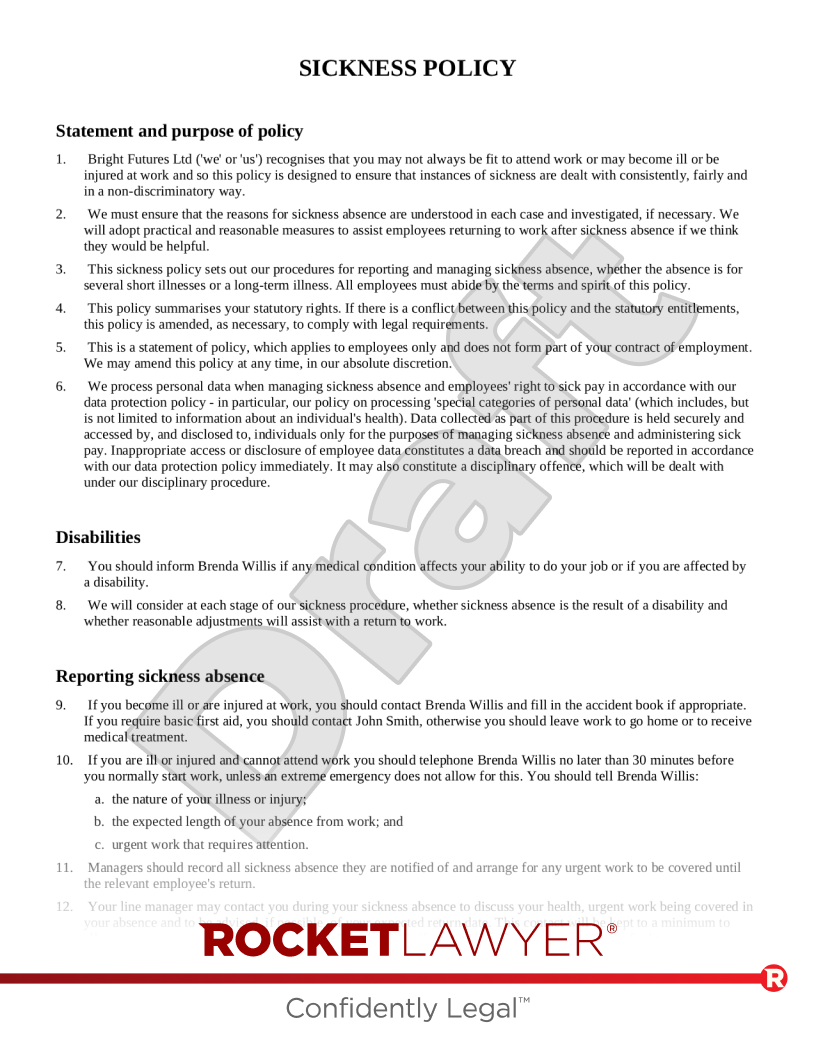
Employers should formalise their procedures in a clear Sickness policy. Do not hesitate to Ask a lawyer if you have any questions or concerns.