What is a tenant eviction under the Renters' Rights Act 2025?
The Renters' Rights Act 2025 fundamentally changed how you end a tenancy. All assured shorthold tenancies (ASTs) have been converted into periodic (ie rolling) tenancies, known as ‘assured periodic tenancies’ or ‘APTs’. This means there's no longer a fixed term after which a tenancy will end. To evict a tenant now, you must always provide a valid legal reason, known as a 'ground'. You can no longer use a section 21 no-fault eviction notice to end a tenancy without a reason.
What is a section 8 notice?
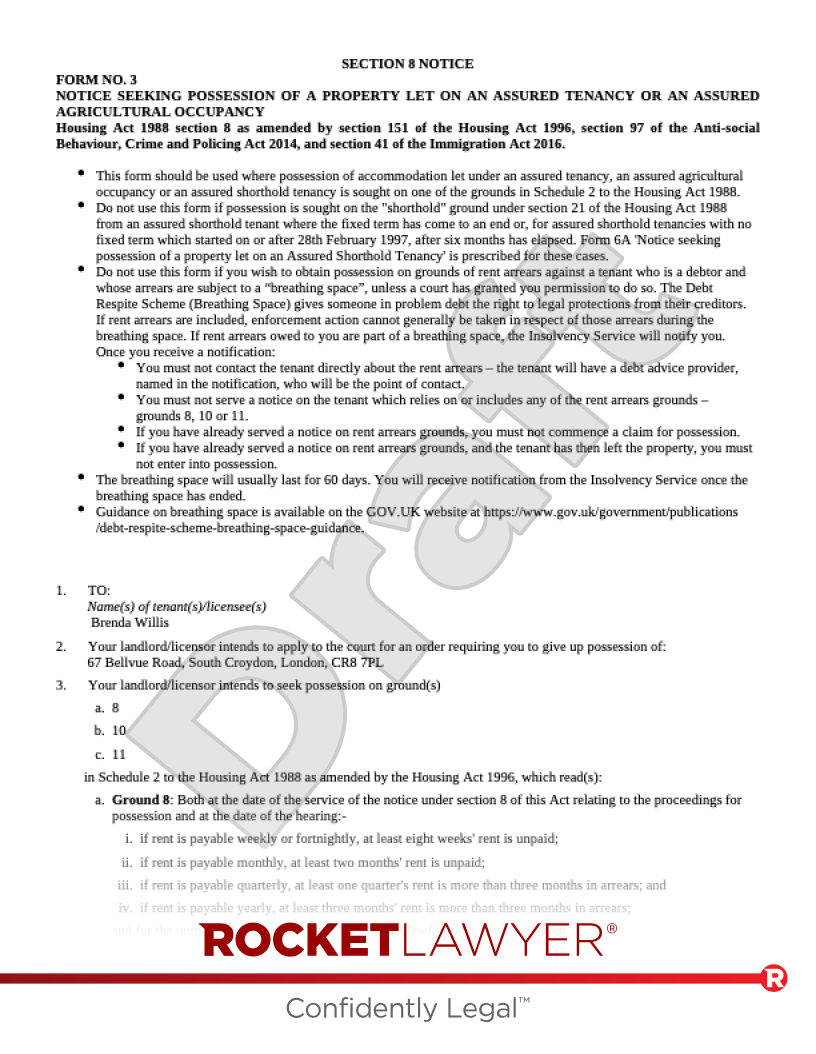
A Section 8 notice is now the primary way to end a tenancy. You can serve this notice if a tenant breaches their agreement or if your circumstances change (for example, if you need to move back into the property). The amount of notice you must give depends on the ground you're using. For example, if you're selling the property, you must usually give four months' notice.
For more information, read Evicting a tenant.
What are the grounds for possession?
Because no-fault evictions have been abolished, you must use a Section 8 notice and state your specific grounds (under section 8 of the Housing Act 1988) for wanting the property back. Common grounds include rent arrears, antisocial behaviour, or wanting to sell the property. Some grounds are 'mandatory', meaning if you prove them, the court must grant possession. Others are 'discretionary', where the court decides if it's fair to evict the tenant.
For more information, read Grounds for eviction and possession.
Why should I use more than one ground for eviction?
If you only rely on one ground, your entire case depends on it. For example, if you serve notice for rent arrears using Ground 8 (mandatory), but the tenant pays just enough off their debt right before the hearing to bring it below the three-month threshold, that mandatory ground fails.
If you've also included Ground 10 (any amount of rent arrears) and Ground 11 (persistent late rent payment), which are both discretionary, in your notice, the judge can still choose to give you possession if they feel the tenant's behaviour justifies it. Including multiple grounds keeps your options open during the court hearing.
For more information, read Grounds for eviction and possession and Evicting a tenant.
I want to evict a tenant for rent arrears. How much notice do I give?
Under the Renter’s Rights Act 2025, if a tenant has at least three months' worth of rent arrears, you can serve a section 8 notice under Ground 8. This is a mandatory ground. You must give the tenant at least four weeks’ notice before you can apply to the court. This gives them a chance to pay back what they owe.
For more information, read Evicting a tenant.
My tenant has not left the property after being given an eviction notice. What should I do?
If your tenant stays in the property after the notice expires, you don’t have the right to move them out yourself. You must apply to the court for a possession order. Most cases will now require a court hearing where a judge will review your grounds. For more information, read Enforcement of possession orders.
My tenant wants to leave the tenancy. How much notice does a tenant have to give me?
Since all tenancies are now periodic, tenants can end the tenancy at any time by giving you two months' notice. They don't need a specific reason to leave, but they must provide this notice in writing.
If they want to leave without giving the full two months’ notice, you can agree to this.
For more information, read Ending and surrendering a tenancy.
Do I need to protect the tenant's deposit?
If you decide to take a deposit from the tenant, this must be protected in one of three government-approved schemes. You must also provide the tenant with prescribed information relating to the deposit within 30 days. For more information, read Deposit protection schemes.
Can I take a holding deposit?
Taking a holding deposit means that the tenant is committed to renting the property and the landlord is committed to renting the property to that tenant, subject to checks (eg referencing).
Before accepting a holding deposit, the landlord should confirm in writing (eg in an Initial holding deposit form):
-
how the holding deposit will be used (eg to facilitate reasonable checks)
-
if the holding deposit will be returned to the tenant (the deposit should be returned if the landlord decides not to rent the property)
-
if the holding deposit will be used towards the tenancy deposit or rent
-
if any of the landlord's fees will be taken from the holding deposit
-
when some of the holding deposit may not be refunded (eg if a tenant gives inaccurate information about themselves)
It is important to remember that a landlord cannot legally keep all of the holding deposit. They will only be able to retain part of the deposit required to compensate for their reasonable costs in preparing for the tenancy. If a landlord refuses to repay the holding deposit, the tenant can take them to court for breaking the agreement.
For more information, read Holding deposits.
My tenant has abandoned the property. How can I lawfully end the tenancy?
Before taking back possession, you must be certain that your tenant has abandoned the property. It could be that the tenant is on a long holiday, in the hospital, or undergoing a short prison sentence. To gain evidence as to whether or not abandonment has occurred, the landlord can make enquiries by speaking to the neighbours or contacting a relative for information on the tenant’s whereabouts.
To regain possession, landlords must follow the formal possession process by relying on a statutory ground and apply to the court for a possession order if the tenant does not return or formally end the tenancy.
Keep in mind that landlords should not take back possession without a court order, as this may amount to an unlawful eviction.
For more information, read Tenant abandonment.
For more information, read Evicting a tenant. If you need help deciding which grounds you should use in a section 8 notice, you can Ask a lawyer. Alternatively, consider using our Tenant eviction service for help with the section 8 eviction process.