What is competition law?
Competition law is a set of rules designed to make sure businesses compete fairly with each other. In the UK, the two most important laws are:
-
the Competition Act 1998, which sets out the main civil rules, including key prohibitions on anti-competitive behaviour
-
the Enterprise Act 2002, which introduced serious criminal penalties for individuals who engage in cartel activity (eg price-fixing), including prison sentences. It also makes it easier to disqualify directors of companies that breach competition law
The law is enforced by the Competition and Markets Authority (CMA). The main goal of competition law is to prevent any business or group of businesses from using anti-competitive practices that could harm the market, limit choice, or result in unfair prices.
What are restricted activities?
The Competition Act 1998 bans two main types of anti-competitive behaviour.
Anti-competitive agreements
Anti-competitive agreements are agreements between businesses that intend to prevent, restrict, or distort competition, and affect trade in the UK. This covers both formal written contracts and informal 'gentlemen's agreements'.
Agreements are more likely to be prohibited when they:
-
fix the prices to be charged for goods or services
-
limit production
-
carve up markets
-
discriminate (eg between customers by charging different prices or imposing different terms depending on the customer)
These anti-competitive agreements are explained in more detail in the next section.
Abuse of a dominant market position
This rule does not ban a business from being dominant, but it does ban that business from abusing its dominant position. A 'dominant position' generally means the business is so large or powerful that it can act independently of its competitors, customers, and suppliers.
Conduct that may be considered an abuse of a dominant position includes:
-
charging excessively high prices
-
limiting production or technical development
-
refusing to supply an existing long-term customer for no good reason
-
charging different prices for the same product or service to different customers
-
making a contract conditional on the other party accepting unrelated obligations
What business agreements are affected by competition law?
Competition law can affect any agreement between businesses that has the object or effect of preventing, restricting, or distorting competition. These agreements are broadly split into two types: 'horizontal' and 'vertical' agreements.
What are horizontal agreements?
A horizontal agreement is an arrangement between businesses that operate at the same level of the supply chain. In other words, competitors. For example, an agreement between two different manufacturers or two different retailers would be horizontal.
What are vertical agreements?
A vertical agreement is any agreement between two or more businesses that operate at different levels of the supply chain. For example:
-
a manufacturer and a distributor (eg under a Distribution agreement)
-
a distributor and a retailer (eg under a Distribution agreement)
-
a principal and an agent (eg under a Sales agency agreement)
These agreements are very common and usually promote competition. However, they can sometimes restrict competition in a way that harms the market (eg by fixing prices).
How do distribution agreements fit in?
A Distribution agreement is one of the most common types of vertical agreement. It's a legal contract between a supplier of goods (who might be the manufacturer) and a distributor (who buys the goods to sell on).
There are several common types, each giving the distributor different levels of rights:
-
exclusive - the supplier agrees to sell the goods only to the distributor with a certain agreed territory and agrees not to appoint other distributors or sell the goods directly to other customers within the territory
-
sole - the supplier appoints a distributor as their only or sole distributor within a territory, but the supplier reserves the right to supply the goods directly to end users
-
non-exclusive - the supplier has complete freedom to sell directly and to appoint other distributors within the territory
What is the vertical agreements block exemption?
Because most vertical agreements are harmless or even beneficial, UK law provides a safe harbour for them. This is known as the vertical agreements block exemption, which is currently set out in the Vertical Agreements Block Exemption Order (VABEO). If your agreement meets the VABEO's conditions, it's automatically presumed to be legal under competition law.
To benefit from the VABEO, your agreement must meet these key conditions:
-
the supplier's market share must be 30% or less
-
the buyer's (eg distributor's) market share must be 30% or less
-
the agreement must not contain any 'hardcore restrictions'
What are hardcore restrictions?
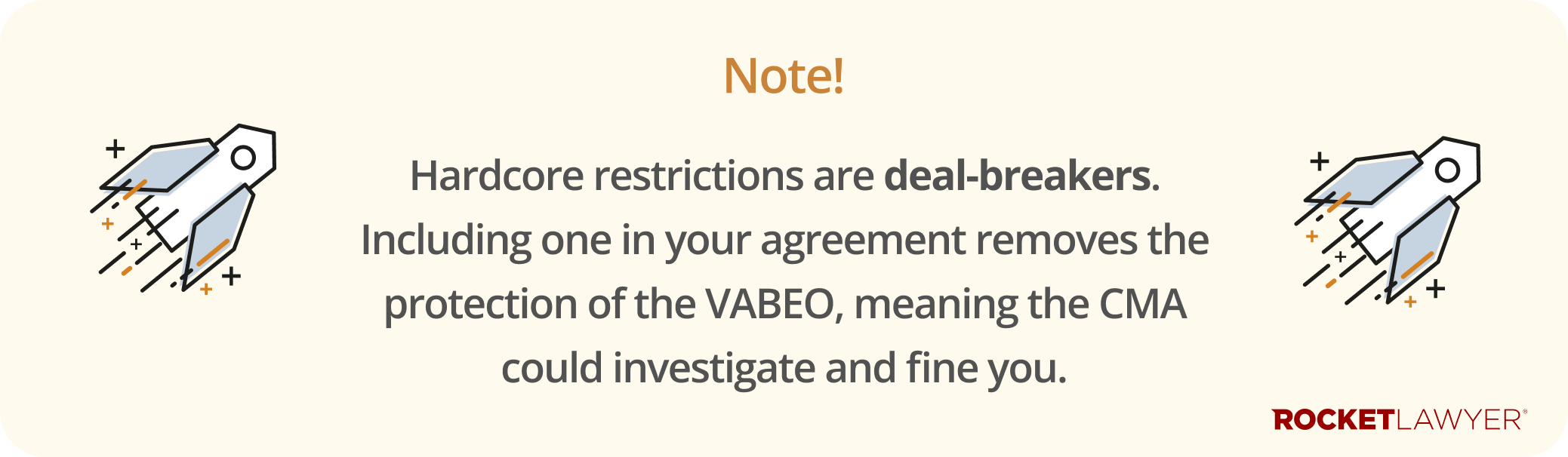
Hardcore restrictions are clauses that are seen as so harmful to competition that they automatically make the entire agreement ineligible for the VABEO. If your agreement has even one of these, it's at high risk of being illegal and unenforceable, regardless of your market share.
The most common hardcore restrictions are:
-
resale price maintenance (RPM) - this is when a supplier sets a fixed or minimum price at which the distributor must resell the goods (eg requiring a distributor to sell toys for at least £10). However, you are generally allowed to set a maximum resale price or provide a recommended resale price (RRP), as long as it doesn't act as a minimum price in practice
-
territorial and customer restrictions - these clauses restrict where or to whom the distributor can sell. While some restrictions are allowed (eg in an exclusive agreement), others are considered ‘hardcore’. The key is understanding the difference between active and passive sales
What are active and passive sales?
Active sales are when your distributor actively targets specific customers or territories. This includes sending direct mail, running targeted online ads, or having sales reps visit a specific area. You can often restrict active sales (eg 'You cannot actively target customers in another distributor's exclusive territory').
Passive sales are when the distributor responds to unsolicited requests from customers. This includes a customer from another territory finding the distributor's website and placing an order, or a customer walking into their shop. You cannot restrict passive sales. A blanket ban on selling to any customer outside an assigned territory is almost always a hardcore restriction.
What about online sales?
Banning a distributor from selling online altogether is usually a hardcore restriction because it prevents both active and passive sales. However, under the VABEO, suppliers have some flexibility. For example, you're generally allowed to:
-
charge a different wholesale price for goods sold online versus those sold in a physical (brick-and-mortar) shop. This is known as 'dual pricing'
-
set different quality criteria for online sales (eg regarding the website's operation) compared to offline sales
What happens if an agreement breaks competition law?
If your business breaches competition law, the consequences can be severe for both the company and the individuals involved. Consequences include:
-
the agreement becomes unenforceable - a court can void the entire agreement or, at best, the specific clause, meaning you can't rely on it
-
fines for the business - the CMA can fine your business up to 10% of its global annual turnover
-
damages claims - you could be sued for damages by any customer, business, or other third party that lost out because of your anti-competitive arrangement
-
director disqualification - under the Enterprise Act 2002, directors of companies that have breached competition law can be disqualified from acting as a director for up to 15 years
-
criminal prosecution for individuals - for the most serious cartel offences, individuals can face up to five years in prison and/or unlimited fines
-
reputational damage - being associated with a competition law investigation can cause significant and lasting damage to your business's reputation
Do I need to worry about EU competition law?
Since 1 January 2021, the UK has its own independent competition law regime, separate from the EU's. If your agreement:
-
only affects trade within the UK, you only need to follow UK rules (the Competition Act 1998 and the VABEO), which are enforced by the CMA
-
could affect trade within the EU (eg you have distributors in both the UK and France), your agreement must comply with both UK law and EU competition law. The EU's rules are very similar but have some slight differences, so it's important to get specific legal advice
If you need to make an agreement, you can use our Distribution agreement and Sales agency agreement. If you have any questions about your market share or whether your terms could be seen as anti-competitive, do not hesitate to Ask a lawyer.