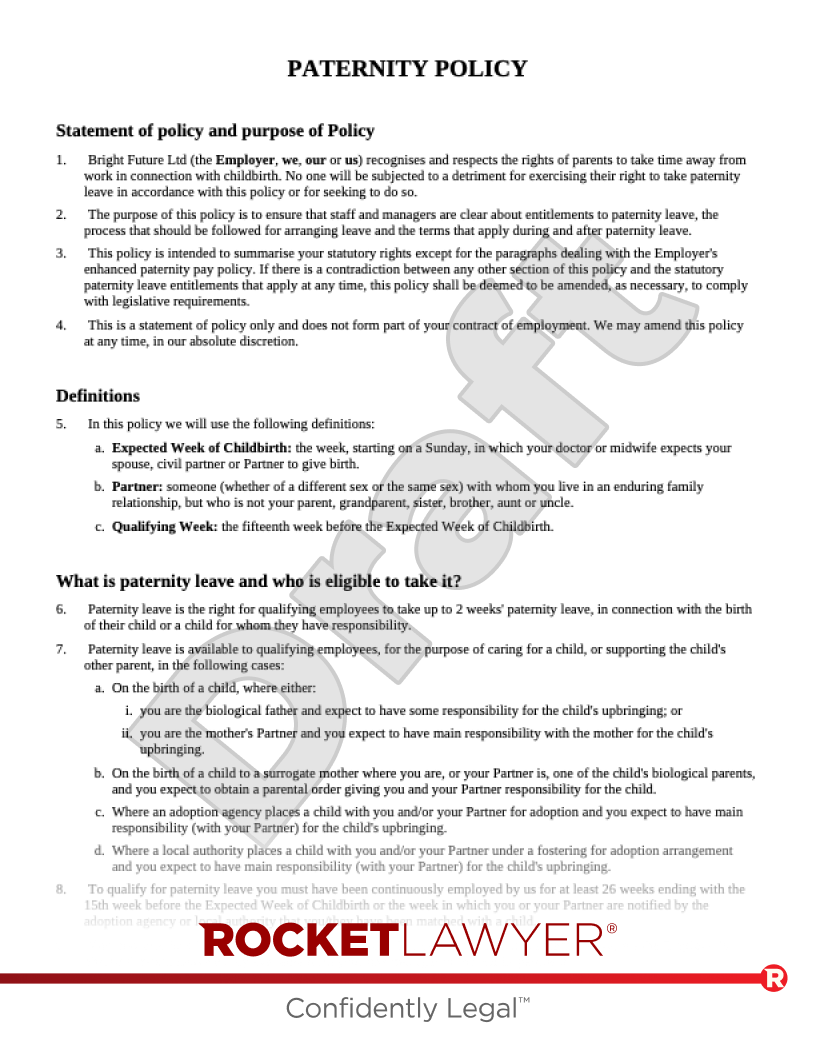
What is paternity leave?
Paternity leave is time off work that fathers and partners may be legally entitled to when they and their partner are having a child. The leave is available to both fathers and other partners (eg same-sex partners) of a child’s mother or birth parent, as long as they meet the eligibility requirements.
Either one or two weeks’ paternity leave may be taken. Somebody taking paternity leave may also be eligible for statutory paternity pay (SPP) during their leave.
Who is eligible for paternity leave?
To qualify for statutory paternity leave, a person must generally:
-
be either:
-
the child’s biological parent (eg father), or
-
the partner of the mother or of a primary adopter (eg a spouse, civil partner, or other partner who lives with the mother or adopter in an enduring family relationship)
-
-
expect to have responsibility for the child’s upbringing
Eligibility also covers adoption via surrogacy arrangements.
Since 6 April 2026, paternity leave is a day one right. This means eligible employees can take paternity leave from their first day of employment.
When can paternity leave be taken?
An employee is entitled to up to two weeks of paternity leave. Paternity leave can be taken:
-
in one block of two weeks of leave
-
in one block of one week of leave, or
-
in two blocks of one week’s leave at different times (ie during non-consecutive weeks)
The employee can take their paternity leave in one of these ways any time between the child’s date of birth or placement for adoption and the end of 52 weeks after that day (or after the end of the week in which it was expected the child would be born, if they were born before this week).
Pay during paternity leave
Employees are generally entitled to statutory paternity pay (SPP) if they take paternity leave, and also:
-
earn more than a set amount (as of April 2026, £129 per week before tax), and
-
have worked for their employer continuously for 26 weeks before the week that is 15 weeks before either the expected birth week or the week of notification of adoption
SPP should usually be claimed in writing at least 15 weeks before the expected birth week or within seven days following notification of adoption. Claims may be via an employer’s own forms or a statutory form.
SPP is paid for up to two weeks. As of 6 April 2026, SPP is the lower of:
-
£194.32 per week, or
-
90% of an employee’s average weekly earnings
An employee’s employment contract or other employment documents (eg the employer’s Paternity policy) may specify that the employee will receive more pay than SPP during paternity leave. This is an ‘additional', ‘contractual’, or 'enhanced' paternity leave entitlement.
How can paternity leave be taken?
An employee must provide the proper notice in order to take paternity leave. They must give both:
-
notice of their entitlement to take paternity leave and their general intention to take it, and
-
notice of a specific period of paternity leave that they intend to take
These notices may be given at the same time. These notices and declarations should be given in a specific way and a specified amount of time before the leave is taken. These time periods vary depending on, for example, whether a child is being born or adopted. For more information, read ACAS’s guidance on taking paternity leave.
Other types of leave for fathers and partners
Expectant fathers or other partners may also take unpaid time off work to attend up to two antenatal or adoption appointments (up to a maximum of 6.5 hours for each appointment). This entitlement exists regardless of the length of time the person has worked for their current employer.
It’s important to note that if somebody exercises their right to take paid time off to attend an adoption appointment, they may lose their right to take paternity leave in relation to that child.
From 6 April 2026, employees can take paternity leave before or after shared parental leave, provided the relevant notice requirements are met. For more information, read Shared parental leave.
The Employment Rights Act 2025 also introduced bereaved partner’s paternity leave, allowing eligible fathers or partners to take up to 52 weeks of unpaid leave if the child’s mother or primary adopter dies. For more information, read Bereavement leave and time off for dependants.
Important considerations for employers
During paternity leave, an employee’s Employment contract continues except for their regular pay provisions, and all benefits must continue as normal.
Employees must not be dismissed or subjected to any detriment for taking or requesting paternity leave. Employers should have a regularly updated Paternity policy in place to help managers and staff members understand paternity leave rights and obligations. This policy should also reference the employer’s Data protection policy and Employee privacy notice. For more information, read Data protection and employees.
Holiday continues to accrue during paternity leave. Employees and workers are also permitted to carry over any statutory holiday entitlements remaining at the end of a leave year into the next leave year if they’ve been unable to take this holiday due to being on paternity leave.
Pension contributions should be maintained during paid paternity leave.
Take care to adjust performance and bonus targets, where appropriate, to avoid unfairly penalising employees on paternity leave. Pro-rating (ie adjusting a target in proportion to the amount of leave taken) is normally acceptable. Do not reduce bonuses that are not dependent on the amount of work performed (eg loyalty bonuses or some Christmas bonuses).
Do not hesitate to Ask a lawyer if you have any questions or concerns about paternity leave. Employers should make a clear Paternity policy to set out what employees are entitled to and how they can take paternity leave.