What is shareholder deadlock?
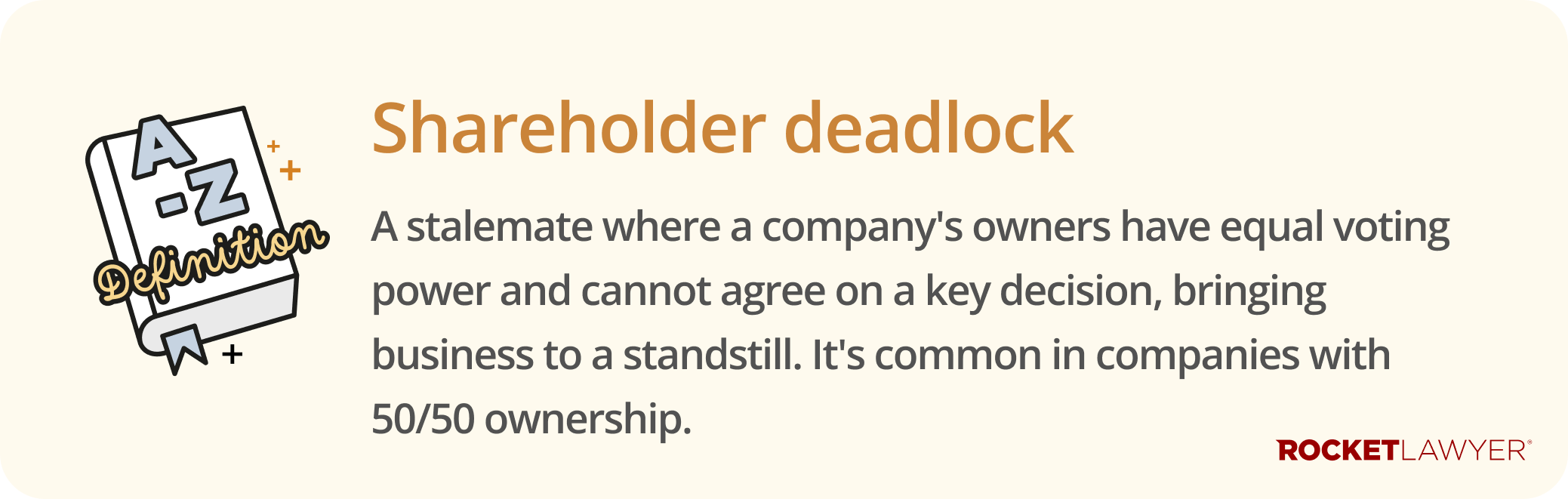
Shareholder deadlock occurs when there is a disagreement or stalemate among the owners (ie shareholders) of a company, and they are unable to reach a consensus on important decisions. This situation often arises when there is an equal division of shares or voting power among the shareholders, making it difficult to break ties and make key choices for the company. In essence, a shareholder deadlock is a standstill where no side has enough support for a decision to be made, leading to a state of gridlock within the company's decision-making processes.
Small companies with few shareholders (eg two directors who each own 50% of the shares) tend to be more susceptible to shareholder deadlock. Such companies may run into difficulties when these joint owners disagree on certain decisions. If negotiation fails, and in the absence of any explicit agreement (eg a Shareholders' agreement) specifying a method for resolving such a dispute, it may be impossible to make any decision. However, it’s important to note that shareholder deadlock not only affects small businesses with few shareholders but can cause problems whenever there is a split decision with equal shares on either side.
What types of decisions can lead to a shareholder deadlock?
There is no hard and fast rule about the types of decisions or disputes that may lead to a shareholder deadlock, as this will depend on the shareholders in question. However, common types of disputes that may cause issues between shareholders include:
-
different business strategies - where shareholders have different views on how to move their business forward (eg disagreements on how to spend funding, allocate dividends, manage the company, make investments, or restructure the company, or over whether to sell or close the company altogether). Small companies with fewer shareholders tend to be most vulnerable to this type of dispute
-
different contributions to the company - where some shareholders also work as employees (including directors) of the company, and others don’t, problems may arise due to a perceived imbalance of contributions to the business. Small companies and family-owned companies may be most susceptible to this
-
information being withheld from shareholders - if not all shareholders are fully informed of the circumstances their company is in (eg if it is facing financial difficulties), this may cause problems that lead to disagreement on key decisions
How can shareholder deadlock be resolved?
There are a number of ways to attempt to resolve a shareholder deadlock, including:
-
mediation - an independent mediator is brought in to help the shareholders come to an amicable decision
-
arbitration - an independent arbitrator is brought in to impose a decision on the shareholders
-
appointment of a non-executive director or expert - bringing in a third party to handle certain business decisions to break a deadlock
-
a new shareholder - in the case of equal shareholders who cannot find a way forward, inviting a new shareholder will ensure that a majority decision can be reached
What are the options if no resolution is reached?
If a shareholder deadlock cannot be resolved (eg if the options above are ineffective or inappropriate or cannot be agreed upon), there are several steps that can be taken to help the company move forward. These include:
-
company/share buybacks - if a shareholder wants to exit the company, and the company has the funds to buy their shares, this can solve the deadlock
-
shareholder buyouts - if a shareholder can buy another shareholder's shares in a shareholder buyout
-
third-party buyers - subject to any agreement to the contrary, a shareholder can sell their shares to a third-party investor (although other shareholders or directors can refuse to register the share transfer if there is a good reason)
-
granting a swing/casting vote to the chairperson or another third party - this will grant the chairperson or another third party (eg the company’s lawyer or accountant) power to act as a tie-breaker in deadlocks. Such a swing vote must be granted in the company’s articles of association (eg if the Articles of association enable a chairperson to have a casting vote)
-
the sale of the company - if no shareholder is able or willing to sell their shares, the shareholders can sell the entire company rather than trying to dispose of shares individually (if you need to sell your company, use our Business sale service for legal assistance)
-
court action - as a matter of last resort, shareholders can apply to the court to resolve a shareholder deadlock. This will typically result in either the court ordering an independent valuation of shares (ie so another party can buy them) or making a winding-up order (ie to close the company)
How can a shareholders' agreement help to prevent deadlock?
Shareholders' agreements protect the interests of each individual shareholder in a company and also create rules that determine how a business will deal with any disputes that arise between its shareholders. Although this may not be enough to avoid all disputes, an effective agreement can go a long way to preventing disputes from reaching the stage of deadlock. Some shareholders' agreements also specifically provide deadlock provisions, but these generally focus on shareholder buyout issues. Examples of such deadlock provisions include:
-
compulsory buyouts - allowing shareholders to buy out another shareholder using a predetermined formula for determining the price of the shares in the event of a deadlock
-
Russian roulette provisions - enabling a shareholder (‘A’) to offer to buy out another shareholder (‘B’) at a specified price. B then has limited time to either sell its interest at that price or purchase A's interest at the same price. If B fails to respond, they may be deemed to have accepted A’s offer. While a Russian roulette provision may seem drastic, it aims to prevent a shareholder from manipulating share prices. However, such a provision may not be appropriate if there are significant financial disparities between the shareholders, as this may lead to unfair price manipulation
-
Texas shoot-out provisions - allowing each shareholder to bid on other shareholders’ shares by submitting a sealed bid to a third party. The shareholder who submits the highest bid has to buy out the other shareholders. While this can be a quick way to resolve disputes, it can lead to problems where the shareholders aren’t financially equal
If you have any questions or concerns about shareholder deadlock, Ask a lawyer.