What is a contract variation?
A contract variation is a formal, legally binding change to one or more terms of an existing contract. For the variation to be valid, the parties on all sides of the contract must agree to it.
The change might be a small tweak (like updating a contact person) or a major change (like altering the price, scope of work, or key delivery dates). The key is that it alters the legal obligations, rights, or terms that were originally agreed upon.
Do I need a contract variation, an addendum, or an amendment?
You'll often hear the terms 'addendum' and 'amendment' used for contract variations. While both are legally binding changes, they're generally used in slightly different contexts:
-
an addendum typically adds something new to the original contract (eg a new exhibit, a price list, or a set of new terms)
-
an amendment typically changes a term that's already in the contract (eg changing a delivery date, removing a clause, or altering a price)
Legally, the distinction isn't critical. Both are simply types of contract variation. A document like our Contract variation is designed to handle both adding new terms and changing existing ones.
When might you need to vary a contract?
There are many reasons why you might need to change a contract. Business is rarely static, and contracts often need to adapt.
Common reasons include:
-
changing business needs - eg you might need to buy more or fewer goods from a supplier than you first thought
-
external factors - eg new laws or regulations might come into force that make the original terms non-compliant or impractical
-
inefficiencies - you might find that a process set out in the contract isn't working, and a simpler method is needed
-
correcting mistakes - you may discover an error in the original contract that needs to be fixed
-
extending a relationship - you may want to extend the length (ie the 'term') of a contract that is working well
Do all parties need to agree to a contract variation?
Yes. A contract is a binding agreement between two or more parties. You can't change it without the agreement of everyone involved. A unilateral (or one-sided) change isn't a variation; it's a breach of contract.
All parties who originally signed the contract (or their legal successors) must agree to the changes. This agreement should be clear and unambiguous to avoid disputes later.
What is a unilateral variation?
A unilateral variation is when one party has the right to change a contract's terms without the other party's agreement for each change.
This is only allowed if the original contract includes a specific clause (a 'unilateral variation clause') that clearly gives one party this right. These clauses are often very specific and limit the types of changes that can be made. For example, an Employee handbook might state that the employer can unilaterally change minor policies, like their dress code or staff uniform, without getting every employee's signature.
What happens if one party refuses to vary the contract?
If one party doesn't want to change the terms, the contract continues as it was originally written. You cannot force another party to accept a variation.
If the other party refuses a change that you feel is essential, you should look at the contract's terms about ending the contract (its 'termination clauses'). In some cases, your best option may be to end the contract (if you have the right to) and try to negotiate a new one.
If you're in this situation, it's highly recommended that you Ask a lawyer for advice before taking any action.
How do you vary a contract?
To make sure your variation is legally binding, you need to follow the correct procedure.
Checking your original contract
Before you do anything, read your original contract. Many modern contracts include a 'variation clause'. This is a specific term that sets out the exact rules you must follow to change the contract. For example, it will almost always say that any variations must be:
-
in writing
-
agreed by all parties
-
signed by authorised people from all parties
If you don't follow the process set out in your own variation clause, a court could decide that your attempted change is invalid.
Can a contract be varied orally?
While it's sometimes possible to vary a contract through a conversation or a phone call (an 'oral variation'), it's a very bad idea in a business context.
If your original contract was in writing, you should always vary it in writing. This is for certainty. If you agree to a change verbally, the other party could later forget, misunderstand, or deny what was said. A written record provides clear proof of the new agreement.
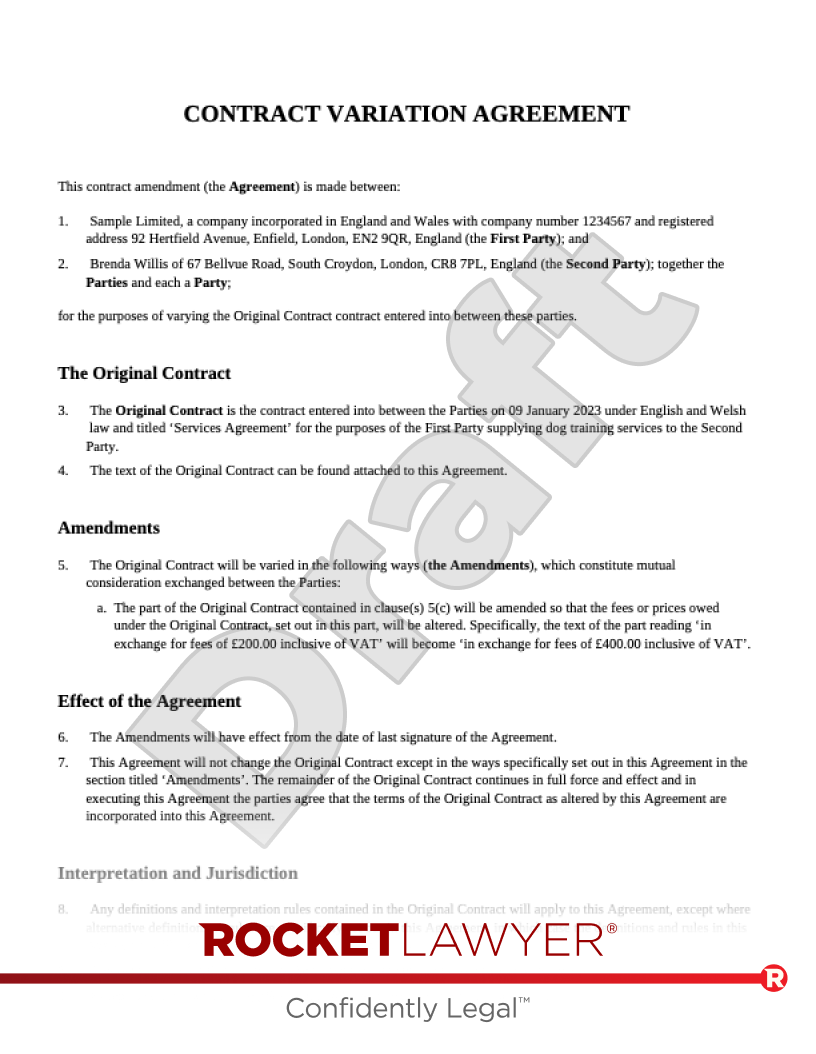
Even if your contract doesn't have a written variation clause, the best practice is always to use a written document. You can easily do this using a Contract variation. This is a separate, short document that clearly states the original contract, which clauses are being changed, and what the new wording is. It's then signed by all parties and attached to the original agreement.
What is variation by conduct?
This is when the parties' actions (ie their conduct) show that they've both agreed to a change, even if they never wrote it down or signed anything. This often happens through a sustained minor breach of the contract.
For example, if a contract states payment is due on the first of every month, but the other party consistently pays in the middle of the month (a 'minor breach'), and the first party consistently accepts this without complaint (it's 'sustained'), it might be implied that the contract term has been varied by conduct. A court could decide the new payment date is the middle of the month.
This is a very risky way to make changes as it relies on an 'implied' agreement, which can easily lead to disputes. It's always better to get a written variation.
Does a variation need new consideration or a deed?
For a variation to be legally binding, it must have a proper legal basis. This is usually achieved in one of two ways: either by new consideration or by making the variation a deed.
What is consideration?
Consideration is the legal term for the value (eg money, goods, or services) that each party gives to the other. For a contract or variation to be legal, there must generally be an exchange of consideration. For example, if you agree to pay a supplier £10 more per item, your consideration is the extra £10. The supplier's consideration is that they continue to supply you with the items.
Problems can arise if a change is one-sided. If one party isn't providing any new consideration for the change (eg if you're just agreeing to give up a right you had), the variation might not be legally binding.
For more information, read How to form a valid contract.
When should you use a deed for a variation?
If there's no new consideration for the change, the variation won't be legally binding unless you make the contract variation as a deed. This is the formal legal alternative to using consideration.
A deed is a special type of legal document that is legally binding without needing an exchange of value. Because of this, it has stricter signing rules (eg the signatures on a deed must be witnessed).
You should make your contract variation as a deed if:
-
there's no new consideration for the change (ie the change is one-sided), or
-
the original contract was made as a deed
For more information, read Execution of deeds.
What is the difference between varying, waiving, assigning, or novating a contract?
It's easy to confuse these terms, but they mean very different things:
-
varying (or amending) a contract means changing one or more of its terms. The contract itself continues, but the rules are updated
-
waiving (ie give up) a right means you choose not to enforce a specific term on a particular occasion. For example, if your client is late with a payment, you might waive your right to charge them interest this time. Be careful, as if you consistently waive a right, a court might decide you've given up that right permanently
-
assigning a contract means transferring your contractual rights (eg the right to be paid), but not your obligations, to a new third party. You can do this using a Letter assigning a contract
-
novating a contract means transferring both your rights and your obligations to a new third party. This effectively substitutes one party for another, and the original party is released from its duties. This requires a Novation agreement
If you need to change your contract, make sure you're using the right document.
If you have any questions or need to make a change to an existing contract, you can Ask a lawyer. If you're ready to make a change, you can use our Contract variation to document the new agreement.