Protecting your assets when you get married
Getting married is a big commitment, and it often means combining your financial lives. But what if you have assets you want to protect, like a business, a property you owned before the relationship, or a future inheritance? One of the most effective ways to provide clarity is with a legal agreement setting out how your finances would be handled if you were to separate. The rules for what counts as matrimonial property that can be divided on divorce differ across Great Britain, making these agreements useful everywhere.
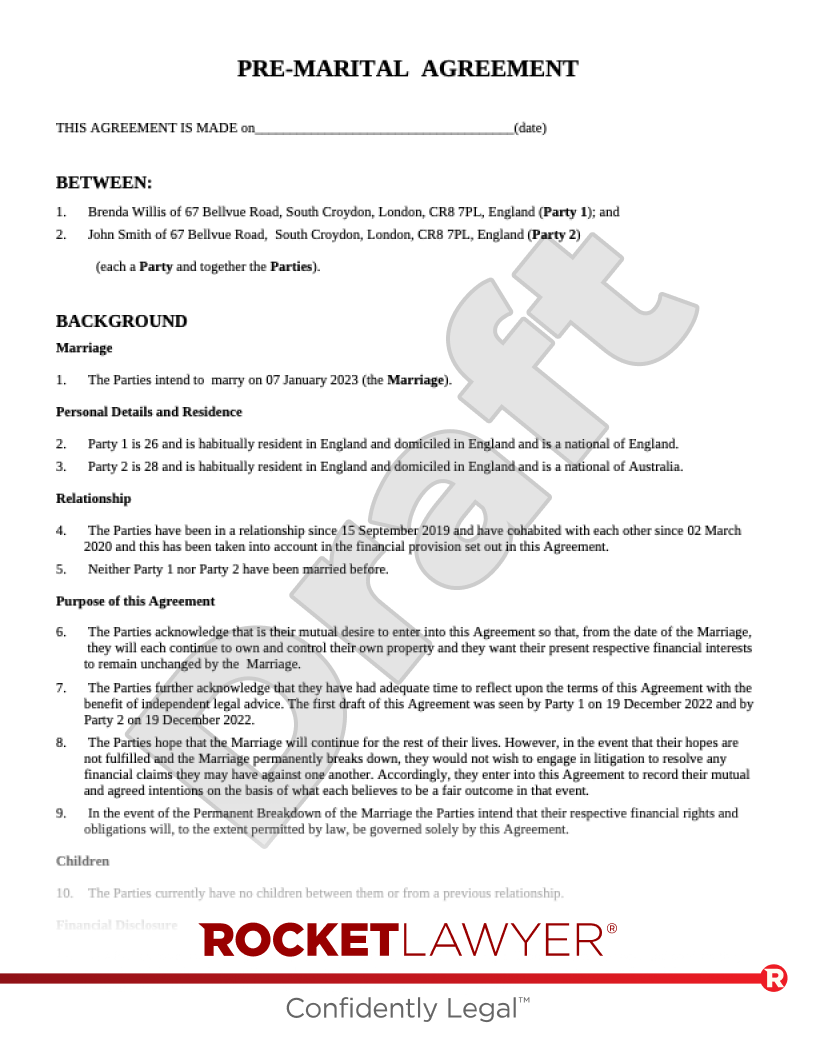
An agreement made before you marry is called a Prenuptial agreement (or 'prenup'). It’s a contract you and your partner make that outlines how your property and other assets would be divided. This provides certainty and can prevent difficult disputes down the line. If you're already married, it's not too late; you can make a similar agreement called a Postnuptial agreement.
Are prenups legally binding?
The legal status of a prenup depends on where you are in Great Britain.
In Scotland, prenuptial agreements (sometimes called 'ante-nuptial agreements') are generally considered legally binding and have a long history of being enforced by the courts, provided they were fair and reasonable when they were made.
In England and Wales, the position is different. Prenups aren't automatically legally binding in the way a commercial contract is. However, courts will give them significant weight and are very likely to uphold them as long as certain conditions are met (eg full financial disclosure and independent legal advice).
For more information, read How to make a prenuptial agreement.
The situation is similar for postnups. For more information, read Postnuptial agreements.
How does getting married affect your will?
This is one of the most important areas where the law is completely different depending on where you live.
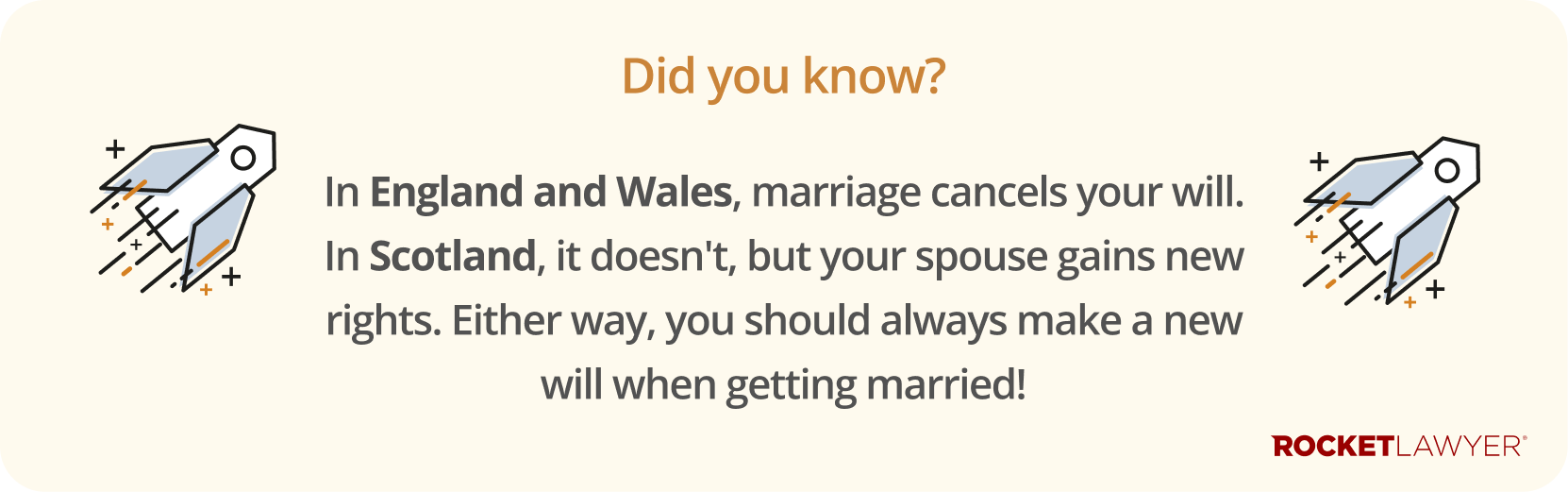
In England and Wales, getting married or forming a civil partnership automatically revokes (ie cancels) any will you've made previously. The only exception is if the will was made 'in expectation' of that specific marriage. If you don't make a new Last will and testament, the law will decide how your assets are split, which may not be what you wanted.
In Scotland, the situation is the opposite. Marriage or a civil partnership does not cancel a will you've already made. However, your spouse or civil partner may have certain legal rights to claim a share of your estate (ie everything you own), regardless of what your will says. It is, therefore, still highly recommended that you review and update your Last will and testament after marrying.
Practical steps for planning your wedding
Beyond the big legal questions, there are practical steps you can take to make sure your wedding planning runs smoothly. For a comprehensive list of tasks, you can use our Checklist for getting married.
Using contracts with wedding suppliers
When you're planning your big day, you'll be hiring various businesses for goods and services. You may need to:
-
book a wedding planner to help you plan your wedding
-
book a wedding venue or reception venue
-
hire a caterer to provide food
-
engage a photographer to capture the day
-
book a DJ or band for your reception
-
hire a florist to provide your flowers
It’s vital that you have legally binding contracts in place with all your suppliers. A contract protects you by clearly setting out what you’ve agreed to, including the services, dates, and costs. This gives you a clear record and legal standing if something goes wrong, for example, if your photographer doesn't deliver your wedding photos.
Changing your name after the ceremony
If you decide to take your spouse's surname, you don't need to make a deed poll – the process is simpler. You just need to send a copy of your marriage or civil partnership certificate to all relevant organisations with a covering letter explaining the name change. This includes government bodies like the Passport Office and the DVLA, as well as your bank and utility companies. Some authorities will insist on seeing an original certificate, so it’s a good idea to order a few extra copies.
For more information, read Changing your name.
Don't forget tax-free gifts
It's also worth knowing about the special rules for tax-free gifts when you get married or form a civil partnership. Under current inheritance tax rules, you can receive a certain amount of money as a gift without it being subject to tax.
Don’t forget to remind your family that:
-
each of your parents can give you up to £5,000
-
each of your grandparents (or great-grandparents) can give you up to £2,500
-
anyone else can give you up to £1,000
These gifts must be made on or shortly before the day of the ceremony to qualify for the exemption.
If you’re ready to protect your assets, you can make a Prenuptial agreement. You should also consider making a Will for England and Wales or a Will for Scotland to reflect your new circumstances. Remember that you can always Ask a lawyer if you have any questions.