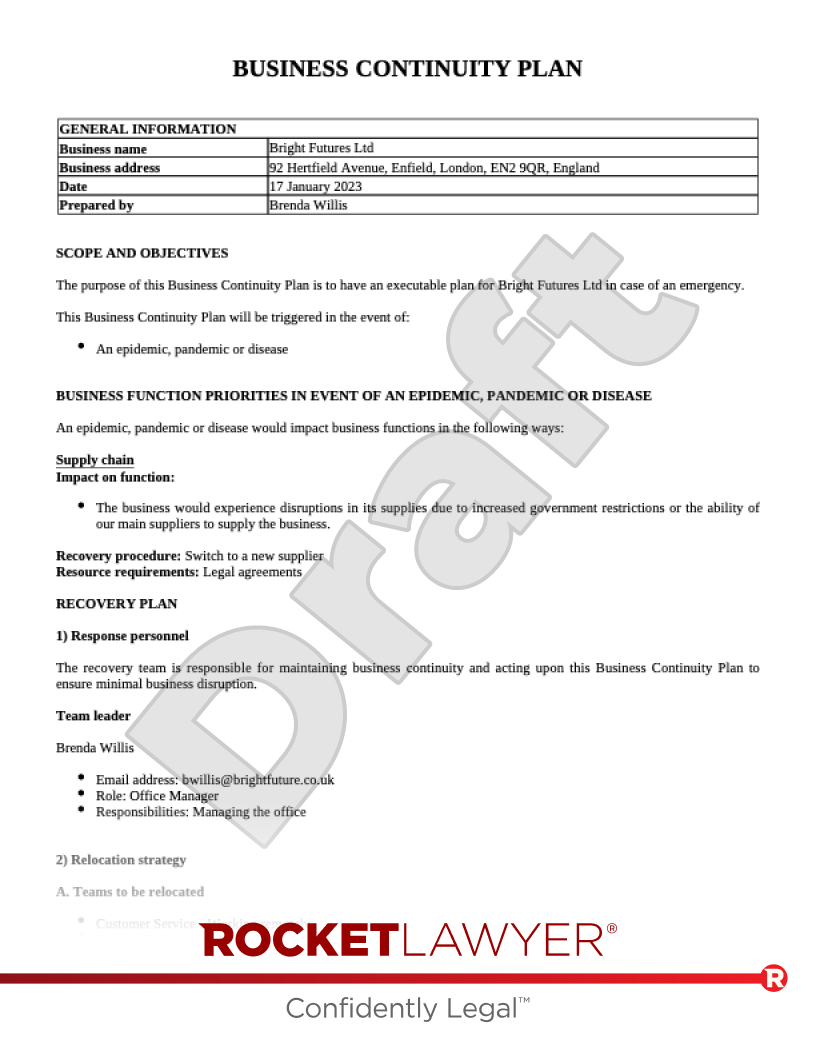
What is business contingency?
A business contingency is any event or circumstance that could affect your business but can't be predicted with certainty. These events range from small-scale disruptions, such as a key employee resigning at short notice or a supplier failing to deliver, to large-scale emergencies like a fire at your premises, a flood, or a cyberattack.
What are business contingency plans?
A Business contingency plan (sometimes called a ‘business continuity plan’, ‘disaster response plan’ or ‘disaster recovery plan’) is a written plan that sets out what your business will do if an unexpected event occurs. It identifies the risks most likely to affect your business, the operational areas those risks could impact, and the specific steps your team should take to keep things running or to recover as quickly as possible.
A good plan will typically cover:
-
who leads the response (sometimes called a ‘crisis management team’)
-
which business functions to prioritise
-
how to communicate with staff and customers
-
how often to review and test the document
Why does every business need one?
Every business, regardless of size or sector, can face an emergency, whether that's a fire, a cyberattack, a pandemic, or a key supplier collapsing. Having a plan in place before one strikes means you can react faster and with more confidence. The faster you resume normal operations, the less damage you'll suffer to revenue, customer relationships, and reputation.
There's no general legal obligation on businesses in the UK to have a business continuity plan, but certain sectors face specific requirements. Businesses operating in financial services, for example, are subject to rules from the Financial Conduct Authority (FCA) that require firms to have adequate arrangements in place to ensure continuity of service. Under the Health and Safety at Work etc. Act 1974, employers also have a duty to protect the health, safety, and welfare of their employees, and having a plan for emergency scenarios is part of meeting that duty.
Even outside regulated sectors, a business continuity plan can help you:
-
respond to disruptions quickly and with clarity
-
protect staff, customers, and suppliers
-
demonstrate preparedness to insurers, lenders, or investors
-
reduce the financial impact of unexpected events
Do you need a contingency plan if you're just starting out?
Yes. Contingency planning isn't just for established businesses. If you're starting out, it's worth thinking about potential risks from the beginning, because they don't wait for your business to find its feet.
The best place to start is your Business plan. A business plan sets out what your business does, who your customers are, and how you'll make it work. Within that, a SWOT analysis (covering Strengths, Weaknesses, Opportunities, and Threats) gives you a natural place to record the risks your business faces and how you'd respond to them.
Building contingency thinking into your business plan also signals to potential investors, lenders, or partners that you've thought carefully about long-term resilience, which can only help when you're trying to grow.
How can you prepare for a crisis?
Making a plan is the first step, but preparation doesn't stop there. Once you have a business continuity plan in place, there are a few practical things you can do to make sure it's ready to use when you need it:
-
share the plan with everyone who has a role in it, so there are no surprises in a real emergency
-
keep it up to date as your business changes, for example, when you take on new staff, move premises, or add new suppliers
-
run a BCP test, a structured exercise where you walk through the plan with your team members to check it works in practice. This might involve simulating a specific scenario, such as a fire or a data breach, to see how your team responds, identify any gaps in your recovery strategies, and update the plan accordingly
-
review the plan at least once a year, or after any significant disruption to your business
Most businesses treat crisis preparedness as an ongoing process rather than a one-off task. The more familiar your team is with the plan, the faster and more confidently they'll be able to act if something goes wrong.
You can make a Business continuity plan using our template, which walks you through all the key areas and can be tailored to your business. If you have any questions about your specific circumstances, don't hesitate to Ask a lawyer.