Facilitate transfer of assets to your Living Trust: Certification of Living Trust
What is a Certification of Living Trust?
If you need to provide third parties with information regarding a revocable Living Trust, then a Certification of Living Trust is the document for you. Certifications of Living Trust allow you to facilitate the transfer of assets to or from your Living Trust.
Typically, when a Living Trust is established, the title to investment and savings assets will be transferred into the name of the trust. The banking institution or brokerage firm that is asked to transfer the title to the assets will often require that the trustee provide copies of key provisions of the trust, as they need this information as proof of the trustee's authority to act on behalf of the trust. That's where a Certification of Trust comes in.
When to use a Certification of Living Trust:
-
You need to provide third parties with information regarding a (revocable) Living Trust.
Have questions about your Certification of Living Trust?
Whether you're preparing your Certification of Living Trust, reviewing one someone sent you, or just want to understand it better, here's how to get help.
- Understand what it says or review it. Use our AI legal assistant to ask questions about your Certification of Living Trust, understand what it says, and spot anything that may need a closer look.
- Ask an attorney a question. Connect with an attorney for legal information, with a written answer within one business day or a live consultation.
- Get advice on what to do. For privileged, confidential advice about your specific circumstances and next steps, book a Legal Advice Session with an attorney.
Sample Certification of Living Trust
The terms in your document will update based on the information you provide
 This document has been customized over 57K times
 Legally binding and enforceable
 Consult an Attorney to ask questions or review your document
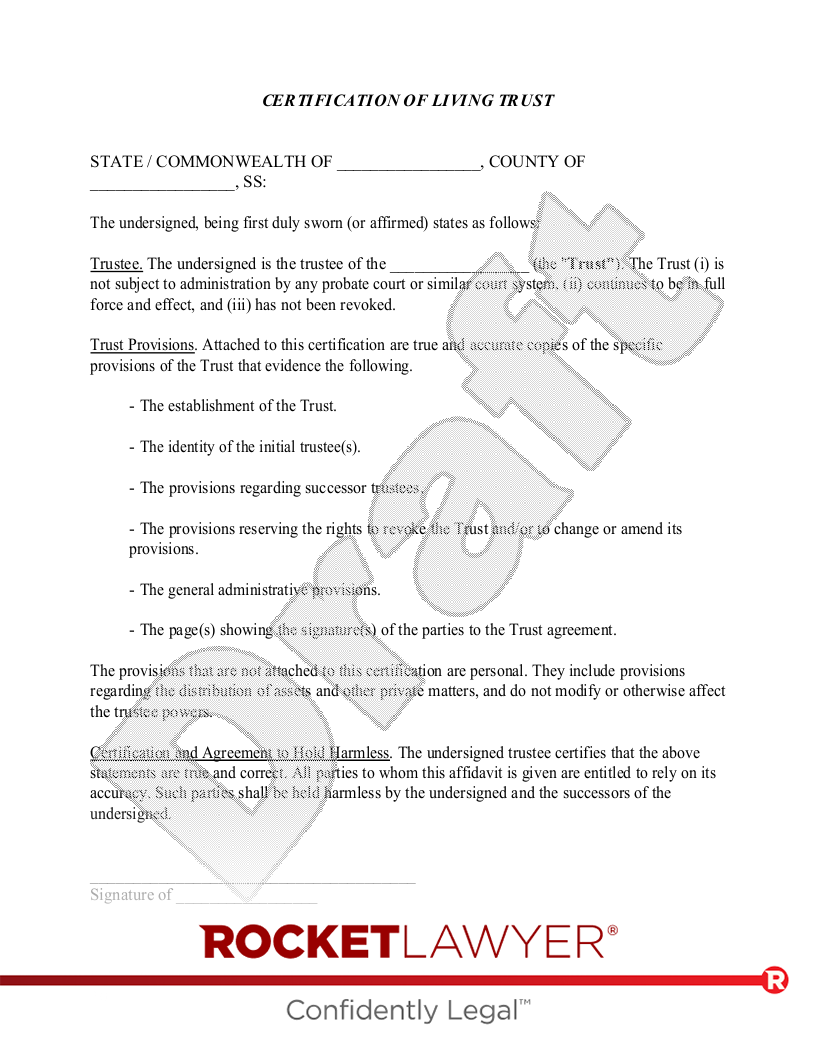
CERTIFICATION OF LIVING TRUST
STATE / COMMONWEALTH OF , COUNTY OF , SS:
The undersigned, being first duly sworn (or affirmed) states as follows:
of the (the "Trust"). The Trust (i) is not subject to administration by any probate court or similar court system, (ii) continues to be in full force and effect, and (iii) has not been revoked.
Trust Provisions. Attached to this certification are true and accurate copies of the specific provisions of the Trust that evidence the following.
- The establishment of the Trust.
The provisions that are not attached to this certification are personal. They include provisions regarding the distribution of assets and other private matters, and do not modify or otherwise affect the trustee powers.
Certification and Agreement to Hold Harmless. The undersigned that the above statements are true and correct. All parties to whom this affidavit is given are entitled to rely on its accuracy. Such parties shall be held harmless by the undersigned and the successors of the undersigned.
______________________________________
Signature of
Subscribed and sworn to (or affirmed) before me this ____ day of ____________________, 20______.
The foregoing instrument was acknowledged before me, by means of ☐ physical presence or ☐ online notarization, this _____ day of ____________________, ______ by ____________________, who is personally known to me or who has produced ________________________________ as identification.
andTrustee:
Certification of Living Trust FAQs
-
How do I get a certified copy of a trust?
Making a Certification of Living Trust online is simple. Just answer a few questions, and Rocket Lawyer will build your document for you. Consider these questions beforehand to make the process speedier:
- Who is providing the certification?
- What is the name of the trust?
- What types of provisions will be attached to the certification?
If you don't have all of the details you need, you can skip questions and save your document for later.
-
Do I need a Certificate of Trust?
Using a Certificate of Trust may not be required, but it may be preferred. When transferring investments or other financial accounts in or out of your Living Trust, banking institutions, for example, may ask to see your trust document. A Certificate of Trust can often be submitted as a replacement for the trust document. The advantage of submitting a Certificate of Trust, as opposed to your trust document, is that it does not include specific information that you may not want to share. For example, a Certificate of Trust does not name your beneficiaries or mention what they are entitled to inherit from you.
-
What is a Certification of Trust used for?
Once you have created a Living Trust or Joint Living Trust, you may want to transfer investments or other financial accounts into the name of the trust. In such scenarios, your banking institution, brokerage firm, or transfer agent may want to confirm that you have the authority to act on behalf of the trust. A Certification of Trust provides the previously mentioned institutions and individuals with the necessary information regarding the trust to facilitate the transfer.
-
What is the difference between a Certificate of Trust and a Trust Agreement?
When doing business with financial institutions, a Certificate of Trust can be used to ensure that specific assets are still in the trust and confirms that a trustee still has access to these assets. A Trust Agreement, on the other hand, is a legal contract that defines why the trust is being established, allows a trustor to name the trustee(s), specifies the property that the trust will cover, and provides instructions for holding and disbursing assets within the trust.