Provide written notice of your resignation: Resignation Letter
What is a Resignation Letter?
A Resignation Letter is a formal written notice from an employee to an employer stating that the employee intends to leave their job. Resignation Letters typically include the employee’s final working day and may explain the reason for leaving.
In many cases, a Resignation Letter also serves as a Two Weeks Notice Letter, which gives an employer advance notice before the employee’s last day. Whether submitted as a printed letter or a Resignation Letter email, this document creates a written record of an employee’s voluntary resignation.
When to use a Resignation Letter:
- You want to notify the employer in writing of your resignation and the reasons for leaving.
- You want to give advance notice of leaving a position, as may be required by the employer.
- Your employer asks for written notice of your voluntary resignation.
- You want a written record that you notified your employer that you were leaving your job.
How do I get my Resignation Letter reviewed?
If you already have a Resignation Letter and want to have it reviewed, or if you have questions about creating or using one, there are a few ways to get help.
Use Rocket Copilot to ask questions or review your document; this helps you better understand what it says and identify anything that may need a closer look.
If you are looking for help from a Legal Pro, you can also ask a question and receive a response within one business day, or request a more in-depth document review.
Sample Resignation Letter
The terms in your document will update based on the information you provide
 This document has been customized over 154.4K times
 Documents and communicates
 Consult a Legal Pro to ask questions or review your document
 Sign this document online for free with RocketSign®
,
,
Dear Sir or Madam,Dear ,
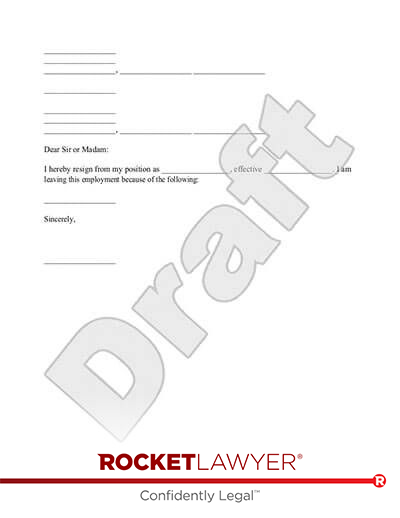
I hereby resign from my position as , effective . I am leaving this employment because of the following reasons:
-
Sincerely,
Checklist
Make It Legal™
Find out next steps for your document
___Sign this document. This document needs to be signed by:
___Everyone gets a copy. Anyone named in the document should receive a copy of the signed document. You can share your document from your account.
Important Details
The Employment Resignation Letter should be mailed or otherwise delivered to the employer immediately, in order to effectuate the advance notice provided in the letter. The letter gives the employer notice of the resignation and an opportunity to begin preparations for a replacement if necessary.
If you are resigning based on perceived unfair or discriminatory treatment, then a copy of the letter should be presented to the attorney, Equal Employment Opportunity Commission or other human rights commission office, if and when you seek legal advice or file a complaint.
About Resignation Letters
Learn about how to provide written notice of your resignation
-
Types of Resignation Letters
A Letter of Resignation can be used across many different roles. While the format of the letter is generally the same, the importance of providing written notice may vary depending on your position within the organization. In leadership or corporate roles, a Resignation Letter helps clearly document when you are stepping away from formal responsibilities. In other situations, written notice may also be important if you want a clear record of your decision to resign.
Below are common roles where submitting a Resignation Letter is especially important, along with why written notice matters in each situation.
Resignation of Officer
For CEOs, executives, and corporate officers
A Letter of Resignation may be used when stepping down from a formal officer role within a company, such as Chief Executive Officer (CEO), Chief Financial Officer (CFO), President, Secretary, or Treasurer.
Officers are typically appointed under company bylaws or operating agreements and may have fiduciary duties or decision-making authority. Providing written notice helps clearly establish the date the officer role ends, which can be important for internal records and governance purposes.
You may want to use a Resignation Letter if:
- You are resigning from an officer position, whether or not you remain employed by the company
- You are resigning from both your officer role and your employment
- The company requires written notice for corporate records
A Resignation Letter for an officer generally identifies the role being resigned, the effective date of resignation, and the individual resigning. Keeping written notice can also be helpful if questions arise later about when officer responsibilities ended.
Resignation of Director
For board members
A Letter of Resignation may also be used when stepping down from a company’s board of directors.
Directors serve in a governance role and owe fiduciary duties to the company and its shareholders. Submitting written notice helps document when those responsibilities end and allows the company to update its records accordingly. Clear documentation can be especially important if board decisions or disputes arise after a director’s departure.
A Resignation Letter may be appropriate if:
- You are resigning from a board or director position
- You serve in a governance role but are not an employee
- Formal notice is required under company bylaws or applicable law
Resignation of Incorporator
For founders and incorporators
A Letter of Resignation may be used by an incorporator who wishes to formally step away from that role.
Incorporators are often listed in formation documents filed with the state. Even if the incorporator is not involved in day-to-day operations, providing a written notice can help ensure company records accurately reflect current leadership and responsibilities.
Standard Employment Resignation Letter
For employees and non-corporate roles
Most employees can use a standard Letter of Resignation to formally notify an employer that they are leaving a job. This includes situations where an employee is providing two weeks’ notice.
For employees, a Resignation Letter focuses on ending the employment relationship by clearly stating the intent to resign and the effective date of resignation. In some cases, providing written notice can also help create a clear record if there are concerns about how a resignation may be handled or described later.
-
How to Write a Resignation Letter
A Resignation Letter should be clear, professional, and concise. In most cases, it is a formality used to document your voluntary departure and your final day of work. In some situations, keeping the letter brief and factual can also help reduce misunderstandings.
While every situation is different, most Resignation Letters follow the same basic structure.
What to say in a Resignation Letter:
- A clear statement of resignation
State that you are resigning from your position. - Your last day of employment
This is often two weeks from the date of the letter but may vary based on company policy or contract terms. - A professional tone
Keep the language polite and neutral. You may express appreciation or offer to assist with the transition, but this is optional.
You are not required to explain why you are leaving. If you choose to include a reason, it is usually best to keep it brief and neutral, particularly if you are concerned about how your resignation may be received.
What to not say in a Resignation Letter:
- Detailed explanations about your next job
- Negative comments about your employer or coworkers
- Emotional or confrontational language
The goal is to create a clear written record of your resignation without creating unnecessary conflict or confusion.
- A clear statement of resignation
-
How to Submit Your Resignation Letter
A Resignation Letter can be submitted as a printed document or sent as a Resignation Letter email. In either case, keep a copy for your records and make sure it is delivered to the appropriate person, such as your direct manager or Human Resources.
While submitting a Resignation Letter is an important step, resigning from a job often involves more than providing written notice. Taking a professional, thoughtful approach can help protect your reputation and support a smoother transition. In some situations, written notice can also be important if you want documentation of when and how you resigned.
Step 1: Decide on When to Resign and How Long Notice You’ll give
Before resigning, consider your financial situation, the start date of any new job, and whether you can afford a gap in income. Although giving two weeks’ notice is standard professional practice, it is not always legally required. In some cases, an employment contract or company policy may specify a different notice period.
If you are concerned that your employer may respond negatively or end your employment immediately, you may want to factor that risk into your timing.
Step 2: Tell Your Manager That You are Quitting
Whenever possible, inform your direct manager of your decision before submitting your Resignation Letter. This conversation is often best handled in person or via a video call.
If an in-person conversation feels uncomfortable or unsafe, you may choose to provide notice in writing first. Let your manager know that you intend to resign and confirm your planned last day of work.
Step 3: Submit Your Written Resignation Letter
After speaking with your manager, submit a formal Resignation Letter. This creates a written record of your voluntary resignation and clearly documents your final working day. Your Resignation Letter may be submitted in print or by email, depending on workplace practices.
Keeping copies of your Resignation Letter and related communications can be helpful if questions arise later.
Step 4: Prepare for the Transition
If you continue working during your notice period, it is generally best to leave on good terms. You may be asked to help transition your responsibilities, train a replacement, or create handoff materials. Continue to perform your duties professionally through your final day.
Before leaving, consider checking in with Human Resources regarding final pay, unused vacation or accrued time, retirement account options, health insurance continuation (such as COBRA), and any other outstanding employment matters.
Step 5: What to Do After You Leave
After you leave your job, take time to document your previous role and accomplishments while they are still fresh. You may also choose to request professional recommendations from managers or coworkers.
Be sure to continue honoring any non-disclosure or confidentiality obligations and properly dispose of any proprietary company information in your possession.
Resignation Letter FAQs
-
Why should I use a Resignation Letter?
A Resignation Letter provides written notice that you are voluntarily leaving your job and documents your intended last day of work. Even when a Resignation Letter is not legally required, having written notice helps avoid confusion and creates a clear record for both you and your employer.
Using a Resignation Letter can also help you leave your position in a professional manner. It allows you to formally communicate your decision, confirm timing, and ensure that your departure is documented for payroll, benefits, and internal recordkeeping purposes. Many employers request or expect written notice when an employee resigns.
-
Is a Resignation Letter the Same as a Two Weeks Notice Letter?
In most situations, yes. A Two Weeks Notice Letter is a type of Resignation Letter that specifies a last day of work that is two weeks from the date the notice is given.
A standard Resignation Letter can serve as a Two Weeks Notice Letter as long as it clearly states your final working day. While two weeks’ notice is commonly considered professional practice, some employers may request a different notice period depending on company policy, role, or employment agreement.
-
Do I have to give two weeks’ notice?
In the United States, most employment relationships operate under “at-will” employment. This generally means there is no law requiring employees to give two weeks’ notice before leaving a job.
However, there are important exceptions. If you have an employment contract, offer letter, or are part of a union or collective bargaining agreement, those documents may require advance notice. Failing to follow required notice terms could result in financial consequences or impact eligibility for certain benefits.
Even when not legally required, giving two weeks’ notice is widely viewed as a professional courtesy and can help maintain positive relationships with your employer.
-
How do I put in my two weeks notice?
Putting in your two weeks’ notice usually involves both a conversation and written notice. Many employees begin by informing their direct manager in person or by video call. This allows for a respectful, direct discussion about the decision to resign and the intended last day of work.
After that conversation, you should submit a written Resignation Letter or Two Weeks Notice Letter. This written notice serves as an official record of your resignation and confirms your final working day for scheduling, payroll, and transition planning.
-
Can I email my Resignation Letter?
Yes. A Resignation Letter can be submitted as a printed document, by email, or both. A Resignation Letter email is common, especially in remote or hybrid workplaces.
Regardless of how you submit your letter, it is a good idea to keep a copy for your records. If your last day changes, you should update your Resignation Letter and resubmit it so there is a clear and accurate record of your departure.
-
Who do I give my two weeks notice to?
Typically, your Resignation Letter should be given to your direct manager or the appropriate Human Resources representative. In many cases, you may want to inform your manager first and then provide written notice.
Submitting your Resignation Letter to the correct person helps ensure your notice is properly recorded and that next steps—such as transition planning and final pay—are handled smoothly.
-
Should I give a reason in my two week’s notice?
You are not legally required to give a reason for resigning. Whether to include a reason is often a matter of personal preference and professional judgment.
If you choose to include a reason, it is usually best to keep it brief and neutral. If you are leaving due to circumstances that could lead to a dispute or legal claim, briefly documenting your reason may be important. In those cases, you may wish to seek legal guidance before submitting your resignation.
-
Can my employer fire me after I give notice?
Be prepared, because in many states, they can. Some states are "employed-at-will" or "right-to-work" states, sometimes nicknamed "right-to-fire" states by employees, which means they can let you go from the company without a reason. In some cases, they may ask you to leave voluntarily to avoid paying unemployment. You may be protected if you have an employment contract or are part of a union. Employment laws may provide additional protections in certain situations, such as when you are part of a protected class of workers. How those laws apply depends on individual facts and circumstances.
Some states may override a company's "at-will" policies. However, be prepared to leave your company after you submit your notice, just in case. It is recommended that you be ready to be escorted out of the building. Make sure you discreetly remove personal information from your company-owned computers and devices before handing in your notice.
They may not fire you immediately, but it is best to be prepared. Many companies are perfectly fine with allowing you to work until your quit date without issues. If serious problems arise, you may benefit from consulting with an employment attorney.
-
When should I give my Letter of Resignation?
Many employees submit a Resignation Letter about two weeks before their planned last day of work. The right timing depends on your financial situation, relationship with your employer, and any contractual obligations.
If you are concerned that your employer may end your employment immediately after notice is given, you may choose to delay resigning until closer to your next start date. Regardless of timing, it is important to clearly state your intended last day in your Resignation Letter.

Our quality guarantee
We guarantee that properly executed Rocket Lawyer legal documents are legally enforceable under applicable US laws.
Need help? No problem!
Get instant answers to any legal question with Rocket Copilot! You can also connect with a Legal Pro at any time — just ask your question and choose a written response or live consult.


