Written formal request for payment: Invoice
What we’ll cover
What is an Invoice?
An Invoice is a document a seller sends to a buyer to request payment for goods or services. It lists what was sold, how much the buyer owes, and when payment is due.
Invoices typically include key transaction details such as the names of the buyer and seller, the invoice number, the date of the sale, and an itemized list of products or services with their prices. They may also include taxes, discounts, payment terms, and accepted payment methods.
Businesses use invoices to request payment, document sales, and maintain financial records for accounting, bookkeeping, and tax purposes. A clear invoice helps ensure both parties understand the transaction and the amount owed.
When to use an Invoice:
- You need to provide an itemized record of a transaction.
- You need to request payment for an itemized list of goods or services.
- You want to document a sale or purchase for bookkeeping or tax purposes.
- You want a clear record of the amount owed and payment terms.
How do I get my Invoice reviewed?
If you already have an Invoice and want to have it reviewed, or if you have questions about creating or using one, there are a few ways to get help.
Use Rocket Copilot to ask questions or review your document; this helps you better understand what it says and identify anything that may need a closer look.
If you are looking for help from a attorney, you can also ask a question and receive a response within one business day, or request a more in-depth document review.
Sample Invoice
The terms in your document will update based on the information you provide
 This document has been customized over 263K times
 Documents and communicates
 Consult an Attorney to ask questions or review your document
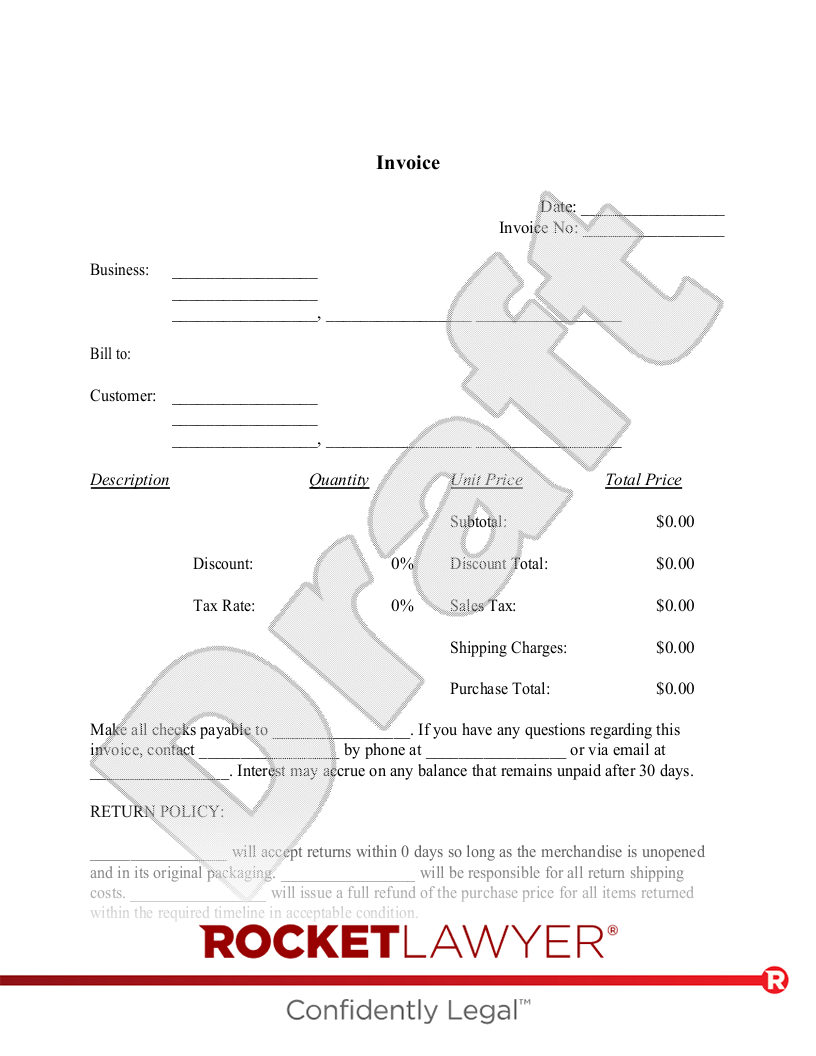
Invoice
| Date: |
| Invoice No: |
| Business: |
| , |
Bill to:
| Customer: |
| , |
| Description | Quantity | Unit Price | Total Price |
| Subtotal: |
| Discount: | % | Discount Total: |
| Tax Rate: | % | Sales Tax: |
| Shipping Charges: |
| Purchase Total: |
Make all checks payable to . If you have any questions regarding this invoice, contact by phone at or via email at . Interest may accrue on any balance that remains unpaid after 30 days.
Thank you for your business.
About Invoices
Learn about how to written formal request for payment
-
What to include in your Invoice
A professional invoice should clearly outline the details of the transaction so both the buyer and seller understand what was sold and how payment should be made.
Important information typically included in an invoice includes:
- Invoice number – A unique number used to track and reference the invoice.
- Invoice date – The date the invoice was created and sent.
- Seller information – The business name, address, phone number, and email of the seller.
- Buyer information – The client’s name and contact information.
- Description of goods or services – A clear list of the products or services provided.
- Quantity and pricing – The number of items or hours worked and the price for each.
- Taxes, discounts, or fees – Any applicable taxes, service fees, or discounts.
- Total amount due – The final amount the buyer needs to pay.
- Payment terms – When payment is due and how it should be made.
Using an invoice template can help ensure you include all of these details and present the information in a professional format.
-
What do I need to make an Invoice?
Making an Invoice online is simple. Just answer a few questions and Rocket Lawyer will build your document for you. Having the details ready can make the process much faster.
To create an Invoice, you will typically need the following information:
Invoice details
- Seller and buyer details (name, address, phone number, email, etc.)
- The invoice number
- The invoice date
- The number of days the buyer has to pay the invoice
- Details of the goods or services provided, including description, quantity, and price
- Any taxes or additional fees
- Any discounts that apply
- Purchase order number and date, if a purchase order was used
Payment information
You may also want to specify the payment methods you accept, such as:
- Credit card
- Debit card
- Bank transfer
- Check
- Cash
Including payment details helps ensure customers know exactly how and where to send payment.
-
Invoice vs. Bill of Sale
Invoices are sometimes confused with Bills of Sale, but they serve different purposes.
An Invoice is sent by the seller to request payment after goods or services have been delivered. It lists the items sold, the total amount owed, and the payment due date.
A Bill of Sale is issued after payment has been made. It confirms that ownership of an item has transferred from the seller to the buyer and serves as proof that the transaction is complete.
In simple terms, an invoice requests payment, while a bill of sale confirms that payment has already been made.
-
What happens if the customer does not pay the Invoice?
Your invoice should include clear payment terms and a due date to help avoid confusion. However, there may still be situations where payment is delayed or not made.
If a customer does not pay by the due date, businesses may choose to:
- Contact the customer with a payment reminder.
- Send a past-due notice or collection letter, like a 60-Day Past Due Letter.
- Charge interest on late payments (if this was disclosed in advance).
If you plan to charge interest for late payments, it is important to specify this in your contracts, invoices, or payment terms from the beginning. Including the interest rate and when interest begins to accrue can help encourage timely payment.
Whatever the case may be, Rocket Lawyer is here to help you out if you run into a nonpayment issue or any other dispute. If you have questions about an invoice or anything to do with your business, you can always ask an attorney.
-
How to make an Invoice
Creating an invoice is straightforward when you follow a few simple steps.
-
Start with a template
Using an invoice template can help ensure all required information is included. -
Enter your business information
Add your business name, address, and contact details. -
Add the client’s information
Include the name and contact details of the person or business being billed. -
Assign an invoice number
Use a unique number for each invoice to help with recordkeeping. -
List goods or services provided
Include descriptions, quantities, hours worked, or other relevant details. -
Calculate the total amount due
Add pricing, taxes, and any applicable discounts. -
Review and send the invoice
Double-check the information before sending it to your customer.
Using the Rocket Lawyer Invoice template can simplify this process and help you create a clear, professional invoice in minutes.
-
Invoice FAQs
-
Am I legally required to issue Invoices?
Most of the time, no. However, it is good practice for businesses to generate invoices as part of their transaction process. If a customer requests an invoice, you generally should provide one.
Invoices can help facilitate quicker payments and reduce misunderstandings. They are also useful documentation if you need to pursue payment for an unpaid bill.
-
How can Invoices help with my tax returns?
Invoices contain itemized charges and transaction records, which help businesses organize financial information. They can serve as proof of income and expenses for tax reporting, bookkeeping, and calculating profits or turnover.
-
How do I create my own Invoice?
With Rocket Lawyer, creating an invoice is simple. Just answer a few questions and we will generate the document for you.
If you need to make changes later, you can edit the invoice online or download it in Word format.
Remember that if you have any questions you can easily ask an attorney.
-
What is usually included in an Invoice?
Invoices typically include:
- The word "Invoice" at the top of the document
- A unique invoice number
- Seller contact details
- Buyer contact details
- Description of goods or services provided
- Date of sale or services
- Price and payment information
If the invoice has already been paid, you may also include the payment date and payment method.
-
What is an appropriate payment period for an Invoice?
An Invoice can (and should) include a reminder of the payment period, or a preferred payment due date if one was not discussed.
Many small businesses require payment upon receipt of an invoice or within 14 calendar days but larger organizations may agree to up to 60 days (or longer, if reasonable for both businesses). If there is no specific payment period, clients may want to check with the business after receipt of the Invoice. Generally, 30 days is considered to be the standard payment period amongst businesses.
-
What payment methods can I set out in an Invoice?
Common payment methods include credit cards, debit cards, bank transfers, checks, or electronic payment services.
If you accept card payments, you may want to specify which card networks you accept. If you accept checks, include the name the check should be made out to and the mailing address. For bank transfers, include the correct account and routing information.

Our quality guarantee
We guarantee that properly executed Rocket Lawyer legal documents are legally enforceable under applicable US laws.
Need help? No problem!
Get instant answers to any legal question with Rocket Copilot! You can also connect with a Legal Pro at any time — just ask your question and choose a written response or live consult.


