Rent out a warehouse space: Warehouse Lease
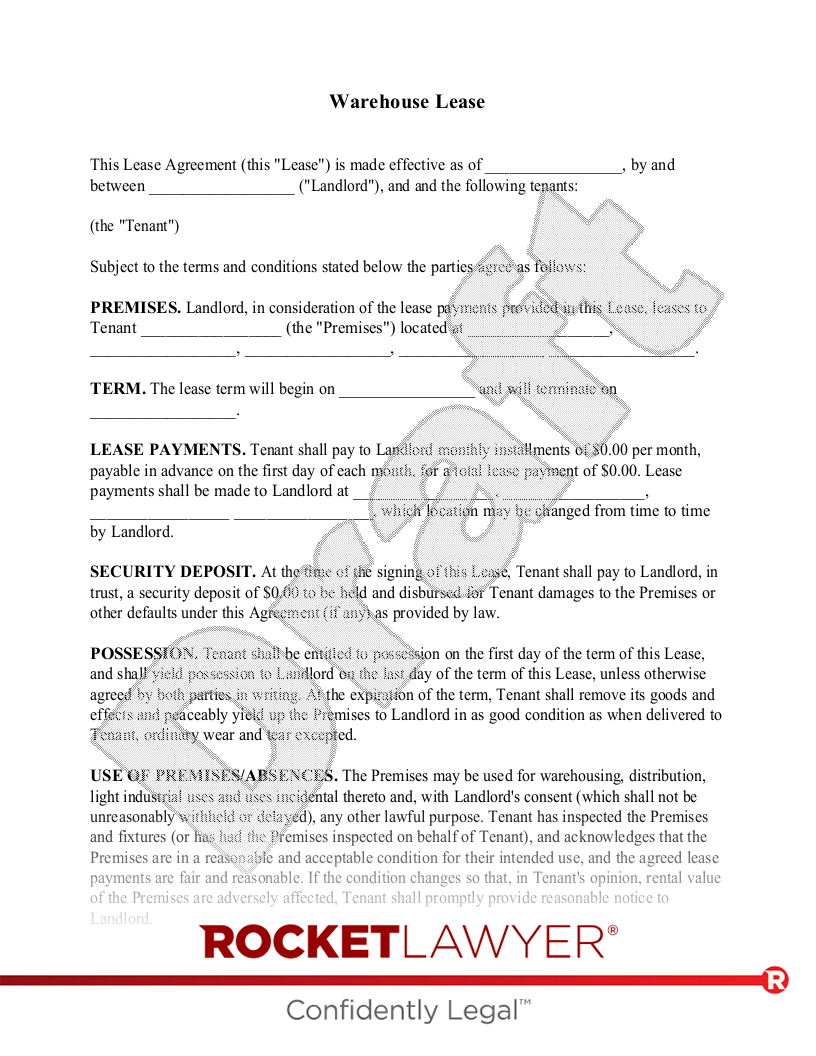
What is a Warehouse Lease?
As a warehouse owner, you can make and sign Warehouse Leases to safeguard your interests when renting out your property. Signed by both the commercial warehouse owner and the tenant (respectively called the "lessor" and the "lessee"), this document can help each party to set appropriate expectations.
When to use a Warehouse Lease:
- You own warehouse property that will be leased to a tenant.
- You own storage units that will be leased to a tenant.
- You want to lease a warehouse or storage facility from a landlord who does not have a lease form.
How do I get my Warehouse Lease reviewed?
If you already have a Warehouse Lease and want to have it reviewed, or if you have questions about creating or using one, there are a few ways to get help.
Use Rocket Copilot to ask questions or review your document; this helps you better understand what it says and identify anything that may need a closer look.
If you are looking for help from a attorney, you can also ask a question and receive a response within one business day, or request a more in-depth document review.
Sample Warehouse Lease
The terms in your document will update based on the information you provide
 This document has been customized over 12.8K times
 Legally binding and enforceable
 Consult an Attorney to ask questions or review your document
 Sign this document online for free with RocketSign®
Warehouse Lease
and and the following tenants:
(the "Tenant")
Subject to the terms and conditions stated below the parties agree as follows:
PREMISES. Landlord, in consideration of the lease payments provided in this Lease, leases to Tenant (the "Premises") located at , , , .
TERM. The lease term will begin on and will terminate on .
LEASE PAYMENTS. Tenant shall pay to Landlord monthly installments of per month, payable in advance on the first day of each month, for a total lease payment of . Lease payments shall be made to Landlord at , , , which location may be changed from time to time by Landlord.
Interest will be paid on this account as follows: percent, .
Upon the vacating of the premises for termination of the lease, Landlord shall have fifteen (15) days to return the security deposit together with interest if otherwise required, or in which to give Tenant written notice by certified mail to Tenant's last known mailing address of his or her intention to impose a claim on the deposit and the reason for imposing the claim. The notice shall contain a statement in substantially the following form:
This is a notice of my intention to impose a claim for damages in the amount of _____ upon your security deposit, due to _____. It is sent to you as required by Section 83.49(3), Florida Statutes. You are hereby notified that you must object in writing to this deduction from your security deposit within 15 days from the time you receive this notice or I will be authorized to deduct my claim from your security deposit. Your objection must be sent to (landlord's address).
If Landlord fails to give the required notice within the 15-day period, he or she forfeits the right to impose a claim upon the security deposit.
Unless Tenant objects to the imposition of Landlord's claim or the amount thereof within fifteen (15) days after receipt of Landlord's notice of intention to impose a claim, Landlord may then deduct the amount of his or her claim and shall remit the balance of the deposit to Tenant within thirty (30) days after the date of the notice of intention to impose a claim for damages.
If either party institutes an action in a court of competent jurisdiction to adjudicate the party's right to the security deposit, the prevailing party is entitled to receive his or her court costs plus a reasonable fee for his or her attorney. The court shall advance the cause on the calendar.
Compliance with this section by an individual or business entity authorized to conduct business in this state, including Florida-licensed real estate brokers and salespersons, shall constitute compliance with all other relevant Florida Statutes pertaining to security deposits held pursuant to a rental agreement or other landlord-tenant relationship. Enforcement personnel shall look solely to this section to determine compliance. This section prevails over any conflicting provisions in Chapter 475 and in other sections of the Florida Statutes, and shall operate to permit licensed real estate brokers to disburse security deposits and deposit money without having to comply with the notice and settlement procedures contained in Section 475.25(1)(d).
To the Tenant: You must notify your Landlord in writing within 4 days after you move of a forwarding address where you can be reached and where you will receive mail; otherwise your Landlord shall be relieved of sending you an itemized list of damages and the penalties adherent to that failure.
Landlord may withhold only that portion of the security deposit necessary to (1) remedy any default in the payment of rent, (2) repair damage to the premises, except ordinary wear and tear, caused by Tenant, and (3) clean the premises if necessary.
POSSESSION. Tenant shall be entitled to possession on the first day of the term of this Lease, and shall yield possession to Landlord on the last day of the term of this Lease, unless otherwise agreed by both parties in writing. At the expiration of the term, Tenant shall remove its goods and effects and peaceably yield up the Premises to Landlord in as good condition as when delivered to Tenant, ordinary wear and tear excepted.
USE OF PREMISES/ABSENCES. The Premises may be used for warehousing, distribution, light industrial uses and uses incidental thereto and, with Landlord's consent (which shall not be unreasonably withheld or delayed), any other lawful purpose. Tenant has inspected the Premises and fixtures (or has had the Premises inspected on behalf of Tenant), and acknowledges that the Premises are in a reasonable and acceptable condition for their intended use, and the agreed lease payments are fair and reasonable. If the condition changes so that, in Tenant's opinion, rental value of the Premises are adversely affected, Tenant shall promptly provide reasonable notice to Landlord.
PROPERTY INSURANCE. Landlord and Tenant shall each be responsible to maintain appropriate insurance for their respective interests in the Premises and property located on the Premises.
MAINTENANCE. Landlord shall have the responsibility to maintain the Premises in good repair at all times and perform all repairs necessary to satisfy any implied warranty of habitability
UTILITIES AND SERVICES.
TAXES. Landlord shall pay all real estate taxes which may be levied against the Premises.
TERMINATION UPON SALE OF PREMISES. Notwithstanding any other provision of this Lease, Landlord may terminate this lease upon sixty (60) days` written notice to Tenant that the Premises have been sold.
DESTRUCTION OR CONDEMNATION OF PREMISES. If the Premises are damaged or destroyed by fire or other casualty to the extent that enjoyment of the dwelling unit is substantially impaired, Landlord, in its sole discretion may elect to repair the Premises or terminate the Lease upon thirty (30) days' written notice to Tenant. If the Premises are condemned or cannot be repaired, this Lease will terminate upon twenty (20) days' written notice by either party.
DEFAULTS. Tenant shall be in default of this Lease if Tenant fails to fulfill any lease obligation or term by which Tenant is bound. Subject to any governing provision of law to the contrary, if Tenant fails to cure any financial obligation within days (or any other obligation within days) after written notice of such default is provided by Landlord to Tenant, Landlord may elect to cure such default and the cost of such action shall be added to Tenant's financial obligations under this Lease. All sums of money or charges required to be paid by Tenant under this Lease shall be additional rent, whether or not such sums or charges are designated as "additional rent." The rights provided by this paragraph are cumulative in nature and are in addition to any other rights afforded by law.
HOLDOVER. If Tenant maintains possession of the Premises for any period after the termination of this Lease ("Holdover Period"), Tenant shall pay to Landlord lease payment(s) during the Holdover Period at a rate equal to 150% of the most recent rate preceding the Holdover Period. Such holdover shall constitute a month-to-month extension of this Lease.
CUMULATIVE RIGHTS. The rights of the parties under this Lease are cumulative, and shall not be construed as exclusive unless otherwise required by law.
NON-SUFFICIENT FUNDS. Tenant shall be charged the maximum amount allowable under applicable law for each check that is returned to Landlord for lack of sufficient funds.
REMODELING OR STRUCTURAL IMPROVEMENTS. Tenant shall have the obligation to conduct any construction or remodeling (at Tenant's expense) that may be required to use the Premises as specified above. Tenant may also construct such fixtures on the Premises (at Tenant's expense) that appropriately facilitate its use for such purposes. Such construction shall be undertaken and such fixtures may be erected only with the prior written consent of Landlord, which shall not be unreasonably withheld. At the end of the lease term, Tenant shall be entitled to remove (or at the request of Landlord, shall remove) such fixtures, and shall restore the Premises to substantially the same condition of the Premises at the commencement of this Lease.
ACCESS BY LANDLORD TO PREMISES. Subject to Tenant's consent, (which shall not be unreasonably withheld), Landlord shall have the right to enter the Premises to make inspections, provide necessary services, or show the unit to prospective buyers, mortgagees, tenants or workers. However, Landlord does not assume any liability for the care or supervision of the Premises. As provided by law, in the case of an emergency, Landlord may enter the Premises without Tenant's consent. During the last three months of this Lease, or any extension of this Lease, Landlord shall be allowed to display the usual "To Let" signs and show the Premises to prospective tenants.
DANGEROUS MATERIALS. Tenant shall not keep or have on the Premises any article or thing of a dangerous, flammable, or explosive character that might substantially increase the danger of fire on the Premises, or that might be considered hazardous by a responsible insurance company, unless the prior written consent of Landlord is obtained and proof of adequate insurance protection is provided by Tenant to Landlord.
MECHANICS LIENS. Neither Tenant nor anyone claiming through the Tenant shall have the right to file mechanics liens or any other kind of lien on the Premises and the filing of this Lease constitutes notice that such liens are invalid. Further, Tenant agrees to (1) give actual advance notice to any contractors, subcontractors or suppliers of goods, labor, or services that such liens will not be valid, and (2) take whatever additional steps that are necessary in order to keep the premises free of all liens resulting from construction done by or for the Tenant.
SUBORDINATION OF LEASE. This Lease is subordinate to any mortgage that now exists, or may be given later by Landlord, with respect to the Premises.
ASSIGNABILITY/SUBLETTING. Tenant may not assign or sublease any interest in the Premises, nor assign, mortgage or pledge this Lease, without the prior written consent of Landlord, which shall not be unreasonably withheld.
NOTICE. Notices under this Lease shall not be deemed valid unless given or served in writing and forwarded by mail, postage prepaid, addressed to the party at the appropriate address set forth below. Such addresses may be changed from time to time by either party by providing notice as set forth below. Notices mailed in accordance with these provisions shall be deemed received on the third day after posting.
LANDLORD:
,
TENANT:
GOVERNING LAW. This Lease shall be construed in accordance with the laws of the State of .
ENTIRE AGREEMENT/AMENDMENT. This Lease contains the entire agreement of the parties and there are no other promises, conditions, understandings or other agreements, whether oral or written, relating to the subject matter of this Lease. This Lease may be modified or amended in writing, if the writing is signed by the party obligated under the amendment.
SEVERABILITY. If any portion of this Lease shall be held to be invalid or unenforceable for any reason, the remaining provisions shall continue to be valid and enforceable. If a court finds that any provision of this Lease is invalid or unenforceable, but that by limiting such provision it would become valid and enforceable, then such provision shall be deemed to be written, construed, and enforced as so limited.
WAIVER. The failure of either party to enforce any provisions of this Lease shall not be construed as a waiver or limitation of that party's right to subsequently enforce and compel strict compliance with every provision of this Lease.
BINDING EFFECT. The provisions of this Lease shall be binding upon and inure to the benefit of both parties and their respective legal representatives, successors and assigns.
LANDLORD:
| By: | Date: |
TENANT:
| By: | Date: |
Landlord:
and .| _____ |
Warehouse Lease FAQs
-
Is this Warehouse Rental Agreement legally binding under state law?
Yes, a Warehouse Rental Agreement is a binding contract and is enforceable by law. Once signed, both parties are obligated to follow the terms outlined in the agreement until it expires.
Creating a legally enforceable Warehouse Rental Agreement is simple with Rocket Lawyer. If you need additional support, you can connect with a attorney, or you can get quick answers or request a fast document review from Rocket Copilot.
-
Is it mandatory to write a Warehouse Rental Agreement?
Even if this is your first time renting out your property, it is critical to record the details of each rental in a lease. These benefits might help your decision-making:
- There is no confusion about rent or fees charged
- Neither party is surprised by how long the rental period will last
- The warehouse owner and tenant(s) understand the scope of their responsibilities
If you or the renter decide against signing a Warehouse Rental Agreement, you might not get to enjoy all of the aforementioned benefits and protections.
-
How should a Warehouse Lease template be structured?
The details that may be necessary to cover in your Warehouse Lease are listed below:
- A description of your property
- Each renter's contact information
- What the duration of the lease is
- How much the rental fee is and when payment is due
As you may expect from a document like this one, any Warehouse Lease built with Rocket Lawyer will also contain language around past due fees, governing law, and liability. Using the document tool, you are able to implement more customization, if needed.
-
Can I make a custom Warehouse Rental Agreement for free?
Fortunately, you don't need to reinvent the wheel to put your contract in writing. With Rocket Lawyer, anyone can make Warehouse Leases online very easily. Your document will be constructed section by section as you answer simple questions to enter more information along the way. Ordinarily, given the level of customization, you might end up paying a traditional law firm fees in the hundreds of dollars, if not more.
-
Would I have to take additional actions after I make my Warehouse Lease?
After creating your Warehouse Lease Agreement, the next step is to review it carefully and have all parties sign it. Once signed, each party should keep a copy for their records.
Depending on your situation, you may also need to take additional steps to comply with local laws—such as providing required disclosures, collecting a security deposit in accordance with local and state regulations, and ensuring the property meets applicable housing standards.
Before signing, make sure all parties fully understand and agree to the terms of the lease. Once finalized, the agreement should be signed by both the landlord and tenant, and each party should keep a copy for their records. It’s also a good idea to store the document in a safe, accessible place in case you need to reference it later.
-
How do I have my Warehouse Leases reviewed by an attorney?
It’s always a smart idea to have an important agreement reviewed before you sign, so you fully understand the terms and avoid potential risks.
While some attorneys may review documents they didn’t draft, others may decline or require a retainer, hourly billing, or a flat fee. This can make getting a contract review less predictable and more time-consuming.
Rocket Lawyer makes the process simpler. With a Rocket Lawyer membership, you can request a review from an attorney or ask questions about your Warehouse Lease. You can also use Rocket Copilot to quickly review your agreement, spot potentially risky terms, and make sure everything looks accurate before signing.
Once you’re ready, you can sign your document online with RocketSign—all in one place.


