Set expectations for employee use of social media: Social Media Contract
What is a Social Media Contract?
A Social Media Contract doesn't have to be rigid. You aren't creating this document so you can micromanage every employee's Twitter, after all. Rather, it makes sure that your employees' presence on social media doesn't reflect poorly on your company, whether they're running your brand's online persona or simply maintaining their own accounts. Generally, having employees who are active on social media is a great thing for a growing business. They can be your evangelists, increase your reputation, and talk about how much fun it is to work for you. You don't want to nip that in the bud. Instead, you just want to make sure nobody says anything that might put your business in an uncomfortable spot. It's a good idea, for example, to ask employees to proclaim their personal accounts are solely their own opinions, not that of your company.
When to use a Social Media Contract:
- You want to set rules around your employee's use of Twitter, Facebook, and other social media
- You want to put someone in charge of social media at your company
How do I get my Social Media Contract reviewed?
If you already have a Social Media Contract and want to have it reviewed, or if you have questions about creating or using one, there are a few ways to get help.
Use Rocket Copilot to ask questions or review your document; this helps you better understand what it says and identify anything that may need a closer look.
If you are looking for help from a attorney, you can also ask a question and receive a response within one business day, or request a more in-depth document review.
Sample Social Media Contract
The terms in your document will update based on the information you provide
 This document has been customized over 16.4K times
 Legally binding and enforceable
 Consult an Attorney to ask questions or review your document
 Sign this document online for free with RocketSign®
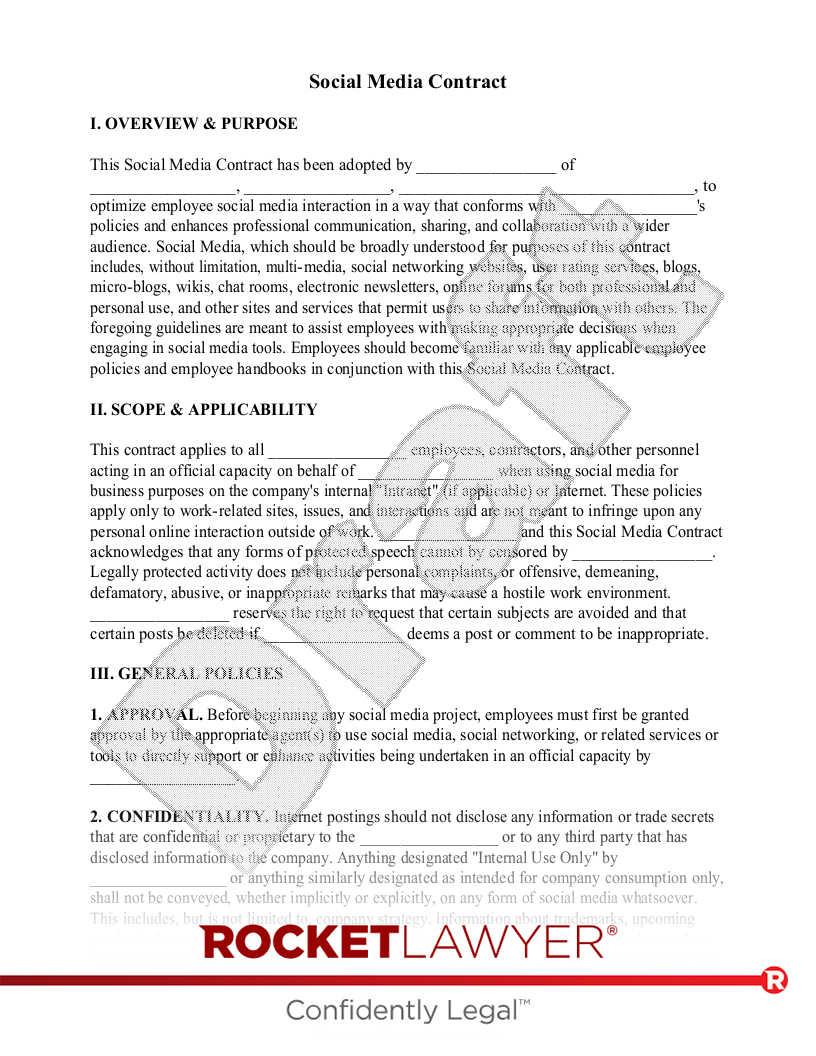
Social Media Contract
I. OVERVIEW & PURPOSE
This Social Media Contract has been adopted by of , , , to optimize employee social media interaction in a way that conforms with 's policies and enhances professional communication, sharing, and collaboration with a wider audience. Social Media, which should be broadly understood for purposes of this contract includes, without limitation, multi-media, social networking websites, user rating services, blogs, micro-blogs, wikis, chat rooms, electronic newsletters, online forums for both professional and personal use, and other sites and services that permit users to share information with others. The foregoing guidelines are meant to assist employees with making appropriate decisions when engaging in social media tools. Employees should become familiar with any applicable employee policies and employee handbooks in conjunction with this Social Media Contract.
II. SCOPE & APPLICABILITY
This contract applies to all employees, contractors, and other personnel acting in an official capacity on behalf of when using social media for business purposes on the company's internal "Intranet" (if applicable) or Internet. These policies apply only to work-related sites, issues, and interactions and are not meant to infringe upon any personal online interaction outside of work. and this Social Media Contract acknowledges that any forms of protected speech cannot by censored by . Legally protected activity does not include personal complaints, or offensive, demeaning, defamatory, abusive, or inappropriate remarks that may cause a hostile work environment. reserves the right to request that certain subjects are avoided and that certain posts be deleted if deems a post or comment to be inappropriate.
III. GENERAL POLICIES
. APPROVAL. Before beginning any social media project, employees must first be granted approval by the appropriate agent(s) to use social media, social networking, or related services or tools to directly support or enhance activities being undertaken in an official capacity by .
. CONFIDENTIALITY. Internet postings should not disclose any information or trade secrets that are confidential or proprietary to the or to any third party that has disclosed information to the company. Anything designated "Internal Use Only" by or anything similarly designated as intended for company consumption only, shall not be conveyed, whether implicitly or explicitly, on any form of social media whatsoever. This includes, but is not limited to, company strategy, information about trademarks, upcoming product releases, sales, finances, number of products sold, number of employees, and any other information that has not been publicly released by . These items are given as an example only and do not cover the range of what the company considers confidential and proprietary. Employees should explicitly identify all copyrighted materials or information, obtain permission to post when necessary, and give credit to original authors.
. OWNERSHIP. Employees who engage in social media should define what materials belong to the company and what materials belong to the employee. Internet and blog posts created during nonworking hours on topics unrelated to the business typically belong to the employee. It is permissible to quote or retweet others, but employees should not attempt to pass off someone else's words, photography, or other information as their own. All copyright, privacy, and other laws that apply offline apply online as well. Employees should always give proper credit when posting a link or information gathered from another source. Any social media contacts, including "followers" or "friends," that are acquired through accounts (including, but not limited to email addresses, blogs, Twitter, Facebook, Youtube, or other social media networks) created on behalf of are the property of
. TRANSPARENCY AND DISCLOSURES. If an employee is granted permission to publicly share what a client, partner, or other organization is doing, such as launching a new website or coming out with a new product, the employee must disclose his/her relationship to the other party. Employees are not permitted to discuss an organization or product in social media in exchange for money. If an employee receives a product or service to review for free, the employee must disclose it in his/her post or review.
. ONLINE DISCRIMINATION & HARASSMENT. shall not tolerate, under any circumstances, without exception, any online behavior that is explicitly or implicitly discriminatory based on race, creed, religion, color, age, disability, pregnancy, marital status, parental status, veteran status, military status, domestic violence victim status, national origin, political affiliation, sex, predisposing genetic characteristics, and any other status protected by the law. This list is not exhaustive. In some cases, local laws and regulations may provide greater protections than those described in this contract.
. POLICY ON BLOCKING SOCIAL MEDIA SITES.
IV. CODE OF CONDUCT
. BLOGGING.
. MICRO-BLOGGING (TWITTER). All official users are identified at .
. ONLINE SOCIAL NETWORKING (FACEBOOK). Employees who are allowed to participate on social networking sites for will be identified as .
. SOCIAL VIDEO (YOUTUBE).
. ONLINE FORUMS AND DISCUSSION BOARDS. In publicly accessible online forums, employees are not to discuss information that is not already considered public information. The discussion of sensitive, proprietary, or classified information is strictly prohibited. This policy applies even in circumstances where password or other privacy controls are implemented. Failure to comply may result in disciplinary action at the discretion of .
V. REVIEWING & AMENDING THE TERMS
This Social Media Contract may be reviewed by the proper agents at from time to time. may revise and update this Social Media Contract to incorporate new and emerging social media sites and trends that could potentially affect .
VI. VIOLATIONS
Any employee engaging in behavior that violates this contract will be subject to disciplinary action, including the possible termination of employment, whether or not an actual law has been violated. Each person at is personally responsible, and may be legally liable, for the content he or she publishes online. Employees can be sued for not disclosing their relationship to the Company, or for purposely spreading false information. Employees can also be sued by other company employees, competitors, and any individual or company that views any commentary, content, or images as defamatory, pornographic, proprietary, harassing, libelous or creating a hostile work environment.
VII. SIGNATORIES AND EFFECTIVE DATE
Implementation of the terms of this contract will be effective as of .
[SIGNATURE PAGE FOLLOWS]
EMPLOYEE
| By: | Date: |
,
APPROVED BY
| By: | Date: |
,
Social Media Contract FAQs
-
Why would I write a contract for social media use?
Whether your company is active on social media or not, it's a smart idea to create a Social Media Contract with your employees. After all, social media is omnipresent and your employees can very easily be seen as a reflection of your company's culture and values. That's why it's important to set out some rules about what your employees can and can't say in a Social Media Contract, as well as who exactly gets access to your official social media channels.
-
What might I traditionally pay for an attorney to create a simple social media contract template?
Attorney fees for drafting or reviewing a Social Media Contract can vary widely. Many lawyers charge hourly rates that may range from around $100 for less experienced attorneys to $350 or more per hour for highly experienced attorneys in major metropolitan areas. For more routine documents, some attorneys may offer flat-fee pricing.
The total cost will depend on several factors, including your location, the attorney’s experience, and the complexity of your agreement. More documents or situations involving negotiation will typically require more time and increase the overall cost.
With Rocket Lawyer, you can create a personalized Social Media Contract tailored to your specific needs—without the high cost typically associated with hiring a lawyer. If you have questions or want additional peace of mind, you can also get your document reviewed or ask an attorney for guidance.
-
What should I do next after creating my Social Media Agreement for employees?
After drafting your Social Media Contract, review it carefully. You may also want to review it with the other party to ensure all parties fully understand and agree to the terms of the agreement. Once all parties agree to the terms, the next step is to have all parties sign it, and each party should keep a copy for their records. It’s also a good idea to store it in a safe, accessible place in case you need to reference it later.
-
Should I get my Social Media Contracts reviewed by a lawyer?
It’s smart to have an important agreement reviewed before you sign, so you fully understand the terms and avoid potential risks.
While some attorneys may review documents they didn’t draft, others may decline or require a retainer, hourly billing, or a flat fee. This can make getting a legal document review of your Social Media Contract less predictable and more time-consuming.
Rocket Lawyer makes the process simpler. With a Rocket Lawyer membership, you can request a review from an attorney or ask questions about your Social Media Contract. You can also use Rocket Copilot to quickly review your agreement, spot potentially risky terms, and make sure everything looks accurate before signing.
Once you’re ready, you can sign your document online with RocketSign—all in one place.


