
What Is Legal Separation?
Legal separation is a court-recognized arrangement that allows married spouses to live apart while remaining legally married. Through a legal separation, couples can formalize decisions about property division, spousal support, child custody, and child support without ending the marriage.
Legal separation is sometimes used as a temporary step before divorce, but it can also be a long-term alternative for couples who do not wish to dissolve their marriage.
Reasons Couples Choose Legal Separation
Couples may choose legal separation instead of divorce for several reasons:
- Uncertainty about ending the marriage: Legal separation can act as a cooling-off period. If spouses later reconcile, they do not need to remarry because the marriage was never legally dissolved.
- Religious or personal beliefs: Some couples prefer separation because of moral or religious objections to divorce, or because they do not plan to remarry but want to live apart.
- Children and family considerations: Parents may delay divorce to give children time to adjust or to postpone significant lifestyle changes while still establishing clear financial and parenting arrangements.
- State-law requirements: In states that require a period of separation before divorce, legal separation can help spouses resolve property, support, and custody issues while waiting to become eligible to file for divorce.
Reasons Couples Choose Divorce
Divorce may be the a preferred option when:
- The marriage has permanently broken down and reconciliation is unlikely.
- Dating or remarriage is anticipated: Legally separated spouses generally cannot remarry. In some states, dating or sexual relationships during separation may still be considered adultery, which could affect divorce outcomes.
- Finality is important: Divorce provides a clean legal break, permanently ending the marriage and most ongoing marital obligations.
Legal Separation vs. Divorce: Key Differences
While both processes address many of the same issues, there are important distinctions.
- Marital status: Legal separation keeps the marriage legally intact; divorce ends the marriage.
- Ability to remarry: Spouses cannot remarry while legally separated but may do so after a divorce is finalized.
- Financial arrangements: Both can address property division, spousal support, and child support, but enforcement and modification rules may differ.
- Health insurance and benefits: In some cases, legal separation allows one spouse to remain on the other’s health insurance or retain certain benefits that would end upon divorce.
- Tax considerations: Filing status and tax treatment may differ between separation and divorce, depending on federal and state rules.
How State Laws Affect Legal Separation
Legal separation is not available in the same way in every state. Some states do not recognize legal separation at all, while others use alternative attorneycesses.
For example:
- South Dakota and North Carolina do not recognize a formal legal separation process. Residents must file for divorce instead.
- Georgia, Massachusetts, Michigan, Mississippi, and Oklahoma do not offer legal separation but allow similar actions—often called separate maintenance—that address finances and custody while leaving the marriage intact.
- New Jersey, Rhode Island, and Virginia refer to their process as divorce from bed and board.
- Maryland and West Virginia refer to legal separation as a limited divorce.
Although the names and procedures differ, these alternatives can still resolve key marital issues without fully dissolving the marriage. Eligibility, terminology, and requirements vary widely by state.
Separation Agreements and Divorce Settlement Agreements
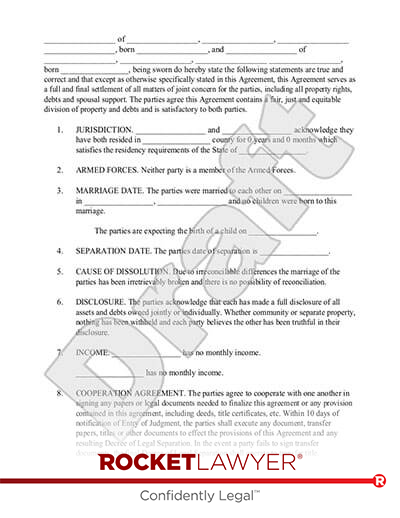
In states that allow legal separation (or a similar process), spouses typically use a Separation Agreement to document decisions about:
- Division of property and debts.
- Spousal support.
- Child custody and parenting time.
- Child support.
If a couple later decides to divorce, some or all of the separation agreement may carry over into the divorce proceedings, subject to court approval.
In states that use alternative legal actions, a Separation Agreement can often still be submitted with the final paperwork.
Can Legal Separation Turn Into Divorce?
Yes. In many states, a legal separation can later be converted into a divorce. The process may require additional filings, updated paperwork, or proof that statutory waiting or separation periods have been met.
In some cases, agreements reached during separation influence the final divorce terms, which can save time and reduce conflict. However, courts will still review agreements to ensure they remain fair and lawful.
When to Get Legal Help
Because legal separation and divorce involve complex and state-specific rules, legal guidance is often helpful. You may want to consult a lawyer or legal service if:
- You’re unsure whether separation or divorce is the better option.
- Children, significant assets, or long-term support obligations are involved.
- You want to understand how benefits, taxes, or insurance may be affected.
- Your state uses alternative procedures instead of formal legal separation.
You can use Rocket Lawyer to prepare separation or divorce documents online, or Consult an Attorney for more information based on your state’s laws.
Please note: This page offers general legal information, but not legal advice tailored for your specific legal situation. Rocket Lawyer Incorporated isn't a law firm or a substitute for one. For further information on this topic, you can Ask an Attorney.


