Record what was discussed in official meetings: Corporate Minutes
What we’ll cover
What are Corporate Minutes?
To maintain your corporate status, all states require your corporation to meet certain business formalities – Corporate Minutes record those official actions so you can maintain your status. It's essential to record Corporate Minutes for all official shareholder and board of director meetings.
Keeping regular Corporate Minutes helps you stay on top of your corporation's record-keeping requirements. It's not just about staying organized. Up-to-date Corporate Minutes help maintain your corporation's limited liability status. Sometimes also referred to as Meeting Minutes or Corporation Minutes, this documentation can help you protect your company.
Make your own Corporate Minutes with Rocket Lawyer now – it can be as simple as answering a few questions.
When to use a Corporate Minutes:
- You need to prepare a written summary of the items discussed, and the actions taken at a meeting of shareholders and/or directors of a corporation.
- You own a small for-profit or non-profit corporation, and you'd like a record of all resolutions and provisions in your official meetings.
How do I get my Corporate Minutes reviewed?
If you already have a Corporate Minutes and want to have it reviewed, or if you have questions about creating or using one, there are a few ways to get help.
Use Rocket Copilot to ask questions or review your document; this helps you better understand what it says and identify anything that may need a closer look.
If you are looking for help from a Legal Pro, you can also ask a question and receive a response within one business day, or request a more in-depth document review.
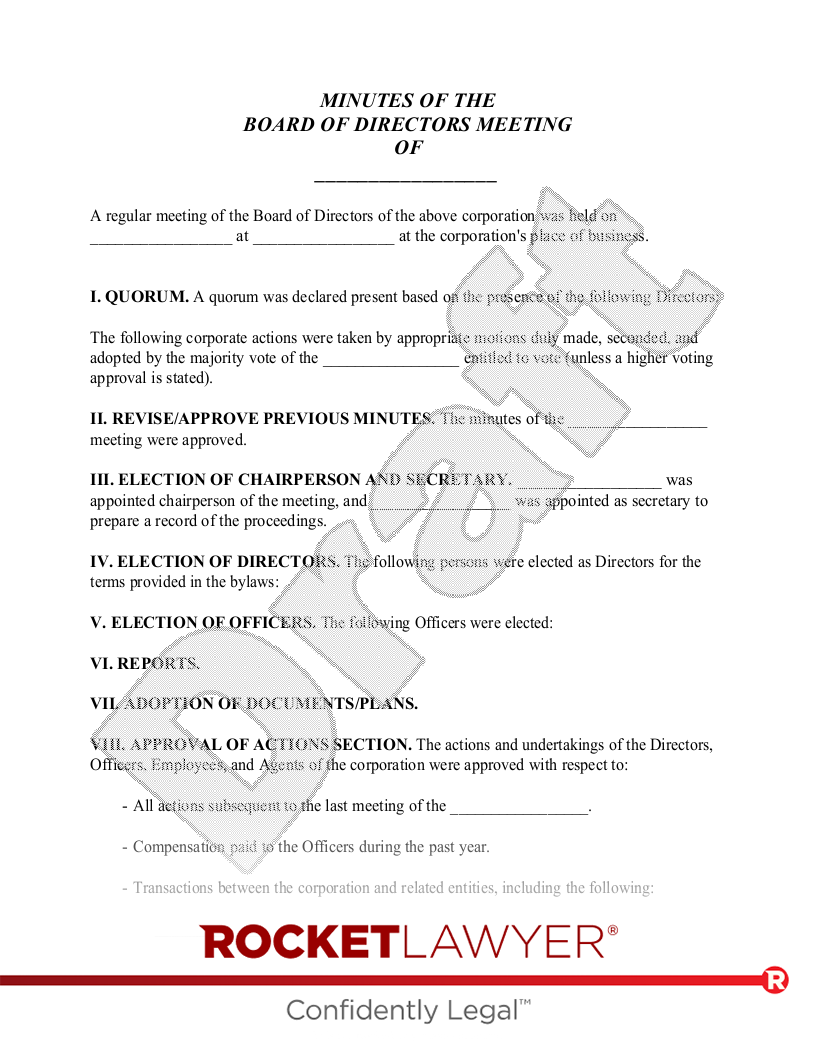
Sample Corporate Minutes
The terms in your document will update based on the information you provide
 This document has been customized over 364.9K times
 Legally binding and enforceable
 Consult a Legal Pro to ask questions or review your document
 Sign this document online for free with RocketSign®
MINUTES OF THE
MEETING
OF
Pursuant to notice (a copy of which is attached), waiver of notice (copies of which are attached), an annual a special meeting of the Directors A regular meeting of the Board of Directors of the above corporation was held on at at the corporation's place of business., .
. QUORUM. A quorum was declared present based on the presence of the following Directors and the following Shareholders who were present or represented by proxy as follows:A quorum was declared present based on the following Shareholders who were present or represented by proxy as follows: A quorum was declared present based on the presence of
- Director:
. GUESTS. The following guests were present at the meeting:
The following corporate actions were taken by appropriate motions duly made, seconded, and adopted by the majority two-thirds unanimous % vote of the Directors entitled to vote (unless a higher voting approval is stated).
. REVISE/APPROVE PREVIOUS MINUTES. The minutes of the meeting were approved as corrected.
. ELECTION OF DIRECTORS. The following persons were elected as Directors for the terms provided in the bylaws:
| Name: |
| Term: |
| Address: |
,
. ELECTION OF OFFICERS. The following Officers were elected:
| Name: |
| Office: |
| Address: |
,
. REPORTS.
- Report by :
. ADOPTION OF DOCUMENTS/PLANS.
The attached adopted by a majority two-thirds unanimous % vote of the Directors.
. APPROVAL OF ACTIONS SECTION. The actions and undertakings of the Directors, Officers, Employees, and Agents of the corporation were approved with respect to:
-
. FINANCIAL STATEMENTS PRESENTATION. The financial statements for the ending , as prepared by the corporation's Officers, the corporation's Treasurer, , the corporation's Accountant(s), , , were approved. Highlights of the financial statements included:
. SALARIES. Salaries for Officers and other employees were established in accordance with the attached schedule.as follows:
| Name: |
| Title: |
| Amount: | per |
. BONUSES. Employee and/or Officer bonuses for the ending , were approved as shown on the attached schedule.as follows:
| Name: |
| Title: |
| Amount: |
. DIRECTORS' FEES. Directors' fees of per per Director were approved.
. CONTRIBUTION TO PROFIT SHARING PLAN. A contribution to the corporation's profit sharing plan was approved in an amount equal to .% of the corporation's net income for the year ended .
. DIVIDENDS. The payment of dividends to the stockholders of record on was approved in the amount of per share.in accordance with the attached schedule.as follows:
| Name: |
| Shares: |
| Dividend: |
| TOTAL: | Shares: |
| Dividend: |
. ISSUANCE OF STOCK. The issuance of stock was approved as shown on the attached schedule.as follows:
| Name: |
| Shares: |
| Amount: |
| TOTAL: | Shares: |
| Amount: |
. BORROWING RESOLUTION. The corporation was authorized to borrow up to a maximum of such amounts as the Officers deem advisable from .
The form of resolution by the above lender was adopted and a copy is attached. The attached resolution states the names of the persons who are authorized to request loan advances. The Officers are authorized to take all actions and to sign all documents reasonably needed to carry out this loan transaction.Only the following Officer(s) are authorized to take all actions and to sign all documents reasonably needed to carry out this loan transaction:
. ESTABLISH BANKING RELATIONSHIP. The Officers are authorized to open accounts with . The form of resolution as provided by the bank was adopted and a copy is attached. The attached bank form of resolution states the names of the persons who are authorized to sign checks and drafts.
. AUTHORIZATION OF CORPORATE ACTION. The Officers and Directors were authorized to take all actions and to sign all documents reasonably needed to:
-
. NEXT MEETING. The next meeting of the Board of Directors will be held on , at , at the corporation's place of business..
There being no further business, the meeting was duly adjourned.
These Minutes are certified by 's .
| By: | Date: |
Checklist
Make It Legal™
Find out next steps for your document
___Sign this document. This document needs to be signed by:
or another person who is authorized to take minutes and/or record official corporate action. There is no requirement that the signature be witnessed or notarized.
The Minutes can be signed online. It becomes effective as of the date specified in the Minutes.
___Store a copy. If you sign this agreement online a signed copy will be securely stored in your account. The signed Minutes should be printed and placed into the corporate records book, which can be simply a 3-ring notebook designated for that purpose. A copy of this records book should be kept off-site in a safe location.
Important Details
In order to verify compliance with the relevant state corporate laws, it is recommended that a lawyer review the corporate minutes upon their completion. This step can become especially important if the corporation has more than one class of stock or if it is involved in unusual transactions. Different classes of stock may have different voting rights, requirements, and characteristics.
About Corporate Minutess
Learn about how to record what was discussed in official meetings
-
What are the common topics in Corporate Minutes?
Corporate Minutes serve as official records of the proceedings and decisions made during meetings of a corporation's board of directors, shareholders, or committees.
While the specific topics discussed in Corporate Minutes may vary depending on the nature of the corporation and the agenda of each meeting, here are some examples of what is typically addressed, particularly in our template:
Adoption of Documents and Plans
The directors and/or shareholders of a corporation may choose to adopt certain types of documents and plans. Generally, these documents represent very important transactions that may require approval by both directors and shareholders, in the case of a for-profit corporation. These actions also may require a higher-than-normal approval vote.
Approval of Past Actions
For the protection of persons who have taken action on behalf of the corporation, it is not unusual for the directors and/or stockholders to approve these past actions on an annual basis. The "Approval of Actions" section of this document includes an "all actions subsequent to the last meeting" option, which provides such general approval. Other important actions can be mentioned specifically, such as officer compensation, transactions with related parties, and purchases of significant assets.
Approval Requirement
Usually, corporate action is taken by a simple majority of the directors present at a directors' meeting, or shareholders present (or represented by proxy) at a shareholders' meeting who own a majority of the corporation's outstanding stock. However, the directors and/or shareholders are permitted to set a higher or lower approval requirement. For example, it is not unusual for the Bylaws to include a provision requiring two-thirds approval to amend them. In some cases, a higher approval may be required for all director and/or shareholder actions, not just certain types of actions.
Authorization of Future Actions
The interview provides various opportunities to document authorization for specific types of corporate action that will occur in the future. For example, the "Authorization of Action" section provides options that authorize lease arrangements and the establishment of insurance and pension plans. This includes:
- Salaries.
- Bonuses.
- Directors' fees.
- Contributions to profit-sharing plans.
- Dividends.
Borrowing and Banking Matters
Corporate minutes are also used to document bank account designation, the persons authorized to sign on those accounts, and major contract agreements. For example, a borrowing resolution may authorize officers to sign loan documents, while a banking resolution may establish signatories for corporate checks.
Proxy
A "proxy" is an agreement (usually written) that permits an agent or a substitute to represent a shareholder at a shareholders’ meeting. For instance, official action could be taken at a shareholders' meeting without Alice if Alice signed a written agreement that designated someone else (perhaps one of the other shareholders) to represent her at the meeting and if the person she designated was present at the meeting with a copy of the written agreement or other proof of the proxy arrangement.
Generally, a designation of proxy is given for one stockholder meeting, and the proxy is given full power to vote the shares in the proxy's discretion or in accordance with an informal oral arrangement between the stockholder and the proxy. However, the stockholder may wish to require the proxy to vote a certain way on one or more specific issues: if directors will be elected at an annual stockholders meeting, the stockholder may wish to require the proxy to vote for certain directors. Or, there may be a key issue that will be decided, and the stockholder wants to ensure that the proxy votes "for" or "against," as the case may be.
Election of Chair
It is common for the Minutes of a corporate meeting to identify the person who chaired the meeting, as well as the person who recorded the minutes. The Bylaws may specify the persons who should fulfill these roles. For example, the Bylaws may specify that the president will chair directors' and shareholders' meetings and that the secretary will record the minutes.
Election of Directors and Officers
Normally, the directors are elected in accordance with the bylaws, in an election usually held on an annual basis. In other cases, they are elected on a "staggered" basis. For example, a corporation with five directors might have a Bylaws provision that provides for two-year directors' terms with two directors elected every other year and three directors elected in the alternate years. Officers also are elected in accordance with the Bylaws, and are usually elected by the directors themselves.
Issuance of Stock
If stock will be sold or "issued," the approval of the shareholders should be obtained. The issuance of stock may be subject to "preemptive" rights which entitle current shareholders to acquire a percentage of the new stock so that their individual percentages of ownership in the corporation are not reduced or diluted by the new issuance.
If the corporation has more than one class of stock, the approval of all classes of stock is generally required. You should refer to your incorporation documents and/or obtain the opinion of a Legal Pro.
Next Meeting
Although not mandatory, it may be desirable to specify the time and location of the next meeting. This provision is more likely to be used in connection with "Minutes" for a regular meeting of the board of directors. It is less likely to be used in connection with annual or special meetings of the shareholders for a for-profit corporation, or with the preparation of "unanimous consent" documents.
Notice of Meeting / Waiver
Generally, if corporate action will be taken at a meeting, the shareholders and/or directors are entitled to formal notice of the time, date, and place of the meeting. However, a Waiver of Notice document can be used to generate waivers for the directors and/or shareholders to sign in order to waive the notice requirement. A copy of the waiver can then be attached to the Minutes as evidence that notice was waived.
Previous Minutes
Typically, the Minutes of the previous meeting would be passed around to the attendees in advance of the present meeting. If any edits should be made to the previous meeting's minutes, those can be made ahead of time or during this meeting and recorded directly into the Minutes under review.
Reports
It is not unusual for officers or corporate employees to present reports at directors' and/or shareholders' meetings that explain certain corporate matters, but do not require any formal action. For example, the corporate treasurer may report on the status of a borrowing request that has been submitted to a lender, or a marketing person may report on quarterly sales.
Still have questions about your Corporate Minutes? Don’t hesitate to ask a Legal Pro.
-
Tips for creating good Minutes for your meetings
In general, Meeting Minutes supply a basic summary of a corporate meeting. But they require a bit more formality than a list of notes. Here are some basics for creating solid Meeting Minutes:
List the People Who Attended the Meeting
In most states, compliance requires a record of everyone present in the meeting. You should also state each person's position within the company. If anyone has to leave early, make note of that, too. Any votes or decisions must also be noted in the minutes, indicating who supports and who dissents.
Include Intended Resolutions and Goals
Most Meeting Minutes don't have to include your intended resolutions and goals. However, one of the added benefits of keeping Minutes regularly is that they can often be introduced into court under the business records' exception under the Rules of Evidence. This can be used to demonstrate that your business had plans to eliminate a potential problem or to stay in compliance with laws. Otherwise, your testimony of the resolutions and goals might wind up being excluded due to hearsay rules.
Be as Precise as Possible
Meeting Minutes do not have to be a virtual copy of all the events in the meeting. Summaries are allowed. However, it's important to precisely document what happens during the meeting, including the statements people make. General statements and summaries such as "discussed financial matters for the business" are significantly less useful than statements such as "discussed interest rates for newest land purchase, recommended strategies for accommodating increased land costs," and so on. You can list these in bullet points to make it easier to read.
Corporate Minutes FAQs
-
How do I write Corporate Minutes?
It's simple and easy to get what you need with a free Corporate Minutes template from Rocket Lawyer:
- Make the document - Provide a few simple details, and we will do the rest.
- Review it or ask questions - Ask your questions or get your document reviewed instantly with Rocket Copilot or with a real Legal Pro with Rocket Lawyer membership
- Sign it - Sign your Corporate Minutes and make it legal.
Once your Corporate Minutes are made, you can edit, download, sign, or share it. Make sure you keep a copy for your records.
-
Why are Corporate Minutes important?
Corporate Minutes serve as legal evidence of the proceedings and decisions made by a corporation’s leadership. They demonstrate compliance with corporate governance requirements, provide transparency, and help protect the corporation from liability. They may cover elections, policies, committee authority, stock issuance, major contracts, conveyance of real estate or other assets, mergers, reorganizations, pensions, loans, and joint ventures.
-
Do small corporations need to keep Corporate Minutes, too?
Yes. Even small corporations are generally required to keep accurate and up-to-date minutes. If the bylaws state that shareholders must be involved in a certain decision, that should also be documented in the minutes.
-
How should Corporate Minutes be recorded and stored?
Corporate Minutes should be recorded in writing, either by hand or electronically, during the meeting and usually by the corporation’s secretary or a designated, impartial individual. They should be formatted clearly and organized chronologically.
After the meeting, the Minutes should be reviewed, approved, and signed. To verify compliance with state corporate laws, it is recommended that a lawyer review the Minutes upon completion. Rocket Lawyer Legal Pros can help you answer any questions you have. It's also advisable to store Corporate Minutes securely in a designated corporate records book or digital repository, like your Rocket Lawyer account.
-
Who has access to Corporate Minutes?
Corporate Minutes are typically considered confidential internal documents and are accessible only to authorized individuals such as directors, officers, shareholders, and legal counsel. However, in some cases, certain stakeholders or regulatory authorities may request access to Corporate Minutes for legal or regulatory purposes.

Our quality guarantee
We guarantee that properly executed Rocket Lawyer legal documents are legally enforceable under applicable US laws.
Need help? No problem!
Get instant answers to any legal question with Rocket Copilot! You can also connect with a Legal Pro at any time — just ask your question and choose a written response or live consult.


