MAKE YOUR FREE Living Trust Revocation
Other Names:
Inter Vivos Trust Revocation
What is a Living Trust Revocation?
Sometimes you need to start fresh by using a Living Trust Revocation. When it comes to your single or joint living trust, you can use this document to dissolve your trust, like when you're looking to restructure your estate plan. Whatever your reason, we make it easy to create a Living Trust Revocation so you can dissolve your current living trust.
You can use a Living Trust Revocation to revoke, dissolve and dismantle a living trust or joint living trust. It's also used when revoking a living trust in preparation for creating a new trust. For example, a single living trust may be revoked when you get married and intend to create a joint living trust with your spouse. Alternatively, after a divorce, you may need to revoke a joint living trust in anticipation of creating a single living trust. Keep in mind that to create a new living trust, all assets in the "old" trust must be transferred over to the new trust. Before revoking your current living trust, consider whether amending or restating your existing living trust is possible. If you can amend or restate it instead of revoking your trust, you can avoid transferring your assets.
You can use a Living Trust Revocation to revoke, dissolve and dismantle a living trust or joint living trust. It's also used when revoking a living trust in preparation for creating a new trust. For example, a single living trust may be revoked when you get married and intend to create a joint living trust with your spouse. Alternatively, after a divorce, you may need to revoke a joint living trust in anticipation of creating a single living trust. Keep in mind that to create a new living trust, all assets in the "old" trust must be transferred over to the new trust. Before revoking your current living trust, consider whether amending or restating your existing living trust is possible. If you can amend or restate it instead of revoking your trust, you can avoid transferring your assets.
When to use a Living Trust Revocation:
- You wish to revoke a single living trust in anticipation of creating a joint living trust, for example, due to marriage.
- You wish to revoke a joint living trust in anticipation of creating a single living trust, for example, due to divorce or the desire for separate trusts.
- You wish to revoke a single living trust or a joint living trust due to a change of mind regarding the use of a living trust.
- You wish to make substantial changes to a living trust by revoking the "old" living trust and preparing a "new" living trust. (Note: If the "old" living trust already holds assets, consider "amending-and-restating" the "old" living trust instead of revoking it. This way, it will not be necessary to transfer the assets from one living trust to the other.)
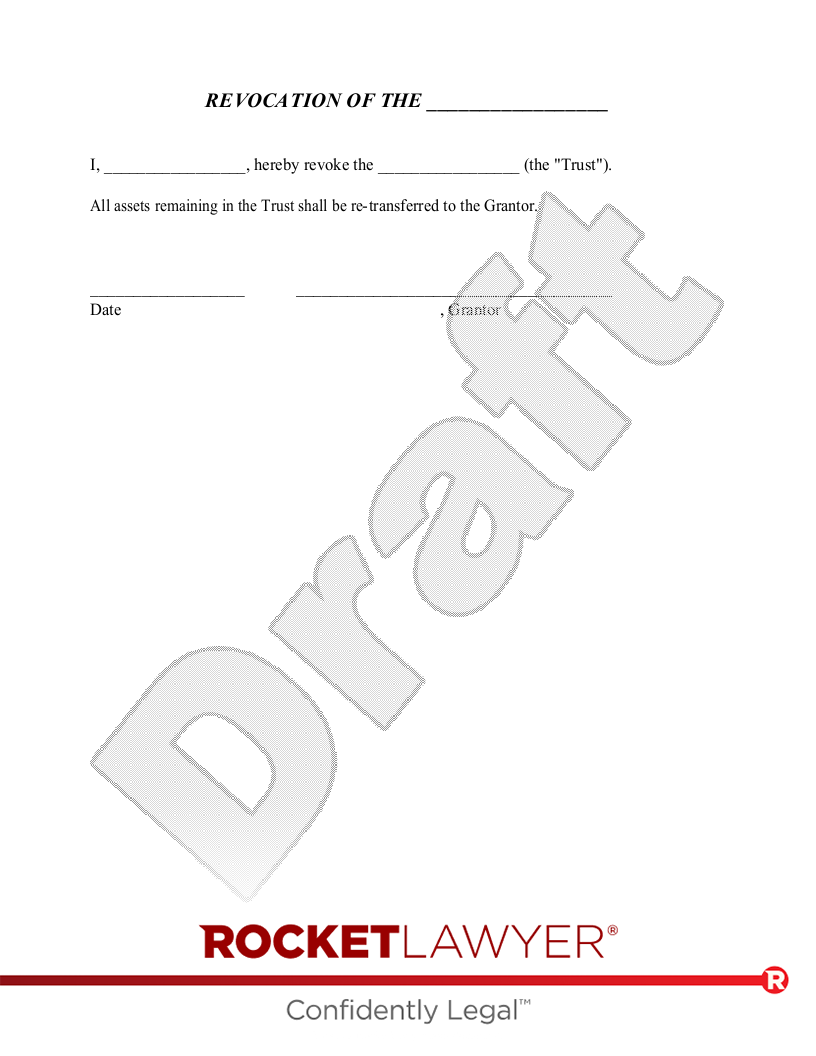
Sample Living Trust Revocation
The terms in your document will update based on the information you provide
 This document has been customized over 29.2K times
 Legally binding and enforceable
 Ask a lawyer questions about your document
REVOCATION OF THE
I, , hereby revoke the (the "Trust").
All assets remaining in the Trust shall be re-transferred to the Grantor.
| _____________________________________ | Date: __________________ |
, Grantor
STATE OF
COUNTY OF
DISTRICT OF COLUMBIA
| Notary Address: | ____________________________________ |
____________________________________
____________________________________
____________________________________
| Notary Address: | ____________________________________ |
____________________________________
____________________________________
____________________________________
| Notary Address: | ____________________________________ |
____________________________________
____________________________________
____________________________________
| _____ | Before signing the Revocation, the grantor should also review his or her pour-over Will. The pour-over Will is designed to transfer the grantor's assets upon death into the living trust which is about to be revoked. IT IS HIGHLY RECOMMENDED THAT THE REVOCATION NOT BE SIGNED UNLESS A NEW WILL IS ALSO PROPERLY SIGNED BY THE GRANTOR. |
| _____ | This Revocation is not valid unless it is signed by the Grantor(s) who are of "sound mind". Being of "sound mind" requires that the Grantor(s): (a) know that he or she is signing a Living Trust Revocation; (b) know the general nature and extent of his or her property; and (c) know the descendants or other relatives that would ordinarily be expected to share in the estate. |
| _____ | The Revocation should be signed by the Grantor(s) in the presence of two DISINTERESTED adult witnesses and a notary public. |
| _____ | Both of the witnesses much watch the Grantor(s) sign the Revocation. The Grantor(s) should verbally declare that the document is intended to revoke the living trust, but the witnesses need not read the Revocation. |
| _____ | Each witness must sign his or her name with the Grantor(s) and the other witness present. The witnesses should be satisfied that the Grantor(s) willingly signed the document as the Grantor(s)' free and voluntary act, and that the Grantor(s) were of full age and sound mind. |
Attachments
| _____ | The Florida Self-Proving Affidavit is a document which should be attached to the end of the Revocation, and which contains the Grantor(s)' acknowledgment and the affidavit of the witnesses, made before a person authorized to take acknowledgments and administer oaths. The affidavit recites that the requisite formalities were observed in signing the Revocation. Although attaching the affidavit has nothing to do with the legality of the Revocation itself, it may prove useful if the validity of the Revocation is ever challenged, because it eliminates the need to have the witnesses testify that the formalities in signing the Revocation were followed. The witnesses may not be available later when they are needed. |
When to Consult a Lawyer
| * | If the Grantor(s) are unable to sign due to physical disability, another person may be able to sign on behalf of the Grantor(s), in the Grantor(s)' presence, and at the express direction of the Grantor(s). However, this document does not provide the necessary language for another person to sign for the Grantor. If there are any questions regarding the possibility of someone signing on behalf of the Grantor(s), a lawyer should be contacted. |


