MAKE YOUR FREE Late Rent Notice
What we’ll cover
What is a Late Rent Notice?
A Late Rent Notice is a letter sent by a landlord to a tenant to remind them that their rent payment is overdue. Late Rent Notices serves as a formal notification and encourages the tenant to pay their rent promptly. Late Rent Notices can also help landlords establish a history of delinquent payments and their efforts to collect, which may be necessary if the landlord needs to take legal action against the tenant.
The notice should clearly state the amount owed, the due date, and any late fees that apply. It should also provide a deadline for the tenant to pay before further action is taken. If the tenant does not pay within the allotted time, the landlord or property manager may begin the process of ending the rental agreement and evicting the tenant, using the procedures specified by state and local law.
Sending a Late Rent Notice is an important step in managing a rental property and maintaining good communication with tenants. It helps ensure that delinquent rent is paid and can prevent more serious issues from arising.
Note: This is a general letter to demand past due rent. While Late Rent Notices can document late rent payments and your efforts to collect, they should not be considered the same as an Eviction Notice, which is the required first step to initiate an eviction process. If you have any questions concerning the eviction process, you can start with an Eviction Process Worksheet that can help you understand your next steps, or ask a lawyer.
When to use a Late Rent Notice:
- Your tenant is late with the rent, and you want to send a notice in writing asking for payment, which may include late charges.
- You want to reinforce the importance of timely payments to your renter.
- You may consider eviction down the road if the rent continues to go unpaid, since a record of late payments will help support your legal eviction.
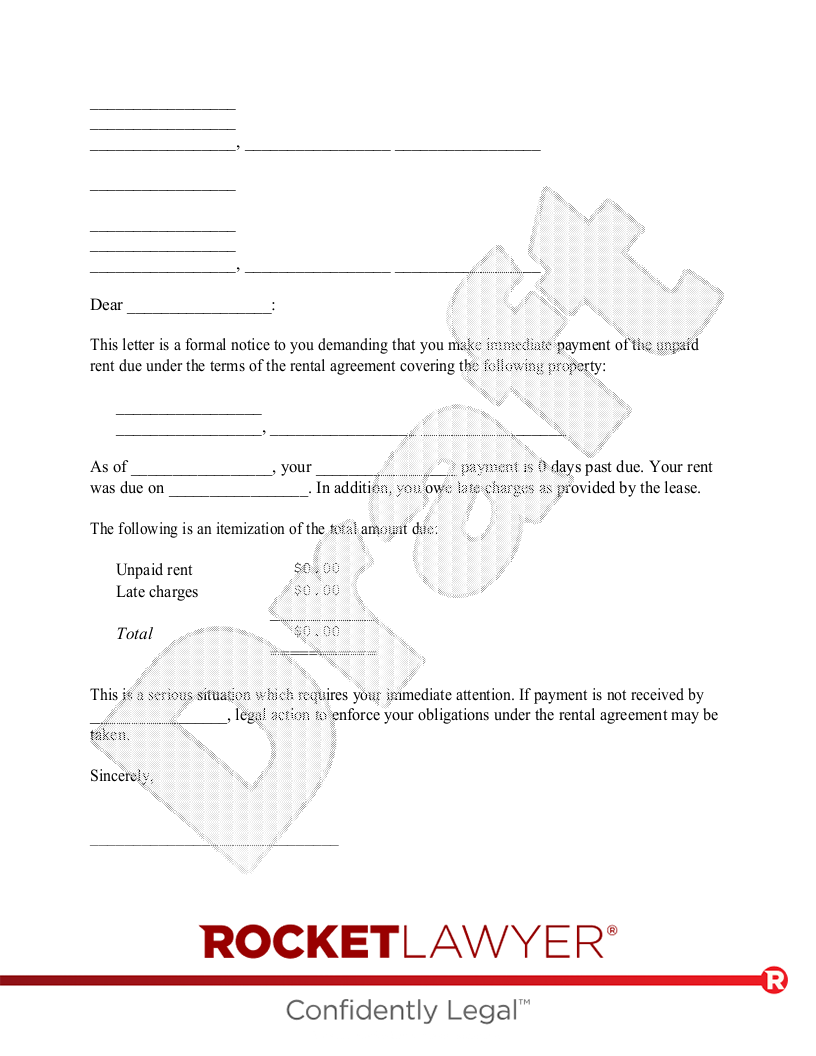
Sample Late Rent Notice
The terms in your document will update based on the information you provide
 This document has been customized over 261.7K times
 Documents and communicates
 Ask a lawyer questions about your document
 Sign this document online for free with RocketSign®
,
,
This letter is a formal notice to you demanding that you make immediate payment of the unpaid rent due under the terms of the rental agreement covering the following property:
,
As of , your payment is days past due. Your rent was due on .
The following is an itemization of the total amount due:
| Unpaid rent |
____________
===========
This is a serious situation which requires your immediate attention. If payment is not received by , legal action to enforce your obligations under the rental agreement may be taken.
at the above address I can be contacted by phone at . My e-mail address is . A fax can be sent to .
Sincerely,
_____________________________
| * | Most states have laws limiting the amount of late fees. Check with an attorney in your state regarding any limits that may apply to you. |
Late Rent Notice FAQs
-
When can I use the Late Rent Notice document?
You may use the Late Rent Notice document if:
- Your tenant is late with the rent and you want to send a notice in writing asking for payment, which may include late charges.
- You want to reinforce the importance of timely payments to your renter.
- You might consider eviction down the road if the rent continues to go unpaid, since a record of late payments will help support your legal eviction.
-
How do I write a Late Rent Notice?
You can make a Late Rent Notice online in minutes. Rocket Lawyer will build your document for you. All you need to do is answer some questions. Putting together your answers to the following questions will help make the process speedier:
- Which month's rent has not been paid?
- How many days is the rent past due?
- Will there be any late charges? If so, how will the late charges be calculated?
- When must payment be received to avoid legal action?
If you don't have all of the details you need, you can skip questions, and save your document for later.
-
What happens when you're late on rent?
If you pay rent late, then a landlord may charge you late fees or provide you with a written Eviction Notice.
-
Can I be evicted for missing one month's rent?
It depends. Landlords must give a proper Eviction Notice before filing an eviction lawsuit. Tenants must pay rent before the time period specified on the notice or risk being evicted from the premises.
-
Is rent late on the 5th of the month?
Rent will be considered late depending on the date specified in your Rental or Lease Agreement. Typically, rent will be due on the first day of the month.

Our quality guarantee
We guarantee our service is safe and secure, and that properly executed Rocket Lawyer legal documents are legally enforceable under applicable US laws.
Need help? No problem!
Ask a question for free or get affordable legal advice when you connect with a Rocket Lawyer network attorney.


