MAKE YOUR FREE Buy-Sell Agreement
What is a Buy-Sell Agreement?
When to use a Buy-Sell Agreement:
- You and the other owners of the company want to control who is allowed to buy an interest in the business.
- You want to outline what happens if an owner becomes disabled, retires, goes bankrupt or dies.
- You want to establish a fair price for the business in advance of any disagreements between owners.
- You want to decide what happens to an owner's interest if an owner divorces.
- You want to require that anyone who inherits interest (by death or divorce) in the business must sell their portion to the company.
Sample Buy-Sell Agreement
The terms in your document will update based on the information you provide
 This document has been customized over 203.4K times
 Legally binding and enforceable
 Ask a lawyer questions about your document
 Sign this document online for free with RocketSign®
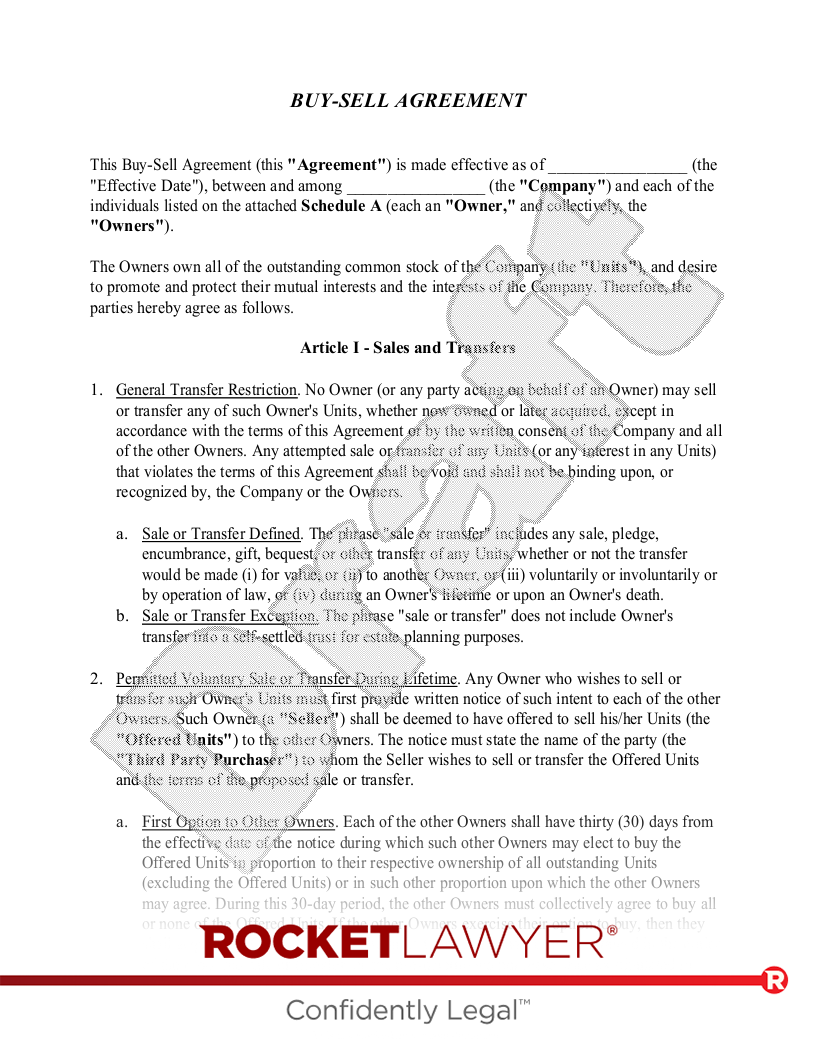
BUY-SELL AGREEMENT
This Buy-Sell Agreement (this "Agreement") is made effective as of (the "Effective Date"), between and among (the "Company") and each of the individuals listed on the attached Schedule A (each an "Owner," and collectively, the "Owners").
The Owners own all of the outstanding of the Company (the "Units"), and desire to promote and protect their mutual interests and the interests of the Company. Therefore, the parties hereby agree as follows.
Article - Sales and Transfers
| 1. | General Transfer Restriction. No Owner (or any party acting on behalf of an Owner) may sell or transfer any of such Owner's Units, whether now owned or later acquired, except in accordance with the terms of this Agreement or by the written consent of the Company and all of the other Owners. Any attempted sale or transfer of any Units (or any interest in any Units) that violates the terms of this Agreement shall be void and shall not be binding upon, or recognized by, the Company or the Owners. |
| a. | Sale or Transfer Defined. The phrase "sale or transfer" includes any sale, pledge, encumbrance, gift, bequest, or other transfer of any Units, whether or not the transfer would be made (i) for value, or (ii) to another Owner, or (iii) voluntarily or involuntarily or by operation of law, or (iv) during an Owner's lifetime or upon an Owner's death. |
| b. | Sale or Transfer Exception. The phrase "sale or transfer" does not include Owner's transfer into a self-settled trust for estate planning purposes. |
| 2. | Permitted Voluntary Sale or Transfer During Lifetime. Any Owner who wishes to sell or transfer such Owner's Units must first provide written notice of such intent to each of the other Owners. Such Owner (a "Seller") shall be deemed to have offered to sell his/her Units (the "Offered Units") to the other Owners. The notice must state the name of the party (the "Third Party Purchaser") to whom the Seller wishes to sell or transfer the Offered Units and the terms of the proposed sale or transfer. |
| a. | First Option to Other Owners. Each of the other Owners shall have thirty (30) days from the effective date of the notice during which such other Owners may elect to buy the Offered Units in proportion to their respective ownership of all outstanding Units (excluding the Offered Units) or in such other proportion upon which the other Owners may agree. During this 30-day period, the other Owners must collectively agree to buy all or none of the Offered Units. If the other Owners exercise their option to buy, then they shall acquire the Offered Units on the same terms and conditions as contained in the notice of the proposed sale or transfer, or the pre-determined purchase price as stipulated in Article II, whichever is lower. These terms shall be supplemented as necessary by the payment terms described in Article III below. |
| b. | Permitted Sale or Transfer to Third Party Purchaser. If the other Owners do not validly exercise their option to buy all of the Offered Units within the 30-day period, then the Seller may complete the sale or transfer to the Third Party Purchaser. may
Article - Purchase Price
The "Purchase Price" shall be determined in accordance with the provisions of this Article II, and the payment terms are set forth in Article III.
Article - Payment Terms
Article - Life Insurance
Article - Terminating or Amending the Agreement
Article - Continuation of Restrictions
This Agreement shall continue to apply to the Units which are the subject of a sale or transfer and to new Units issued by the Company. The transferee shall execute a counterpart signature page to this Agreement. Such signature shall be binding on all Owners and the Company as if the transferee was an original signor.
Article - Miscellaneous
SCHEDULE A
List of Owners
SCHEDULE B
Name of Each Owner and Life Insurance Policy Amount
|
Buy-Sell Agreement FAQs
-
How does a Buy-Sell Agreement work?
A Buy-Sell Agreement is a legally binding contract that lays out the parameters under which shares in a business can be bought or sold. A Buy-Sell agreement is an attempt to avoid potential chaos should one of the partners in an organization want or need to exit the business.
-
Do I need a Buy-Sell Agreement?
You should consider making a Buy-Sell agreement if:
- You and the other partners of the company want to control who is allowed to buy an interest in the business.
- You want to outline what happens if a partner becomes disabled, retires, goes bankrupt, or dies.
- You want to establish a fair price for the business in advance of any disagreements between partners.
- You want to decide what happens to an owner's interest if a partner divorces.
- You want to require that anyone who inherits interest (by death or divorce) in the business must sell their portion to the company.
If you do not have a Buy-Sell agreement in place under any of the preceding circumstances, then your business could be subject to a partition by sale. This means that a court may order the dismantling and selling off components of the business in order to provide the financial value that a new owner is entitled to. Alternatively, a court could decide to grant ownership to a new person under one of the aforementioned circumstances, which would grant that new person the same decision-making ability as the existing partners.
-
What are the key elements of a Buy-Sell Agreement?
The key elements of a Buy-Sell Agreement that ought to be considered include the following.
- What happens if an owner wants out?
Will you require that their portion is sold to the remaining owners? How much notice must they give? What happens if the other owners cannot afford to make the purchase? Will a third-party buyer be allowed to purchase the interest if all members approve? Will life insurance be required?
- What if an owner involuntarily loses possession of their portion of the business?
What happens if an owner dies and a beneficiary inherits their portion of the business? What if an owner divorces and an ex-spouse is awarded part of the business? What if a person dies and their executor needs to sell their portion of the business to cover debts? Will the other owners have the first option to purchase? If an owner is going to declare bankruptcy, how much notice do they need to give?
- What is the value of the company and the purchase price?
You will likely need to consult with a professional to determine a fair value for your company. Companies typically hire a CPA and or a valuation professional in order to determine a reasonable valuation of the business. A method for determining the valuation of the business in the future should also be considered.
- Will payment options be considered?
If you agree that payment options will be considered for future purchasers, how much will they need to pay down? How long do they have to pay the entire balance? Will interest be charged? How much time do they have to begin payments?
- What happens if an owner wants out?
-
Why is a Buy-Sell Agreement important?
Some people refer to Buy-Sell Agreements as a "prenup" for businesses. This is a relevant comparison in that a Buy-Sell Agreement is typically created at the inception of a business, when all of the stakeholders are generally agreeable. This is the best time to sit down and discuss how best to plan for potential potholes in the future. Every co-owned business should draft a Buy-Sell Agreement as soon as possible. It outlines, before problems occur, what happens if an owner's interest in the company becomes available (for whatever reason), who can buy available portions, and what the fair purchase price will be.


