Authorize someone to make decisions on your behalf: Power of Attorney
What we’ll cover
What is a Power of Attorney?
A Power of Attorney (POA) is a legal document that gives a trusted person or entity the authority to handle your finances and legal matters, such as signing contracts, selling property, accessing bank accounts. The individual giving control is called the "principal," and the individuals or organizations obtaining powers are known as the "agents."
When to use a Power of Attorney:
- You want to grant authority to someone to act on your behalf in legal affairs during your absence.
- You want to grant authority to someone to act on your behalf in legal affairs in the event you become incapacitated.
- You want to grant authority to someone to act on your behalf in legal affairs in specific situations.
How do I get my Power of Attorney reviewed?
If you already have a Power of Attorney and want to have it reviewed, or if you have questions about creating or using one, there are a few ways to get help.
Use Rocket Copilot to ask questions or review your document; this helps you better understand what it says and identify anything that may need a closer look.
If you are looking for help from a Legal Pro, you can also ask a question and receive a response within one business day, or request a more in-depth document review.
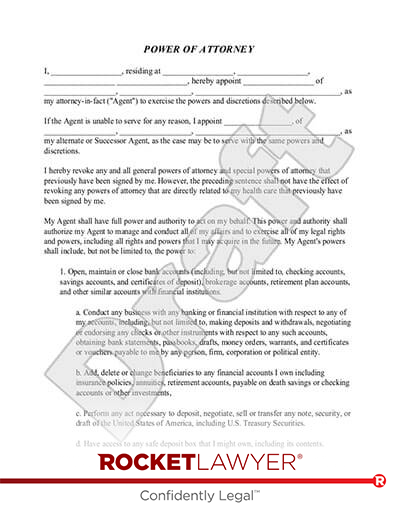
Sample Power of Attorney
The terms in your document will update based on the information you provide
 This document has been customized over 1.3M times
 Legally binding and enforceable
 Consult a Legal Pro to ask questions or review your document
 Complies with relevant laws
| - | Real property transactions |
| - | Tangible personal property transactions |
| - | Stock and bond transactions |
| - | Commodity and option transactions |
| - | Banking and other financial institution transactions |
| - | Business operating transactions |
| - | Insurance and annuity transactions |
| - | Estate, trust, and other beneficiary transactions |
| - | Claims and litigation |
| - | Personal and family maintenance |
| - | Benefits from social security, Medicare, Medicaid, or other governmental programs or civil or military service |
| - | Retirement plan transactions |
| - | Tax matters |
| - | Digital assets and the content of an electronic communication |
However, the preceding sentence shall not have the effect of revoking any powers of attorney that are directly related to my health care that previously have been signed by me.
My agent is entitled to reimbursement of reasonable expenses incurred on my behalf and to compensation that is reasonable under the circumstances.My agent is entitled to reimbursement of reasonable expenses incurred on my behalf but shall receive no compensation for serving as my agent.
SPECIAL INSTRUCTIONS APPLICABLE TO CO-AGENTS:
| - | Create, amend, revoke, or terminate an inter vivos trust |
| - | Make a gift, subject to the limitations of and any special instructions in this power of attorney |
| - | Create or change rights of survivorship |
| - | Create or change a beneficiary designation |
| - | Authorize another person to exercise the authority granted under this power of attorney |
| - | Waive the principal's right to be a beneficiary of a joint and survivor annuity, including a survivor benefit under a retirement plan |
| - | Access the content of electronic communications |
| - | Exercise fiduciary powers that the principal has authority to delegate and that are expressly and clearly identified (including the persons for which the principal acts as a fiduciary) in the special instructions |
| - | Renounce an interest in property, including a power of appointment |
The fiduciary powers that my Agent are authorized to exercise, along with the persons for whom I act as a fiduciary, are as follows:
I shall be considered disabled or incapacitated for purposes of this power of attorney if a physician certifies in writing at a date later than the date this power of attorney is executed that, based on the physician's medical examination of me, I am mentally incapable of managing my financial affairs. I authorize the physician who examines me for this purpose to disclose my physical or mental condition to another person for purposes of this power of attorney. A third party who accepts this power of attorney is fully protected from any action taken under this power of attorney that is based on the determination made by a physician of my disability or incapacity.
This power of attorney shall become effective .
If the Agent is unable to serve for any reason, I appoint , of , , , as my alternate or Successor Agent, as the case may be to serve with the same powers and discretions.
If we become legally separated or divorced, the other Agent shall serve alone.
If the Agent is my spouse, then I also hereby appoint , of , as my substitute Agent solely for the purpose of releasing any dower, homestead or other inchoate interest or other property rights (of whatever nature), which under local law may not be released by my spouse.
This power of attorney continues until I revoke it or it is terminated by my death or other event described in Subtitle P, Title 2 of the Texas Estates Code.
I agree that any third party who receives a copy of this document may act under it. Termination of this power of attorney is not effective as to a third party until the third party has actual knowledge of the termination. I agree to indemnify the third party for any claims that arise against the third party because of reliance on this power of attorney. The meaning and effect of this power of attorney is determined by Texas law.
Dated ____________________, ______, at , Texas.
__________________________________
NOMINATION OF CONSERVATOR:
If it becomes necessary for a court to appoint a conservator of my estate, I nominate the following person for appointment:
,
immediatelyon on upon written certification by my physician that I am incapacitated or mentally incapable of managing my financial affairs, and shall not be affected by my disability or lack of mental competence, except as may be provided otherwise by an applicable state statute. This is a Durable Power of Attorneydurable durable
If the Agent is unable to serve for any reason, I appoint , of , , , as my alternate or Successor Agent, as the case may be to serve with the same powers and discretions.
If we become legally separated or divorced, the other Agent shall serve alone.
This Power of Attorney shall not be affected by my subsequent incapacity. This Power of Attorney is revoked and shall not be effective if I am incapacitated. This Power of Attorney is not affected by subsequent disability or incapacity of the principal or lapse of time.
Manner of Revocation: The Principal may revoke this document in writing at any time before the expiration date for no reason or for cause, or if the Attorney-in-Fact exceeds or violates the scope and authority granted by this document. If the Principal becomes disabled or incapacitated, the Attorney-in-Fact may continue acting as such despite the disability, incapacity or the expiration date.
Manner of Revocation: The Principal may revoke this document in writing at any time before the expiration date for no reason or for cause. Also, if the Attorney-in-Fact exceeds or violates the scope and authority granted by this document, the Principal may revoke in writing the Power of Attorney at any time before the expiration date.
However, the preceding sentence shall not have the effect of revoking any powers of attorney that are directly related to my health care that previously have been signed by me.
My Agent shall have full power and authority to act on my behalf. This power and authority shall authorize my Agent to manage and conduct all of my affairs and to exercise all of my legal rights and powers, including all rights and powers that I may acquire in the future. My Agent's powers shall include, but not be limited to, the power to:
My Agent shall have full power and authority to act on my behalf but only to the extent permitted by this Special Power of Attorney. My Agent's powers shall include the power to:
.
. Conduct any business with any banking or financial institution with respect to any of my accounts, including, but not limited to, making deposits and withdrawals, negotiating or endorsing any checks or other instruments with respect to any such accounts, obtaining bank statements, passbooks, drafts, money orders, warrants, and certificates or vouchers payable to me by any person, firm, corporation or political entity.
. Add, delete or change beneficiaries to
| - | Insurance or annuity accounts |
| - | Retirement accounts |
| - | Payable on death savings accounts |
| - | Payable on death checking accounts |
| - | The following accounts: |
initials: ___________
. Perform any act necessary to deposit, negotiate, sell or transfer any note, security, or draft of the United States of America, including U.S. Treasury Securities.
. Waive my right to be a beneficiary of a joint and survivor annuity, including a survivor benefit under a retirement plan.
initials: ___________
. Have access to any safe deposit box that I might own, including its contents.
. Create or change rights of survivorship
Bank Accounts
Investment Accounts
Insurance Policies
Annuities
Retirement Plans
Other:
. Provide for the support and protection of myself, my spouse, or of any minor child I have a duty to support or have established a pattern of prior support, including, without limitation, provision for food, lodging, housing, medical services, recreation and travel.
. Purchase and/or maintain insurance and annuity contracts, including life insurance upon my life or the life of any other appropriate person.
.
. Maintain and/or operate any business that I may own.
. Employ professional and business assistance as may be appropriate, including attorneys, accountants, and real estate agents.
my homestead as described in the attached Exhibit.any homestead that I now own or may own in the future.my homestead legally described as:
If the Agent is my spouse, then I also hereby appoint , of , as my substitute Agent solely for the purpose of releasing any dower, homestead or other inchoate interest or other property rights (of whatever nature), which under local law may not be released by my spouse.
. Make gifts from my assets to members of my family and to such other persons or charitable organizations with whom I have an established pattern of giving (or if it is appropriate to make such gifts for estate planning and/or tax purposes), to file state and federal gift tax returns, and to file a tax election to split gifts with my spouse, if any. No Agent acting under this instrument, except as specifically authorized in this instrument, shall have the power or authority to (a) gift, appoint, assign or designate any of my assets, interests or rights, directly or indirectly, to such Agent, such Agent's estate, such Agent's creditors, or the creditors of such Agent's estate, (b) exercise any powers of appointment I may hold in favor of such Agent, such Agent's estate, such Agent's creditors, or the creditors of such Agent's estate, or (c) use any of my assets to discharge any of such Agent's legal obligations, including any obligations of support which such Agent may owe to others, excluding those whom I am legally obligated to support.
initials: ___________
. To transfer any of my assets to the trustee of any revocable trust created by me, if such trust is in existence at the time of such transfer.
. To utilize my assets to fund a trust not created by me, but to which I have either established a pattern of funding, or to fund a trust created by my Agent for my benefit or the benefit of my dependents, heirs or devisees upon the advice of a financial adviser.
initials: ___________
. To create, sign, modify or revoke any trust agreements or other trust documents in an attempt to manage or create a trust that was created for my benefit or the benefit of my dependents, heirs or devisees. This shall include the creation, modification or revocation of any inter vivos, family living, irrevocable or revocable trusts.
initials: ___________
. To exercise fiduciary responsibilities that I have a right to delegate.
. Subject to other provisions of this document, my Agent may disclaim any interest, which might otherwise be transferred or distributed to me from any other person, estate, trust, or other entity, as may be appropriate. However, my Agent may not disclaim assets to which I would be entitled, if the result is that the disclaimed assets pass directly or indirectly to my Agent or my Agent's estate.
initials: ___________
. Have access to my healthcare and medical records and statements regarding billing, insurance and payments.
. Act on my behalf for the purposes of managing, distributing, and terminating my digital assets. For the purposes of this Power of Attorney, digital assets shall mean electronic assets that are stored on my computers, electronic devices, or on any online account, as identified in the Digital Assets Memorandum of this Power of Attorney. Online accounts include, but are not limited to, social-networking sites, online backup services, servers, email accounts, photo and document sharing sites, financial and business accounts, domain names, virtual property, websites, and blogs. The Digital Assets Memorandum, with associated websites, usernames, passwords, and related information, is hereby incorporated by reference into this Power of Attorney and shall be distributed to my Agent designated in this Power of Attorney. My Agent shall have the power and authority to manage, conduct, and to exercise all of my legal rights and powers relating to my digital assets, including all rights and powers that I may acquire in the future. My Agent's powers shall include, but not be limited to, the power to access, download, and backup digital assets, convert my file formats, access any and all devices necessary to manage digital assets, and clear computer caches and delete files.
. Open, maintain or close bank accounts (including, but not limited to, checking accounts, savings accounts, and certificates of deposit), brokerage accounts, retirement plan accounts, and other similar accounts with financial institutions. This power shall include the authority to conduct any business with any banking or financial institution with respect to any of my accounts, including, but not limited to, making deposits and withdrawals, negotiating or endorsing any checks or other instruments with respect to any such accounts, obtaining bank statements, passbooks, drafts, money orders, warrants, and certificates or vouchers payable to me by any person, firm, corporation, or political entity.
. Open, maintain or close the following specific accounts. This power shall include the authority to conduct any transaction for these accounts, including, but not limited to, making deposits and withdrawals, negotiating or endorsing any checks or other instruments with respect to any such accounts, obtaining bank statements, passbooks, drafts, money orders, warrants, and certificates or vouchers payable to me by any person, firm, corporation, or political entity.
Perform any act necessary to deposit, negotiate, sell, or transfer any note, bond, security, or draft of the United States of America, including U.S. Treasury Securities.
Institute, supervise, prosecute, defend, intervene in, abandon, compromise, arbitrate, settle, dismiss, and appeal from any and all legal, equitable, judicial or administrative hearings, actions, suits, proceedings, attachments, arrests or distresses, involving me in any way.
. . . Sell or convey any interest of mine in real estate (whether currently owned or later acquired). Sell or convey any interest of mine in real estate located at: and legally described on the attached Exhibit. and legally described as
The total sale price must be at least .
This power shall include the power to (i) sell upon such terms as my Agent shall deem appropriate, subject to the limitations (if any) stated above, (ii) sign any documents (including deeds) that may be required to convey title to such property (including changing tenancy regarding right of survivorship), and (iii) collect and receive the proceeds from any such sale.
initials: ___________
If the Agent is my spouse, then I also hereby appoint of , , as my substitute Agent solely for the purpose of releasing any dower, homestead or other inchoate interest or other property rights (of whatever nature), which under local law may not be released by my spouse.
. . . Mortgage or encumber any interest of mine in real estate (whether currently owned or later acquired). Mortgage or encumber any interest of mine in real estate located at:
and legally described on the attached Exhibit. and legally described as
The mortgage amount shall not exceed .
If the Agent is my spouse, then I also hereby appoint of , , as my substitute Agent solely for the purpose of releasing any dower, homestead or other inchoate interest or other property rights (of whatever nature), which under local law may not be released by my spouse.
. . . Manage, insure, improve, repair, collect rents, execute leases, or take any other action that a landlord might take, with respect to any interest of mine in real estate (whether currently owned or later acquired). Manage, insure, improve, repair, collect rents, execute leases, or take any other action that a landlord might take, with respect to any interest of mine in real estate located at: and legally described on the attached Exhibit. and legally described as . . . Sell or convey any personal property that I might own now or in the future, tangible or intangible, on such terms and conditions as my Agent deems appropriate. Sell or convey .
This power shall include the power to (i) sign contracts of sale and documents to transfer title (including bills of sale), and (ii) accept a security interest for any unpaid portion of the purchase price.
This power shall include the power to (i) obtain credit upon such terms as my Agent may deem appropriate, subject to the limitations (if any) stated above, (ii) sign any documents (including notes, credit agreements, security agreements, and financing statements), and (iii) take any other action that may be required to complete the above transactions.
, , .
This power shall include the power to: (i) make and carry out decisions regarding sales, purchases, employees, loans, and equipment, and (ii) take any action needed (at the discretion of my Agent) to operate the business.
This power shall be limited to the power to make decisions in the ordinary course of business, including, but not limited to, decisions regarding sales, purchases, employees, and equipment.
, including, but not limited to, authorization to: . , including, but not limited to, authorization to: . , including, but not limited to, authorization to: .
. Prepare, sign, and file income, gift and other tax returns of all kinds with federal, state, local, and other governmental bodies, and any Power of Attorney form appointing an Agent required by the Internal Revenue Service and/or any state or local taxing authority.
. Obtain information or documents from any government or its agencies, and represent me in all tax matters, including the authority to negotiate, compromise, or settle any matter with such government or agency.
. Prepare applications, provide information, and perform any other act reasonably requested by any government or its agencies in connection with governmental benefits (including medical, military and social security benefits), and to appoint anyone, including my Agent, to act as my "Representative Payee" for the purpose of receiving Social Security benefits.
| - | Exercise all stock rights on my behalf as my proxy, including all rights with respect to stocks, bonds, debentures, commodities, options or other investments. |
| - | Engage in stock, bond and other securities transactions. |
| - | Enter into binding contracts on my behalf. |
| - | Purchase, maintain, surrender, collect, or cancel (a) life insurance or annuities of any kind on my life or on the life of anyone in whom I have an insurable interest, (b) liability insurance protecting me and my estate against third party claims, (c) hospital insurance, medical insurance, Medicare supplement insurance, custodial care insurance, and disability income insurance for me or any of my dependents, and (d) casualty insurance insuring assets of mine against loss or damage due to fire, theft, or other commonly insured risk; to pay all insurance premiums, to select any options under such policies, to increase coverage under any such policy, to borrow against any such policy, to pursue all insurance claims on my behalf, to adjust insurance losses, and the foregoing powers shall apply to private and public plans, including but not limited to Medicare, Medicaid, SSI and Worker's Compensation; to designate and change beneficiaries of insurance policies insuring my life and beneficiaries under any annuity contract in which I have an interest; to decrease coverage under or cancel any of these policies described above; to receive and make such disposition of the cash value on termination of any such policy as my Agent deems appropriate. However, my Agent shall have no power or authority whatsoever with respect to any interest in or incidents of ownership in any policy of insurance I may own on the life of my Agent. |
| - | Create and contribute to an employee benefit plan, including a plan for a self-employed individual, for my benefit; to elect retirement on my behalf; to select any payment option under any IRA or employee benefit plan in which I am a participant, including plans for self-employed individuals, or to change options I have selected; to make voluntary contributions to such plans; to make "roll-overs" of plan benefits into other retirement plans; to apply for and receive payments and benefits; to waive rights given to nonemployee spouses under state or federal law; to borrow money or purchase assets from such plans, if authorized by such plans; to make revocable and irrevocable beneficiary designations and to change revocable beneficiary designations; to consent and/or waive consent in connection with the designation of beneficiaries and the selection of joint and survivor annuities under any employee benefit plan. |
| - | Employ professional and business advisors as may be appropriate, including attorneys, accountants, and real estate agents. |
| - | Insurance or annuity accounts |
| - | Retirement accounts |
| - | Payable on death savings accounts |
| - | Payable on death checking accounts |
| - | The following accounts: |
initials: ___________
initials: ___________
initials: ___________
initials: ___________
initials: ___________
, including any power of appointment, including any power of appointment, including any power of appointment
initials: ___________
Act on my behalf for the purposes of managing, distributing, and terminating my digital assets. For the purposes of this Power of Attorney, digital assets shall mean electronic assets that are stored on my computers, electronic devices, or on any online account, as identified in the Digital Assets Memorandum of this Power of Attorney. Online accounts include, but are not limited to, social-networking sites, online backup services, servers, email accounts, photo and document sharing sites, financial and business accounts, domain names, virtual property, websites, and blogs. The Digital Assets Memorandum, with associated websites, usernames, passwords, and related information, is hereby incorporated by reference into this Power of Attorney and shall be distributed to my Agent designated in this Power of Attorney. My Agent shall have the power and authority to manage, conduct, and to exercise all of my legal rights and powers relating to my digital assets, including all rights and powers that I may acquire in the future. My Agent's powers shall include, but not be limited to, the power to access, download, and backup digital assets, convert my file formats, access any and all devices necessary to manage digital assets, and clear computer caches and delete files.
Bank Accounts
Investment Accounts
Insurance Policies
Annuities
Retirement Plans
Other:
I hereby grant to my Agent the full right, power, and authority to do every act, deed, and thing necessary or advisable to be done regarding the above powers, as fully as I could do if personally present and acting.
Any power or authority granted to my Agent under this document shall be limited, to the extent necessary, to prevent this Power of Attorney from causing, (i) my income to be taxable to my Agent, (ii) my assets to be subject to a general power of appointment by my Agent, or (iii) my Agent to have any incidents of ownership with respect to any life insurance policies that I may own on the life of my Agent.
A Successor Agent shall not be liable for acts of a prior Agent. An Agent is not liable for the actions of another Agent, including a Co-Agent or Predecessor Agent, unless the Agent participates in or conceals a breach of fiduciary duty committed by the other Agent. An Agent who has knowledge of a breach or imminent breach of fiduciary duty by another Agent must notify me and, if I am incapacitated, take whatever actions may be reasonably appropriate in the circumstances to safeguard my best interest.
No person who relies in good faith on the authority of my Agent under this instrument shall incur any liability to me, my estate or my personal representative. I authorize my Agent to indemnify and hold harmless any third party who accepts and acts under this document.
If any part of any provision of this instrument shall be invalid or unenforceable under applicable law, such part shall be ineffective to the extent of such invalidity only, without in any way affecting the remaining parts of such provision or the remaining provisions of this instrument.
My Agent shall not be entitled to any compensation, during my lifetime or upon my death, for any services provided as my Agent. My Agent shall be entitled to reasonable compensation for any services provided as my Agent. My Agent shall not be entitled to reimbursement of expenses incurred as a result of carrying out any provision of this Power of Attorney. My Agent shall be entitled to reimbursement of all reasonable expenses incurred as a result of carrying out any provision of this Power of Attorney.
My Agent shall have the right by written instrument to delegate any or all of the foregoing powers involving discretionary decision-making to any person or persons whom my Agent may select, but such delegation may be amended or revoked by any Agent (including any Successor) named by me who is acting under this Power of Attorney at the time of reference.
I hereby appoint
If either Co-Digital Agent is unable to serve for any reason, the other Co-Digital Agent shall serve alone. If either Co-Digital Agent is unable to serve for any reason, or if we become legally separated or divorced, the other Co-Digital Agent shall serve alone. If either Co-Digital Agent is unable to serve for any reason, I appoint , of , , , as my alternate Co-Digital Agent to serve alone. If either Co-Digital Agent is unable to serve for any reason, or if we become legally separated or divorced, I appoint , of , , , as my alternate Co-Digital Agent to serve alone. If both Co-Digital Agents are unable to serve (either together or independently) I appoint , of , , , , to act as my alternate Digital Agent to serve alone. If both Co-Digital Agents are unable to serve (either together or independently), or if we become legally separated or divorced, I appoint , of , , , , to act as my alternate Digital Agent to serve alone. My Digital Agent shall not be entitled to any compensation, during my lifetime or upon my death, for any services provided as my Digital Agent. My Digital Agent shall be entitled to reasonable compensation for any services provided as my Digital Agent. My Digital Agent shall not be entitled to reimbursement of expenses incurred as a result of carrying out any provision of this Power of Attorney. My Digital Agent shall be entitled to reimbursement of all reasonable expenses incurred as a result of carrying out any provision of this Power of Attorney.
This Power of Attorney shall become effective immediately. on . upon written certification by my physician that I am incapacitated or mentally incapable of managing my financial affairs, and shall not be affected by my disability or lack of mental competence, except as may be provided otherwise by an applicable state statute. This is a Durable Power of Attorney. immediately, and shall not be affected by my disability or lack of mental competence, except as may be provided otherwise by an applicable state statute. This is a Durable Power of Attorney. on , and shall not be affected by my disability or lack of mental competence, except as may be provided otherwise by an applicable state statute. This is a Durable Power of Attorney. This Power of Attorney shall continue effective until or until I lack sufficient mental competence to understand and handle my financial and personal affairs or until I lack sufficient mental competence to understand and handle my financial and personal affairs. This Power of Attorney may be revoked by me at any time by providing written notice to my Agent.
This Power of Attorney shall become effective This Power of Attorney shall continue to be effective until or until I lack sufficient mental competence to understand and handle my financial and personal affairs or until I lack sufficient mental competence to understand and handle my financial and personal affairs
This Power of Attorney shall become effective immediately. on . upon written certification by my physician that I am incapacitated or mentally incapable of managing my financial affairs, and shall not be affected by my disability or lack of mental competence, except as may be provided otherwise by an applicable state statute. This is a Durable Power of Attorney. immediately, and shall not be affected by my disability or lack of mental competence or in the event of later uncertainty as to whether I am dead or alive, except as may be provided otherwise by an applicable state statute. This is a Durable Power of Attorney. on , and shall not be affected by my disability or lack of mental competence, except as may be provided otherwise by an applicable state statute. This is a Durable Power of Attorney. This Power of Attorney shall continue effective until or until I lack sufficient mental competence to understand and handle my financial and personal affairs or until I lack sufficient mental competence to understand and handle my financial and personal affairs
DESIGNATION OF SUCCESSOR AGENT(S)
If the Agent is unable to serve for any reason, I appoint , of , , , as my alternate or Successor Agent, as the case may be to serve with the same powers and discretions.
If we become legally separated or divorced, the other Agent shall serve alone.
This Power of Attorney shall not be affected by my subsequent incapacity.
This Power of Attorney DOES NOT REVOKE any Powers of Attorney previously executed by me.
However, the preceding sentence shall not have the effect of revoking any powers of attorney that are directly related to my health care that previously have been signed by me.
| ________ | () | Real estate transactions |
| ________ | () | Chattel and goods transactions |
| ________ | () | Bond, share, and commodity transactions |
| ________ | () | Banking transactions |
| ________ | () | Business operating transactions |
| ________ | () | Insurance transactions |
| ________ | () | Estate transactions |
| ________ | () | Claims and litigations |
| ________ | () | Personal and family maintenance |
| ________ | () | Benefits from governmental programs or civil or military service |
| ________ | () | Healthcare billing and payment matters, records, reports and statements |
| ________ | () | Retirement benefit transactions |
| ________ | () | Tax matters |
| ________ | () | All other matters |
| ________ | () | Full and unqualified authority to my agent(s) to delegate any or all of the foregoing powers to any person or persons whom my agent(s) select |
[SIGNATURE PAGE FOLLOWS]
Dated ____________________, ______, at , .
Dated ____________________, ______, at , County, .
I, , the principal, sign my name to this Power of Attorney this _____ day of __________ and, being first duly sworn, do declare to the undersigned authority that I sign and execute this instrument as my power of attorney and that I sign it willingly, or willingly direct another to sign for me, and that I execute it as my free and voluntary act for the purposes expressed in the Power of Attorney, and that as required by A.R.S. § 14-5501, and that I am eighteen years of age or older, of sound mind and under no constraint or undue influence.
The principal is personally known to me and I believe the principal to be of sound mind. I am eighteen (18) years of age or older. I am not related to the principal by blood or marriage, or related to the attorney-in-fact by blood or marriage. The principal has declared to me that this instrument is his or her Power of Attorney granting to the named attorney-in-fact the power and authority specified in this document, and that he or she has willingly made and executed it as his or her free and voluntary act for the purposes expressed in this document.
I, , the witness, sign my name to the foregoing Power of Attorney, being first duly sworn, and do declare to the undersigned authority that the principal signs and executes this instrument as his/her Power of Attorney and that he/she signs it willingly, and that I, in the presence and hearing of the principal, sign this Power of Attorney as witness to the principal's signing and that to the best of my knowledge the principal is eighteen years of age or older, of sound mind and under no constraint or undue influence.
We, and , the witnesses, sign our name to the foregoing Power of Attorney, being first duly sworn, and do declare to the undersigned authority that the principal signs and executes this instrument as his/her Power of Attorney and that he/she signs it willingly, and that we, in the presence and hearing of the principal, sign this Power of Attorney as witnesses to the principal's signing and that to the best of our knowledge the principal is eighteen years of age or older, of sound mind and under no constraint or undue influence.
We, the undersigned, hereby certify that the above instrument, which consists of _______ pages, including the pages(s) which contain the witness signatures, was signed in our sight and the presence by (the "Principal"), who declared this instrument to be his/her Power of Attorney and we, at the Principal's request and in the Principal's sight and presence, and in the sight and presence of each other, do hereby subscribe our names as witnesses on the date shown above.
The foregoing power of attorney was, on the date written above, published and declared by in our presence to be his/her power of attorney. We, in his/her presence and at his/her request, and in the presence of each other, have attested to the same and have signed our names as attesting witnesses.
| Witness Signature: | ___________________________________ |
| Name: |
| City: |
| State: |
(may not be the Agent, the Agent's spouse or child, or the Notary Public)
| Witness Signature: | ___________________________________ |
| Name: |
| City: |
| State: |
(witnesses may not be under 18 or related by blood or marriage to the principal or to the Agent)
(witnesses must be adults and at least one may not be related by blood or marriage to the principal)
STATE OF ,
DISTRICT OF COLUMBIA, ss:
The foregoing instrument was acknowledged before me this _____ day of ____________________, ______ by , who is personally known to me or who has produced ________________________________ as identification.
Before me, a Notary Public (or justice of the peace) in and for said county, personally appeared the above named , ________________________________, and ________________________________, who acknowledged that they did sign the foregoing instrument, and that the same is their free act and deed. In testimony whereof, I have hereunto subscribed my name at ________________________________, this _____ day of ____________________, ______.
The foregoing instrument was acknowledged before me this _____ day of ____________________, ______, by , , and .
The foregoing instrument was acknowledged before me, by means of ☐ physical presence or ☐ online notarization, this _____ day of ____________________, ______ by , who is personally known to me or who has produced ________________________________ as identification.
This instrument was acknowledged before me on this _____ day of ____________________, ______ by .
Subscribed, sworn to and acknowledged before me by , the principal, and subscribed and sworn to before me by , witness, this ________ day of _____________.
Before me, the undersigned authority, on this ______day of _________________, ______, personally appeared (principal), (witness), and (witness), whose names are signed to the foregoing instrument in their respective capacities, and all of these persons being by me duly sworn, the principal declared to me and to the witnesses in my presence that the instrument is his or her Power of Attorney, and that the principal has willingly and voluntarily made and executed it as the free act and deed of the principal for the purposes expressed in the document, and the witnesses declared to me that they were each eighteen (18) years of age or over, and that neither of them is related to the principal by blood or marriage, or related to the attorney-in-fact by blood or marriage.
On this _____ day of ____________________, ______, before me personally appeared , to me known to be the person described in and who executed the foregoing instrument, and acknowledged that he/she executed same as his/her free act and deed.
On this _____ day of ____________________, ______, before me, ________________________________, personally appeared , known to me (or satisfactorily proven) to be the person whose name is subscribed to the within instrument and acknowledged that he/she executed the same as for the purposes therein contained.
On this _____ day of ____________________, ______, before me, the undersigned, Notary Public for the State of Vermont, personally appeared , to me known (or to me proved) to be the identical person named in and who executed the above General Power of Attorney, and acknowledged that such person executed it as such person's voluntary act and deed.
The foregoing instrument was acknowledged before me this _____ day of ____________________, ______, by .
In witness whereof, I hereunto set my hand and official seal.
Signature of person taking acknowledgment
Notary Public
_________________________________
Name typed, printed, or stamped
My commission expires _____________
Notary Address:
_________________________________
_________________________________
_________________________________
_________________________________
I, , have read the attached Power of Attorney and am the person identified as the Agent for the principal. I hereby acknowledge that when I act as Agent:We, and , have read the attached Power of Attorney and are the persons identified as the Agents for the principal. We hereby acknowledge that when we act as Agents: I shall act in accordance with the principal's reasonable expectations to the extent actually known by me and, otherwise, in the principal's best interest, act in good faith and act only within the scope of authority granted to me by the principal in the power of attorney.We shall act in accordance with the principal's reasonable expectations to the extent actually known by us and, otherwise, in the principal's best interest, act in good faith and act only within the scope of authority granted to us by the principal in the power of attorney.
| ______________________________________ | _____________________________ |
| Date |
I shall act in accordance with the principal's reasonable expectations to the extent actually known by me and, otherwise, in the principal's best interest, act in good faith and act only within the scope of authority granted to me by the principal in the power of attorney.
I, , have read the attached Power of Attorney and am the person identified as the Digital Agent for the principal. I hereby acknowledge that when I act as Digital Agent:We, and , have read the attached Power of Attorney and are the persons identified as the Co-Digital Agents for the principal. We hereby acknowledge that when we act as Co-Digital Agents: I shall act in accordance with the principal's reasonable expectations to the extent actually known by me and, otherwise, in the principal's best interest, act in good faith and act only within the scope of authority granted to me by the principal in the power of attorney. We shall act in accordance with the principal's reasonable expectations to the extent actually known by us and, otherwise, in the principal's best interest, act in good faith and act only within the scope of authority granted to us by the principal in the power of attorney. Date Date
| ______________________________________ | _____________________________ |
| Date |
This Power of Attorney must be dated and must be acknowledged before a notary public must be mentally competent and they must witness the principal's signing of the Power of Attorney or (2) the principal's signing or acknowledgment of his or her signature. A Power of Attorney that may affect real property should be acknowledged before a notary public so that it may easily be recorded.
This Power of Attorney must be dated and must be acknowledged before a notary public and signed by two witnesses. Both witnesses and the principal must be mentally competent adults, and the witnesses should actually watch the principal sign the Power of Attorney.
Date Date
| ______________________________________ | _____________________________ |
| Date |
Digital Agent's Name Printed
,
Digital Agent's Address
Digital Agent's Telephone Number
Co-Digital Agent's Name Printed
,
Co-Digital Agent's Address
Co-Digital Agent's Telephone Number
,
Dated: ________________________
Signed: _______________________________________
I, , We, and , I am we are person people my our I We I we I, we, my our
Dated: ________________________
Signed: _______________________________________
Name of Digital Agent:
Address:
City:
State:
Postal Code:
Phone Number:
Name of Digital Agent:
Address:
City:
State:
Postal Code:
Phone Number:
Name of First Co-Digital Agent:
Address:
City:
State:
Postal Code:
Phone Number:
Name of First Co-Digital Agent:
Address:
City:
State:
Postal Code:
Phone Number:
Name of Second Co-Digital Agent:
Address:
City:
State:
Postal Code:
Phone Number:
Name of Second Co-Digital Agent:
Address:
City:
State:
Postal Code:
Phone Number:
.; andGeneral Special Durable The Power of Attorney must be signed by a principal who is mentally competent and the signature must be notarized (signed in front of a notary public). Notarization is required because it makes it harder for a third party to challenge the validity of the signature and allows the document to be "recorded" for use with real estate transactions, if recording becomes necessary or advisable. The Power of Attorney must be signed by a principal who is mentally competent and the signature must be acknowledged before a notary public or signed by two witnesses. Notarization is useful because it makes it harder for a third party to challenge the validity of the signature, and allows the document to be "recorded" for use with real estate transactions, if recording becomes necessary or advisable. As a further precaution, you may be required to provide your thumb print to your notary if you are signing this Power of Attorney in the state of California. If it is signed by two witnesses, they must either witness (1) the signing of the power of attorney or (2) the principals signing or acknowledgment of his or her signature. You may have this document signed by two witnesses in front of a notary public as well. The Power of Attorney must be signed by a principal who is mentally competent and the signature must be notarized. Arizona also requires that the Power of Attorney be signed in the presence of one witness. In some states the name of the person who prepared the Power of Attorney document must be indicated in the document in order for it to be recorded. requires that the Power of Attorney be signed in the presence of two witnesses, each of whom must also sign the Power of Attorney. Pennsylvania requires that the Power of Attorney be signed in the presence of two witnesses, that the Principal sign the Notice at the beginning of the Power of Attorney, and that the Agent(s) sign the acknowledgment at the end of the Power of Attorney. Georgia requires that the Power of Attorney be signed in the presence of two adult witnesses at least one of which is not related to the principal by blood or marriage. Oklahoma requires that the Power of Attorney be signed in the presence of two adult witnesses who are not related to the principal or the Agent by blood or marriage. The Power of Attorney is not valid unless it is signed by a Principal, who is of "sound mind" and at least 18 years old, in the presence of two DISINTERESTED adult witnesses and a notary public. As a further precaution, you may be required to provide your thumb print to your notary public if you are signing this Power of Attorney in the state of California. The Power of Attorney must be signed by a principal who is mentally competent and the signature must be notarized. Notarization is required because it makes it harder for a third party to challenge the validity of the signature, and allows the document to be "recorded" for use with real estate transactions, if recording becomes necessary or advisable. Texas requires that the Power of Attorney be signed in the office of a title company, or the office of an attorney if the agent is to be empowered to make a lien against the principal's real estate.
Your digital assets memorandum should be separated from the rest of the Power of Attorney and be accessible only to the Principal and the Agent(s).
Your Agents and Successor Agents should read and sign the notices provided so they understand their responsibilities.
If you elected to allow your Agent to make gifts exceeding $500.00 per individual in a calendar year, the signing of your Power of Attorney must be witnessed by two (2) witnesses in addition to a notary public in order for this provision to be valid.
Carefully review the Statutory Gift Rider and initial power you wish to grant your agent. The powers contained in the Statutory Gift Rider will not be granted until each power is initialed and the document is signed and witnessed.
Both witnesses must watch the Principal sign this Power of Attorney. The Principal should verbally declare that the document is intended to be his or her Power of Attorney, but the witnesses need not read the Power of Attorney or know of its contents.
Each witness must sign his or her name with the Principal and the other witness present. The witnesses should be satisfied that the Principal willingly signed the document as a free and voluntary act, and that the Principal was of full age and sound mind.
The Power of Attorney must be recorded in the office of the County Recorder.
The name of the person who prepared the Power of Attorney document must be indicated in the document in order for it to be recorded.
The witnesses must be adults and cannot be the Agent, the Agent's spouse or children, or the notary public.
The Power of Attorney must be registered in the office of the register of deeds in order for it to be effective after the principal becomes incompetent. Until then, registration is unnecessary.
If you plan to register this document, you will need to manually change the margins of your document to fit the recording requirements. The first page should have a 3 inch top margin and a 1/4 inch margin on all other sides. All subsequent pages should have a 1/4 inch margin on all sides. For more information please visit: http://www.secretary.state.nc.us/ahcdr/.
If the Principal is unable to sign due to a physical disability, another person may be able to sign on behalf of the Principal, in the Principal's presence, and at the express direction of the Principal. However, this document does not provide the necessary language for another person to sign for the Principal. For assistance with this procedure, a lawyer should be contacted.
Your digital assets have changed.
About Powers of Attorney
Learn how to authorize someone to make decisions on your behalf
-
General and Special Powers of Attorney
A General Power of Attorney is a document under which you authorize another person to act on your behalf in a variety of situations. In contrast, a Special Power of Attorney is a document under which you authorize another person to act on your behalf in specific situations only.
A General Power of Attorney is very broad and provides extensive powers. A general statement is included which gives the Agent "full power and authority" to act on your behalf. The document then lists certain powers to make it clear that you intended to grant such broad powers. For a list, see General Powers, below.
A Special Power of Attorney document provides the Agent with only those powers that are listed in the document. For a list, see Special Powers, below.
General Powers
Broad powers granted in a General Power of Attorney can include authority to act with respect to the following subjects:
- Real Property.
- Tangible Personal Property.
- Stocks and bonds.
- Commodities and options.
- Banks and other financial institutions.
- Operation of entity or business.
- Estates, trusts, and other beneficial interests.
- Claims and litigation.
- Personal and family maintenance.
- Benefits from governmental programs or civil or military service.
- Retirement plans.
- Taxes.
In addition, optional powers include powers to:
- Maintain and operate business interests.
- Employ professional assistance.
- Make gifts.
- Make transfers to revocable ("living") trusts.
- "Disclaim interests" (this power can be an important estate planning tool that helps avoid estate taxes).
If providing broad powers is not desirable, a Special Power of Attorney, which can be limited in scope, may be more appropriate.
Special Powers
A Special Power of Attorney document provides the Agent with only those powers that are listed in the document, which may include the following special powers:
- Create, amend, revoke, or terminate an inter vivos trust.
- Make a gift.
- Create or change rights of survivorship.
- Create or change a beneficiary designation.
- Authorize another person to exercise the authority granted under this power of attorney.
- Waive the principal's right to be a beneficiary of a joint and survivor annuity.
- Access the content of electronic communications.
- Exercise the fiduciary powers that the principal has authority to delegate.
- Disclaim or refuse an interest in property, including a power of appointment.
If limiting the Agent's power to this list is not desirable, a General Power of Attorney, which is broader in scope, may be more appropriate.
Power of Attorney FAQs
-
Do I need a Power of Attorney?
It is advisable for anyone over 18 to have a Power of Attorney. Though it's painful to acknowledge, a time might come when you can no longer handle your affairs on your own. There will also be times when you're simply not available. Here are a few common situations in which a PoA can be useful:
- You are incapacitated, injured or detained and unable to attend to financial, real estate, or other personal matters in a timely manner
- You are planning to move out of your home and into an adult care facility
- You have plans to travel or move abroad temporarily or permanently
- You would like to authorize someone to act on your behalf if you are unable to be present
- You are getting older or dealing with limited mobility or ongoing health issues
Whether this Power of Attorney has been produced as a result of an emergency or as part of a long-term plan, witnesses and/or notarization are strongly recommended for protecting your agent if a third party disputes their privileges and authority.
-
What are the main types of Power of Attorney?
There are multiple ways to classify Power of Attorney documents. They are primarily dependent on what powers will be granted, when they come into effect, and how long they are valid. Often, you'll see them separated into the four groups below:
- General Power of Attorney - Grants a broad scope of authority over your affairs
- Durable Power of Attorney - Remains in effect even when you become mentally incompetent or otherwise incapacitated
- Special Power of Attorney - Grants a limited scope of authority over selected affairs
When making your free Power of Attorney with Rocket Lawyer, you may decide to have the authority begin upon signing, on a selected day, or only when you're no longer capable. Your Power of Attorney can terminate either upon your death or on a specific date.
-
What can a Power of Attorney not do?
Typically, a Power of Attorney cannot grant the agent the ability to:
- Change the principal's will
- Change or transfer Power of Attorney to another person
- Break their fiduciary duty to act in the principal's best interest
- Make decisions on behalf of the principal following their death, with a few exceptions.
Ask a Legal Pro if you would like to know more about these exceptions.
-
Do I need to hire an attorney for my PoA?
PoA forms are typically easy to make; however, you or your agent might still have legal questions. With a membership, you can get your documents reviewed or send any questions. As always, you can rest assured that Rocket Lawyer is here to help.
-
How much does it cost to get a Power of Attorney?
Attorney fees for drafting or reviewing a Power of Attorney can vary widely. Many lawyers charge hourly rates that may range from around $100 for less experienced attorneys to $350 or more per hour for highly experienced attorneys in major metropolitan areas. For more routine documents, some attorneys may offer flat-fee pricing.
The total cost will depend on several factors, including your location, the attorney’s experience, and the complexity of your agreement. More documents or situations involving negotiation will typically require more time and increase the overall cost.
With Rocket Lawyer, you can create a personalized Power of Attorney tailored to your specific needs—without the high cost typically associated with hiring a lawyer. If you have questions or want additional peace of mind, you can also get your document reviewed or ask a Legal Pro for guidance.
-
Does a Power of Attorney need to be notarized, witnessed, and/or recorded?
The specifications and restrictions governing PoA forms will be different in each state; however, it is a best practice to have your Power of Attorney signed by yourself and two witnesses in front of a notary public in order to reinforce its validity. Witnesses should be at least 18 years old, and no witness should simultaneously be acting as your agent.
If your agent(s) will engage in real estate transactions, the Power of Attorney will also need to be recorded or filed with the county.
-
Can I change my agent at a later time?
You can revoke a signed power of attorney at any time, regardless of the reason. For example, you may change your mind about the POA agent you selected. The revocation should be made in writing using a Revocation of Power of Attorney form, and you must provide notice to the agent under the Power of Attorney that you are revoking.

Our quality guarantee
We guarantee that properly executed Rocket Lawyer legal documents are legally enforceable under applicable US laws.
Need help? No problem!
Get instant answers to any legal question with Rocket Copilot! You can also connect with a Legal Pro at any time — just ask your question and choose a written response or live consult.
Power of Attorney checklist
Complete your free Power of Attorney with our Make it Legal™ checklist

Learn more about Power of Attorneys in your state
Choose the state where you will need to use a Power of Attorney
Pick a state:
- Alaska
- Alabama
- Arkansas
- Arizona
- California
- Colorado
- Connecticut
- District of Columbia
- Delaware
- Florida
- Georgia
- Hawaii
- Iowa
- Idaho
- Illinois
- Indiana
- Kansas
- Kentucky
- Louisiana
- Massachusetts
- Maryland
- Maine
- Michigan
- Minnesota
- Missouri
- Mississippi
- Montana
- North Carolina
- North Dakota
- Nebraska
- New Hampshire
- New Jersey
- New Mexico
- Nevada
- New York
- Ohio
- Oklahoma
- Oregon
- Pennsylvania
- Rhode Island
- South Carolina
- South Dakota
- Tennessee
- Texas
- Utah
- Virginia
- Vermont
- Washington
- Wisconsin
- West Virginia
- Wyoming


